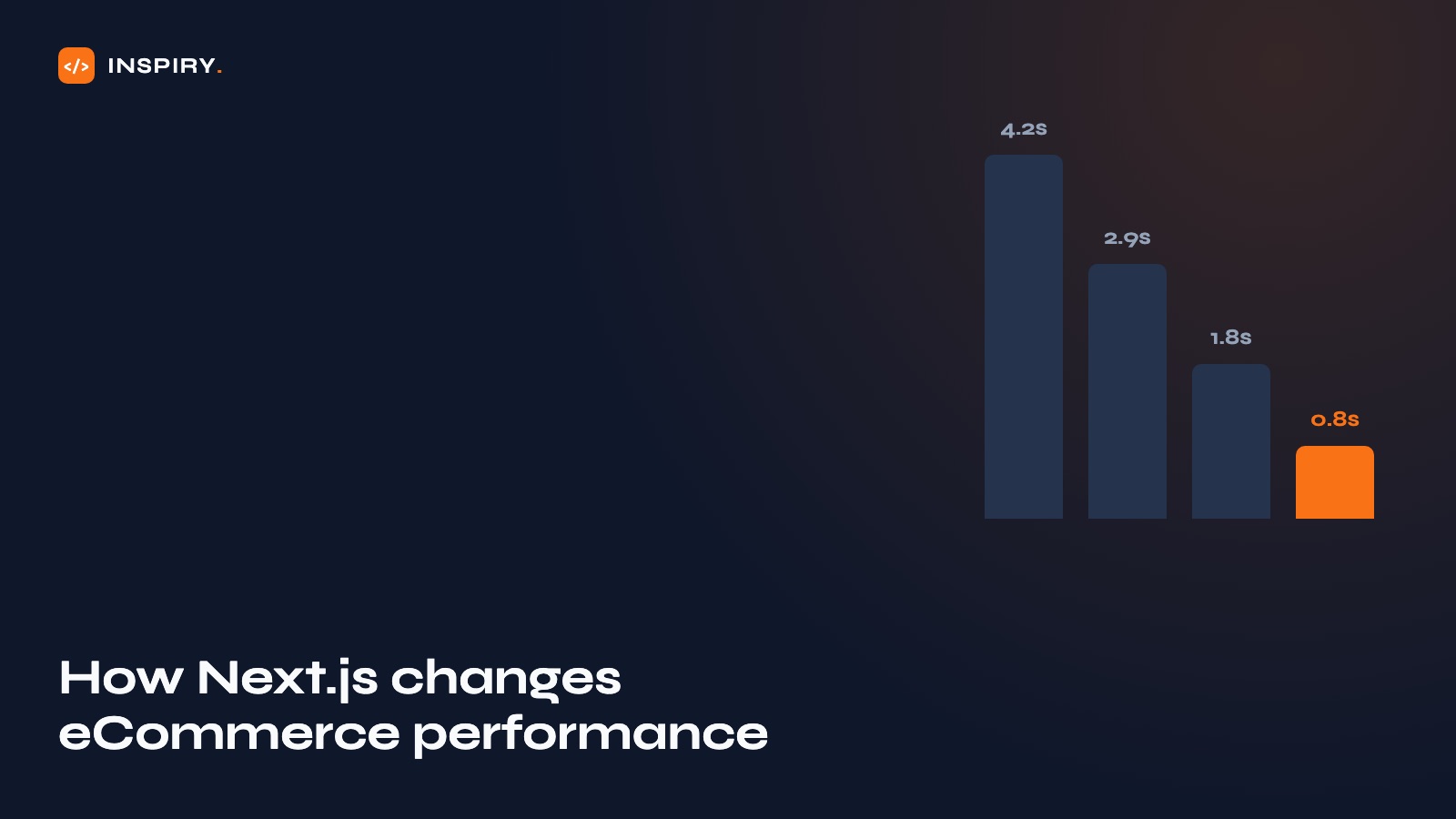
Next.js is a React framework that lets an e-commerce team choose how every page renders: on the server, at build time, or at the CDN edge. The stakes are concrete: Akamai's research puts a one-second delay in page load at a 7% drop in conversions, which for a store doing $100,000 a month works out to roughly $84,000 a year riding on a single second. This guide covers the rendering strategies behind those numbers, what they do to Core Web Vitals, and how a headless Next.js storefront compares with a traditional theme in production.
Why e-commerce page speed is a revenue number
Google's own data shows that as page load time goes from 1 to 3 seconds, the probability of bounce increases by 32%. Yet most traditional e-commerce platforms, including standard Shopify themes and WooCommerce setups, ship bloated JavaScript bundles, render everything client-side, and struggle to bring Largest Contentful Paint under 2.5 seconds.
Next.js changes the shape of the problem. Instead of a single-page application where the browser downloads a large bundle and renders everything client-side, the framework gives developers precise control over how, when, and where each page is rendered. That matters for stores because different pages have radically different needs: the homepage must load instantly for first-time visitors, product pages need fresh pricing on a pre-rendered layout, category pages need efficient pagination, and checkout needs client-side interactivity with zero layout shift.
Next.js rendering strategies: SSR, SSG, and ISR
Server-Side Rendering (SSR) generates the full HTML for a page on every request. The browser receives ready-to-paint markup instead of a blank shell with a spinner, so product pages with real-time pricing and inventory can still achieve sub-1-second First Contentful Paint, and search crawlers see fully rendered content, which is critical for product page indexation.
Static Site Generation (SSG) pre-renders pages at build time as static HTML served straight from a CDN edge node. For landing pages, blog content, and catalog pages that do not change every minute, a statically generated page consistently achieves LCP under 1 second, faster than any server-rendered alternative.
Incremental Static Regeneration (ISR) is where Next.js earns its keep for commerce: pages are statically generated, then revalidated in the background at a configurable interval. A product page is served at CDN speed while still reflecting updated pricing, stock, and reviews within seconds. For a catalog of 50,000 products, ISR eliminates the need for 50,000 origin requests per pageview; the origin handles only revalidation.
Two supporting pieces round it out. The built-in Image component serves modern formats (WebP, AVIF), generates responsive sizes, lazy-loads below the fold, and reserves space to prevent layout shift; on a store with hundreds of product images this alone can cut page weight by 40-60% against unoptimized tags. And middleware runs at the CDN edge before requests reach the server, enabling geo-targeted pricing, A/B tests without client-side flicker, and bot detection with sub-millisecond cold starts.
How Next.js architecture moves Core Web Vitals
The three Core Web Vitals are ranking signals, and Next.js architecture optimizes for each by default:
- →LCP under 1.5 seconds: SSG and ISR serve pre-rendered HTML from edge CDNs, images are optimized automatically, and code splitting loads only the JavaScript the current page needs.
- →INP under 100 milliseconds: React Server Components send zero JavaScript for static content, and interactive elements like the add-to-cart button hydrate independently, so the main thread is not blocked by content that never needed scripting.
- →CLS near zero: the Image component reserves exact dimensions, font loading strategies prevent flashes of unstyled text, and streaming SSR delivers content progressively without layout jumps.
Next.js with headless commerce backends
The strongest architecture for a performance-critical store is headless: a Next.js frontend connected to a commerce backend over an API, which decouples the presentation layer from the commerce engine. Three backends cover most builds:
- →Shopify Storefront API: keep Shopify's inventory, checkout, and payment systems under a fully custom Next.js frontend. For teams already fluent in Next.js, this is an increasingly popular alternative to Shopify's Hydrogen framework.
- →Medusa.js: an open-source commerce engine with full control over business logic, pricing rules, and multi-region support.
- →Saleor: a GraphQL-first, open-source platform built with Python and Django that pairs well with high-performance storefronts.
Pair any of these with a headless CMS such as Sanity, Contentful, or Strapi for editorial content, and the stack is fully modular. The same pattern works outside commerce too; we cover it in headless WordPress with Next.js.
Headless Next.js vs traditional Shopify theme: a performance snapshot
These are production metrics from headless storefronts serving thousands of daily visitors, not theoretical benchmarks:
| Metric | Headless Next.js | Traditional Shopify theme |
|---|---|---|
| LCP | 0.8-1.2 seconds | 2.5-4.0 seconds |
| Total page weight | 200-400 KB | 1.5-3.0 MB |
| JavaScript payload | 80-150 KB with RSC | 500 KB-1.2 MB |
| Time to Interactive | Under 1.5 seconds | 4-6 seconds |
The conversion impact is measurable: headless storefronts consistently see 15-30% higher conversion rates than their traditional counterparts, driven mainly by faster loads and smoother interactions. If your store is on a standard theme and not ready for headless, the cheaper wins live in speeding up the existing Shopify store first.
How to start a Next.js e-commerce build
A practical starting path, in order:
- →Audit current performance: run the existing store through PageSpeed Insights and WebPageTest, and record LCP, INP, and CLS as a baseline.
- →Choose the commerce backend: already on Shopify, the Storefront API is the lowest-friction path; for new builds, evaluate Medusa.js or Saleor against your customization needs.
- →Start from a Vercel template: production-ready Next.js Commerce templates come pre-integrated with Shopify, Saleor, and other backends.
- →Implement ISR strategically: ISR with a 60-second revalidation window for product pages, SSG for marketing pages, SSR only where real-time personalization demands it (cart, checkout).
- →Measure in production: use Vercel Analytics or a real-user monitoring tool like SpeedCurve to track what actual customers experience, not just lab tests.
We build headless storefronts as fixed-price full-stack development: projects from $1,499, quoted upfront, shipped in 6–12 weeks, with the code in your repository from day one. As consumers expect instant experiences and Google rewards speed with visibility, the gap between traditional platforms and frameworks like Next.js will keep widening, and the brands that invest in performance now compound that advantage for years.
This page is written and maintained by the Inspiry Solutions engineering team and reviewed by Mian Rizwan, founder. We have built WordPress, Shopify and full-stack projects for clients in 15+ countries since 2019: 200+ shipped, all at fixed prices. What you read here reflects how we actually scope and build.