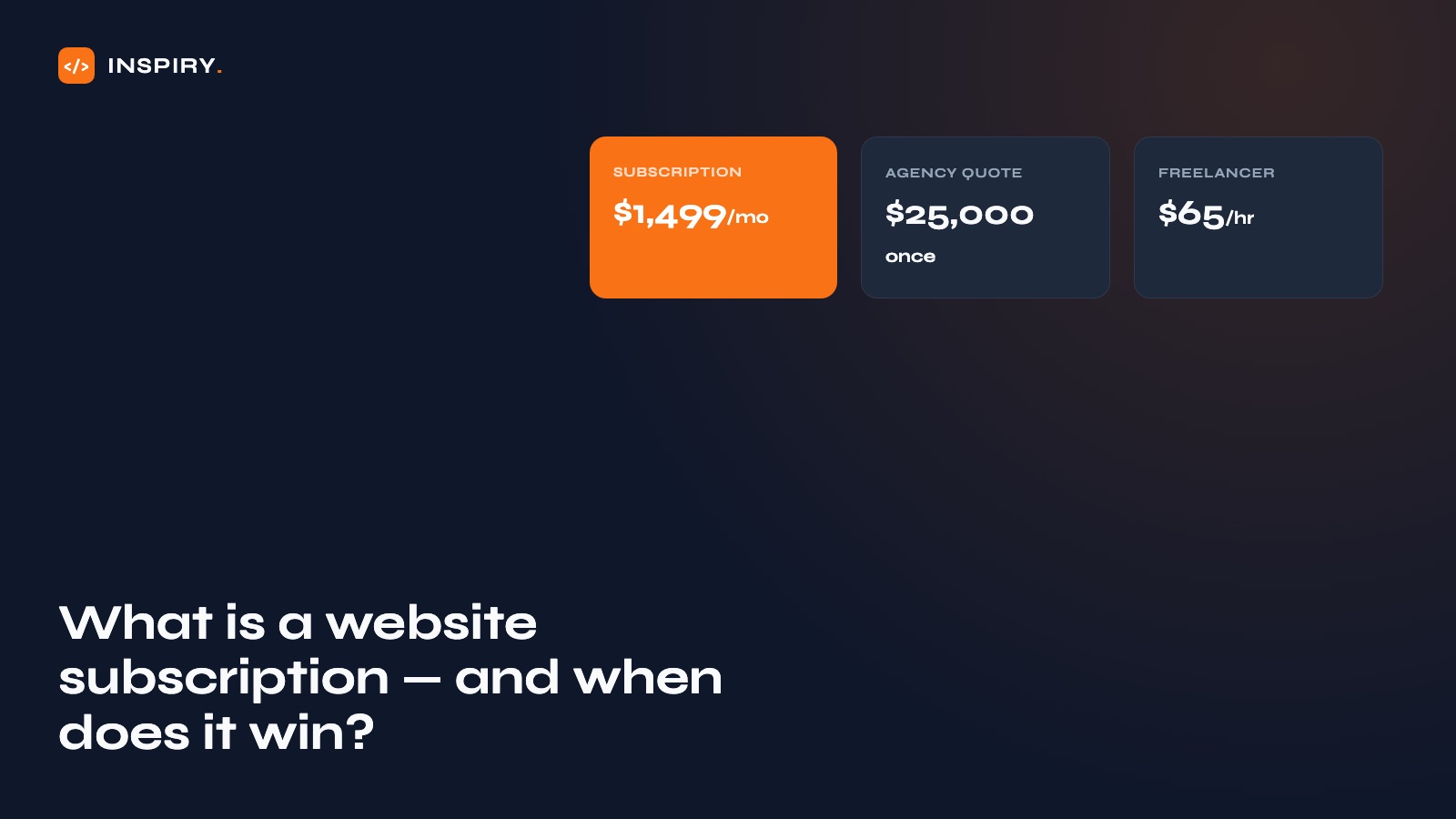
A website subscription is a flat monthly plan that covers design, development, and ongoing care of a website as one continuous service, instead of a large one-time quote or hourly rates. The math is easy to state: a plan at $1,499 a month totals about $18,000 a year, build and upkeep included. The model has real strengths and real traps, and it is not how we price our own work anymore: Inspiry moved to one-time fixed projects. This guide explains how subscriptions work, when they win, and why we changed.
The three ways businesses buy websites
Every business that needs a website ends up choosing between three models, usually without realizing it. There is the agency quote: a fixed price for a defined scope, typically five figures, delivered as a project. There is the freelancer: hourly or per-task, flexible, and entirely dependent on one person's availability. And there is the website subscription: a flat monthly plan that covers design, development, and ongoing care as a continuous service.
The first two models share a quiet problem: they price the build and ignore the life of a website. Sites are not finished at launch. They need new pages, seasonal campaigns, plugin and security updates, speed work, and the dozen small changes a month that keep them accurate. Under a project model, every one of those is a new negotiation. The subscription model exists to price that ongoing life directly.
What a website subscription includes
A serious subscription plan gives you a development team on retainer: you submit requests, they get built at a steady, defined pace, and the site stays maintained. At minimum it should include:
- →Active build capacity: a defined number of requests in progress at once, with further requests queued. "Unlimited" only describes the queue, never the pace.
- →Design and development together: pages designed, built, and revised until approved, not just tickets executed.
- →Ongoing care: updates, security patches, backups, and performance kept in check as part of the plan, not as an upsell.
- →A response commitment: a stated turnaround, in writing, for the first reply and for typical requests.
- →Full ownership: code, content, and accounts in your name from day one.
Website subscription vs. agency quote vs. freelancer
| Website subscription | Agency quote | Freelancer | |
|---|---|---|---|
| Upfront cost | None, just the first month's fee | Commonly $10,000-50,000+ | Deposit, varies |
| Ongoing changes | Included, continuous | Change orders / new quotes | Hourly, when available |
| Maintenance & security | Included | Separate care contract | Usually nobody's job |
| Speed to start | Days | Weeks (proposal cycle) | Depends on availability |
| Risk if it goes wrong | Cancel next month | Sunk five figures | Single point of failure |
| Best for | Sites that keep evolving | One large, fixed build | Small, well-defined tasks |
The 12-month math on a website subscription
Take a growing business that needs a proper site now and roughly a day or two of design and development work every month after. On a typical plan at $1,499 a month, that year costs about $18,000 and covers the initial build, every change since, and all the maintenance, in one number. The same year under a project model commonly looks like a $10,000-25,000 build, plus a monthly care contract, plus billable change requests: usually the same range or higher, with the entire spend concentrated up front, before you have seen the team work.
The subscription does not make websites cheap. It spreads the cost, removes the negotiation overhead, and moves risk from buyer to provider: if the team is slow, you cancel. The catch runs the other way. The meter never stops, so for a site that stabilizes after launch, year two and year three of a subscription buy less and less work for the same money.
When a website subscription is the wrong choice
An honest provider will say the model does not fit everyone. A subscription is the wrong choice when:
- →You need one site, once, and it will rarely change. A brochure site you touch twice a year is better bought as a fixed-price project with a defined scope.
- →You have in-house developers and only need occasional overflow capacity. A freelancer or a short contract fills that gap more naturally.
- →You are buying a large one-time replatform with a hard deadline and a budget approved by procurement. That is a project engagement with milestones, not a monthly queue.
Why Inspiry moved from subscriptions to one-time fixed pricing
We know this model from the inside, and we stopped selling it. Watching the 12-month math play out across real clients, most did not need a perpetual build queue. They needed a defined build done well, then steady care. So Inspiry now quotes every build as a one-time fixed project starting at $1,499, agreed upfront, with 50% to start, 50% on launch, and the code in your repository from day one. The ongoing-life problem that subscriptions rightly identified is priced on its own: a maintenance and support plan covering updates, backups, security, and small changes. Our guide to what maintenance should cost breaks down that market tier by tier.
Separating the two numbers keeps each honest. You can compare the build against other build quotes, the care against other care plans, and stop paying build-money for months when all you needed was upkeep.
Five questions to ask before signing any plan
- →Who owns the code and accounts? The only acceptable answer is you, from day one, unconditionally.
- →What exactly happens when I cancel? You should keep everything and lose only the future work.
- →How many requests are active at once, and what is the real turnaround? "Unlimited requests" means little without a concrete pace.
- →Who actually does the work? Ask whether the person scoping your project is the person building it, or a layer above the people who do.
- →Is maintenance genuinely included? Does the plan cover updates, backups, security, and speed, or is "care" a separate line item?
Those five questions filter out most of the market. The model is young, and like every young model it has both serious operators and people reselling templates behind a subscribe button. Whichever way you buy, subscription or fixed project, the questions are the same, and the answers are what you are really purchasing.
This page is written and maintained by the Inspiry Solutions engineering team and reviewed by Mian Rizwan, founder. We have built WordPress, Shopify and full-stack projects for clients in 15+ countries since 2019: 200+ shipped, all at fixed prices. What you read here reflects how we actually scope and build.