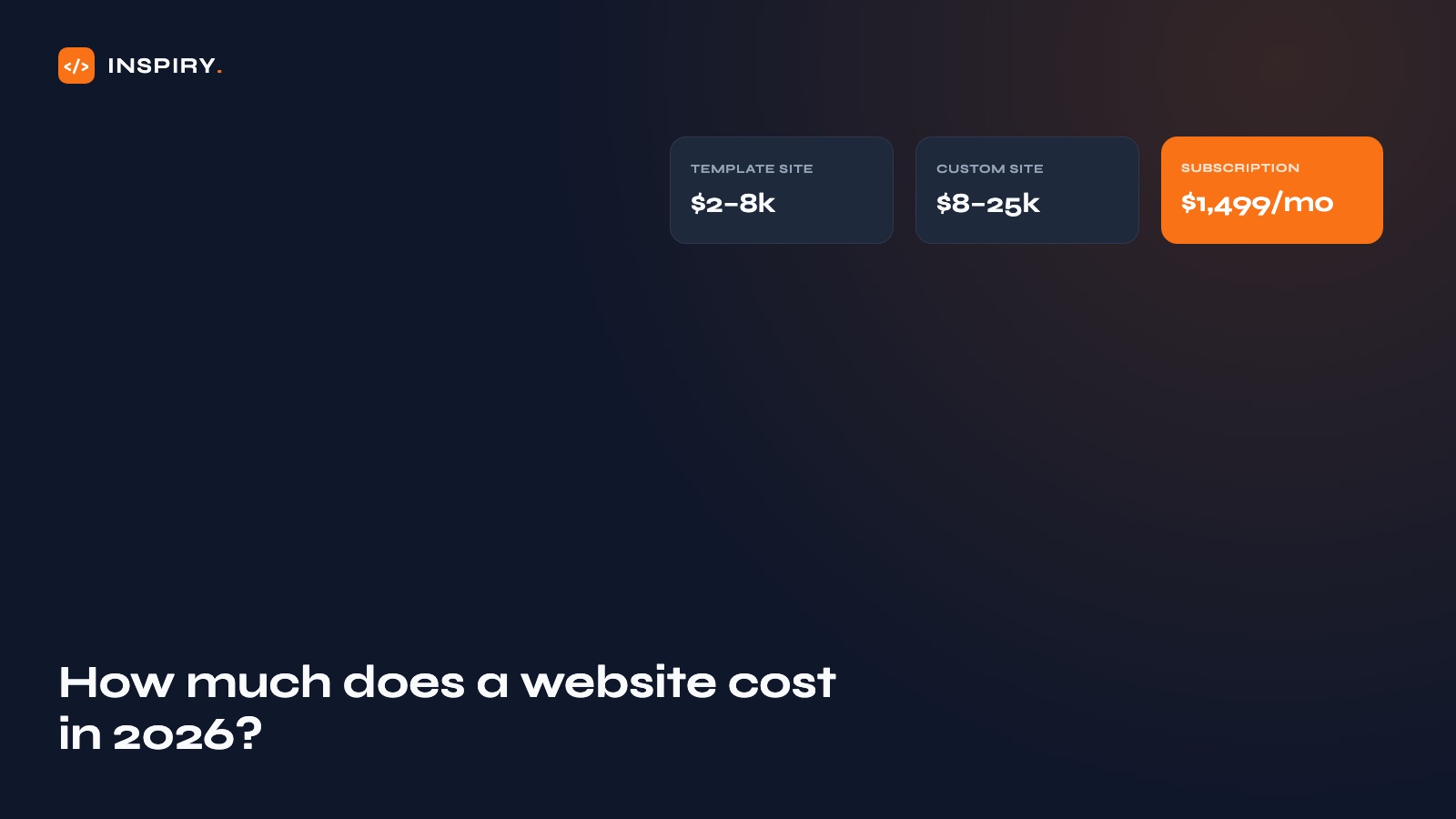
A website's cost is the total of design, development, and the running costs that follow launch, and in 2026 it depends almost entirely on project type. Template WordPress or Shopify sites commonly cost $2,000-8,000, custom small-business sites $8,000-25,000, custom eCommerce $15,000-60,000, and web applications $30,000 to $150,000 and beyond. This guide explains why five quotes for the same brief can span a 10x range, which line items sit outside the sticker price, and the five questions that make any proposal comparable.
Why website quotes vary 10x for the same brief
Ask five providers what a website costs and you will get five numbers spanning a 10x range. That is not because four of them are lying. "A website" is a category, like "a vehicle," and nobody blinks when a scooter and a truck carry different prices. Three variables drive almost all of the spread:
- →Scope. A five-page brochure site and a forty-page site with booking, search, and three languages are different projects wearing the same name. Until scope is written down page by page, every number is a guess.
- →Who builds it. A student freelancer, a senior independent developer, a small studio, and a 50-person agency have very different cost structures. You are paying for experience, overhead, or both, and it is worth knowing which.
- →What is included after launch. Some quotes end at launch day. Others include hosting, maintenance, and revisions for a year. Two identical-looking totals can differ by thousands once you price the second year.
Website cost in 2026 by project type
These are the ranges commonly quoted in the market in 2026. Individual projects land outside them all the time, so treat them as the middle of the bell curve, not a rate card.
| Project type | Common cost in 2026 | What you are really paying for |
|---|---|---|
| DIY builder (Wix, Squarespace) | Commonly $10-50/month | Your evenings and weekends. The real cost is your time |
| Template WordPress / Shopify site | Commonly $2,000-8,000 | A pre-built theme configured and filled with your content |
| Custom small-business site | Commonly $8,000-25,000 | Original design, custom build, content structure done properly |
| Custom eCommerce | Commonly $15,000-60,000 | Catalog, checkout, payments, shipping, tax: commerce is plumbing |
| Web application | Commonly $30,000-150,000+ | Software, not a site: accounts, data, logic, ongoing engineering |
The jumps between tiers are not padding. They mark where the work changes kind. A template site is configuration. A custom site is design plus development. An application is engineering. Each step adds a discipline, and each discipline has a payroll.
What moves a website quote up or down within a range
Projects inside a tier still differ, which is why the ranges are wide. Four things reliably push a quote toward the top:
- →Integrations. Every system the site must talk to (CRM, booking, payments, inventory) adds work and testing. One integration is a line item; five are a project.
- →Content volume. Ten pages and eighty pages are not the same site, even on the same design. Migrating old content adds more.
- →Custom functionality. Anything with the word "calculator," "portal," or "dashboard" in it moves you toward the next tier up.
- →Deadlines. Compressed timelines cost money everywhere, and websites are no exception.
The bottom of a range usually means the opposite: few pages, no integrations, finished content in hand, and a flexible launch date. If that describes your project, say so. It is worth real money.
The hidden line items website quotes leave out
The sticker price is where budgets start going wrong, not where they end. Four costs routinely sit outside the quote:
- →Maintenance. Updates, security patches, backups, and uptime monitoring. Bought separately it commonly runs $50-500 a month depending on the stack; we break the tiers down in our guide to WordPress maintenance cost. Ask whether it is in the number you are looking at. Usually it is not.
- →Licenses and services. Premium plugins, themes, email delivery, form tools, hosting itself. Individually small, collectively a real monthly bill, and it lands on your card, not the developer's.
- →Content. Most quotes assume you supply finished copy and photography. Most buyers assume the opposite. In our experience this single mismatch delays more launches than any technical problem.
- →The revisions policy. A quote with two revision rounds and hourly billing after is a very different purchase from one with revisions until approval, at the same headline price.
How fixed-price web development changes the math
The alternative to a mystery quote is a fixed one. At Inspiry every project is a one-time fixed price quoted upfront, starting at $1,499, with WordPress and Shopify sites shipping in 2–4 weeks and full-stack applications in 6–12. Terms are 50% to start and 50% on launch, and the code sits in your repository from day one. Ongoing care is a separate, clearly priced maintenance and support plan rather than a number hidden inside the build.
Some providers sell the whole arrangement as a flat monthly fee instead. That model has real trade-offs of its own, and we cover them in our explainer on website subscriptions.
Five questions that make any website quote comparable
- →What exactly is in scope? Ask for pages and features listed, not described. "Modern responsive website" is not a scope; "9 pages, blog, contact form, two integrations" is.
- →Who does the work? The person quoting, or someone cheaper you will never meet? Seniority is most of what you are paying for.
- →What does the second year cost? Hosting, licenses, maintenance, and typical changes. If they cannot answer, they have not thought past launch.
- →What is the revisions policy? Rounds included, and the rate after. This is where cheap quotes recover their margin.
- →Who owns everything at the end? Code, content, accounts, domain: in your name, unconditionally. Any hedge here is a reason to walk.
Ask all five and the quotes stop being darts. A $6,000 number and a $20,000 number for the "same site" usually turn out to be different scopes, different seniority, and different second years. Now you can see which difference you are paying for. The price of a website is not a secret; it is just never one number.
This page is written and maintained by the Inspiry Solutions engineering team and reviewed by Mian Rizwan, founder. We have built WordPress, Shopify and full-stack projects for clients in 15+ countries since 2019: 200+ shipped, all at fixed prices. What you read here reflects how we actually scope and build.