The client
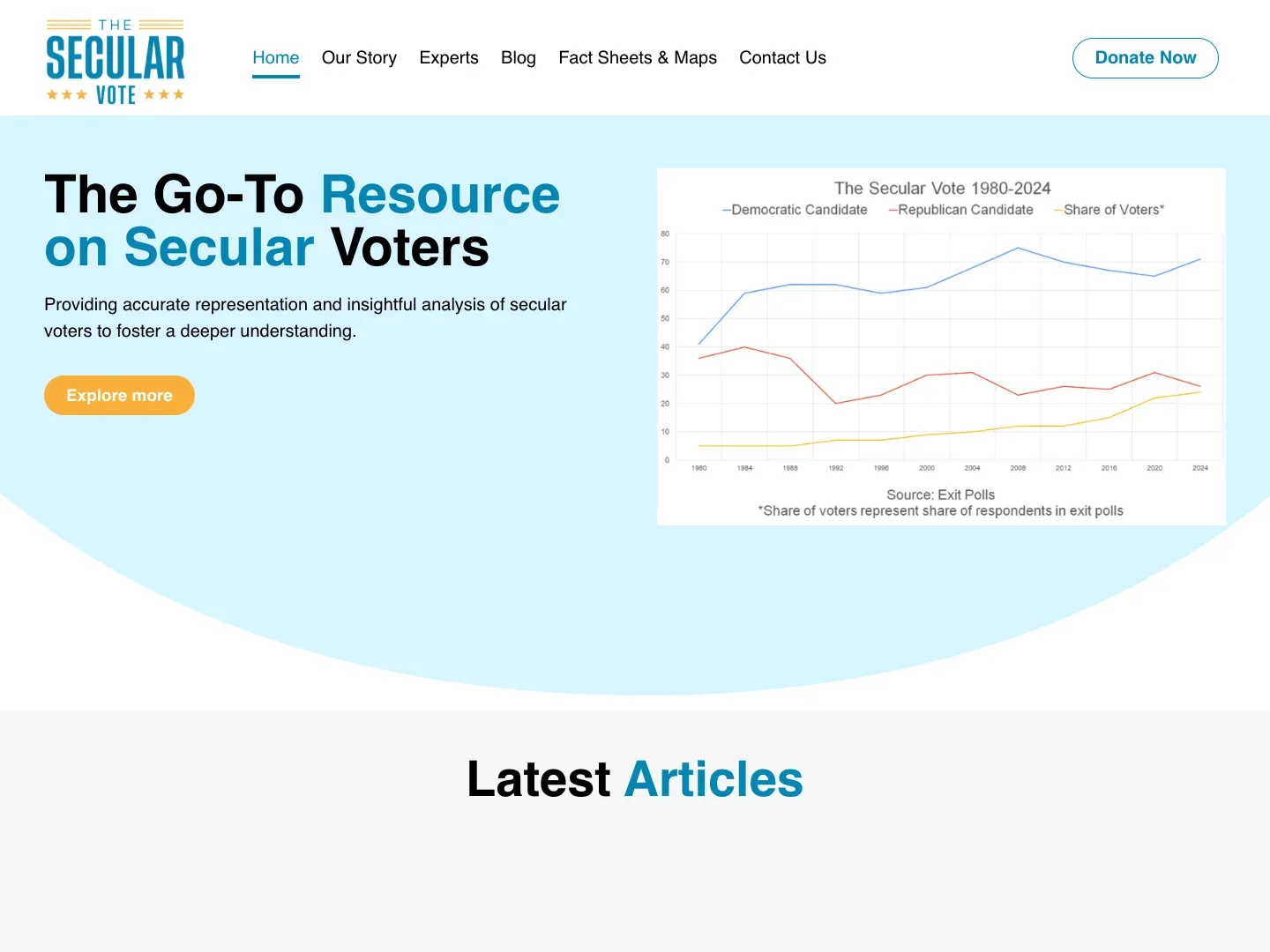
The Secular Vote is a free public resource on nonreligious voters in the United States, set up by Sarah M. Levin and Dr. Juhem Navarro-Rivera as a joint project of Secular Strategies and Socioanalítica Research. It publishes data, analysis and expert commentary so that secular voters are described accurately and in their own terms.
What they needed
A single place to publish data, analysis and expert voices on US secular voters, with ways for readers to subscribe, contact the experts and fund new research.
What we built
- State-by-state map of secular voters. A clickable map of the US. Each state opens a panel with its share of secular adults, its share of all secular Americans, and breakdowns by gender, race, LGBT identity, age and belief (atheist, agnostic or nothing in particular), with a separate layout for phones. The figures come from the 2022 Cooperative Election Study.
- Map of secular elected officials. 125 elected officials, from state representatives to city councillors and school board members, plotted on a US map. Each marker shows the official’s name, office, district, jurisdiction and how they identify, and a dropdown picks them out by state and district.
- Expert directory and profiles. Twelve experts on secular people and politics, each with a card showing a short bio and their areas of expertise. Each has a profile page with a full bio and, for most, an email address and a key contributions list giving each publication, where and when it appeared and a short summary.
- Blog and interviews. Analysis of the secular vote in recent elections and in individual states, plus interview posts with secular elected officials, sorted into categories such as elections by year, secular demographics and secular representation. Each post lists related articles, and the latest posts appear in a carousel on the homepage.
- Fact sheets, newsletter and donations. Three downloadable PDF fact sheets, on topline data, a political profile and young secular voters, plus a link to download infographics. A newsletter sign-up sits in the footer, a contact form takes requests to consult the experts and a Support page carries an embedded fundraising widget.
How we built it
We built the site on WordPress with Elementor Pro and the Hello Elementor theme. Experts are a separate content type, and one profile template lays out every expert from their own custom fields. Both maps run on an interactive maps plugin, and each state and each official has its own entry.