The agency vs freelancer decision is about delivery capacity, communication and continuity, not just portfolios. Either can do good work; either can fail when ownership or support is unclear. Compare the actual people, written scope and handover evidence. This guide gives seven practical checks for choosing a web development partner.
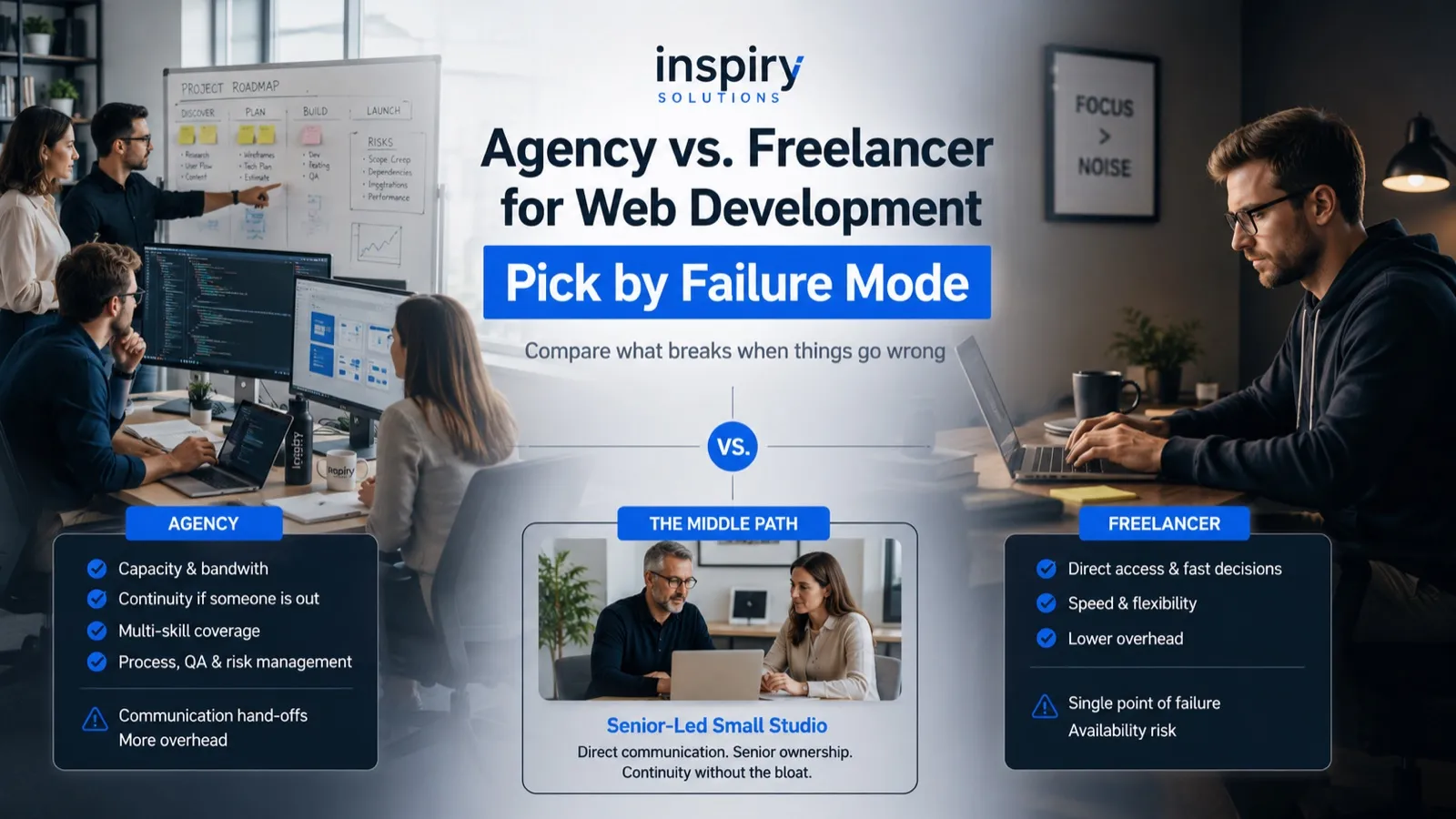
Agency vs freelancer: compare delivery, not portfolios
An agency vs freelancer comparison is more useful when it examines difficult weeks as well as successful launches. Ask what happens during illness, a staffing change, a missed milestone or an urgent post-launch defect. The provider’s answer matters more than the business label.
Freelancer web development: where it wins, how it fails
A capable freelancer can offer direct communication and focused delivery with relatively little organisational overhead. Fees still depend on expertise and scope. A single specialist may suit a defined task; a broader project may need collaborators and a more explicit coordination plan.
Possible risks arise when delivery depends entirely on one person without a documented backup arrangement.
- Single point of failure. Illness, a bigger client, a career change, burnout. Any one of these stops your project completely, and there is no bench behind them.
- Availability. Good freelancers are booked. You share a calendar with every other client, and urgent for you is Tuesday-after-next for them.
- Breadth limits. One person is rarely senior at design, development, performance, and SEO all at once. Whichever skill is weakest becomes your site’s weakest point.
You can soften these risks but not remove them: insist that code, hosting, and every account live in your name; ask for documentation as a deliverable, not a favor; and pay by milestone so a disappearance costs you time, not the budget. What you cannot buy back is momentum. A stalled project loses weeks even after work resumes.
Agency web development: where it wins, how it fails
An agency can offer several specialists and shared delivery systems, but size alone does not prove available capacity or good continuity. Ask how the assigned team works and who will actually make decisions during your project.
The structure that provides all that creates its own failure modes:
- The account-manager telephone. You explain your business to someone who explains it to someone who builds it. Every hop loses fidelity, and you find out at the review meeting.
- Junior hand-offs. The senior team that won your business is not always the team doing your work. The pitch deck and the sprint board can be staffed very differently.
- Overhead pricing. The account managers, offices, and processes are in your invoice. You pay agency rates even when the task only needed one good developer for a day.
Ask to meet the implementation lead and document how staffing changes are communicated. Agree reasonable approval and escalation arrangements with the provider. For legally binding terms, use appropriate professional advice rather than treating a blog checklist as a contract.
Three questions that expose both models
Use the same questions in an agency vs freelancer review. Specific answers reveal how the provider plans ownership and continuity; vague answers warrant follow-up rather than proving future failure.
- Who exactly does the work? Names, not roles. If the person selling cannot tell you who is building, or will not let you talk to them, you have found the telephone.
- What happens if they disappear? For a freelancer: is the code in your accounts, documented, and deployable without them? For an agency: what happens when your developer leaves mid-project? “That won’t happen” is not an answer.
- What is included after launch? Maintenance, updates, small changes: in the price, or a new invoice each time? Both models tend to leave this vague, because vague is billable.
The senior-led small studio as the middle path
A small studio is another option in the agency vs freelancer decision. It may combine direct communication with a small team, but it still needs credible capacity and continuity arrangements. That is how Inspiry describes its model; evaluate the actual team and evidence rather than assuming the structure eliminates risk.
The small studio has limits too. It cannot staff a twenty-person enterprise build, and if you need a vendor with a procurement department and account teams, it is the wrong shape. What it does well is the ground most businesses actually stand on: sites and applications that need senior work, direct communication, and someone still answering a year after launch.
| Check | Freelancer | Agency | Small studio |
|---|---|---|---|
| Contact | Often the implementer | Confirm project and technical contacts | Confirm direct access |
| Capacity | Check availability and collaborators | Check assigned team, not total headcount | Check workload and coverage |
| Continuity | Request documented handover | Request replacement and handover process | Request backup and handover process |
| Skills | Validate fit and gaps | Validate assigned specialists | Validate core team and collaborators |
| Price | Scope and expertise dependent | Scope and expertise dependent | Scope and expertise dependent |
How to run the web development hiring decision
Strip the pitches away and the choice comes down to four checks you can do in a week:
- Size the scope honestly. A defined task with a clear end favors a freelancer. Anything open-ended, like a site that will keep changing, favors a structure with continuity.
- Price the stall, not just the build. Ask what a two-week outage in the middle of your project would cost your business. That number tells you how much single-point-of-failure risk you can afford.
- Ask the three questions above and write down the answers. Vague on any of them is a no, whatever the portfolio looks like.
- Check the after-launch story. Who answers in month six, how fast, and at what price. Most regret in this industry lives after launch; our guide to what a website costs covers the second-year line items in detail.
The agency vs freelancer decision does not need a universal winner. It needs a provider whose delivery and support arrangements fit the work. Write down the remaining risks and the contingency plan before approving the project.
Seven agency vs freelancer checks before approving a project
Give each provider the same short brief and request evidence against these checks. The agency vs freelancer choice becomes easier when capacity and accountability are concrete.
- Name the delivery team. Identify the implementation and decision contacts. A portfolio does not tell you who is available for your project now.
- Verify relevant work. Ask for a comparable workflow and what the team personally delivered. Evaluate the editing and customer tasks, not just the homepage design.
- Check present capacity. Request a realistic start date, milestones and known dependencies. More staff does not automatically mean your work has a reserved slot.
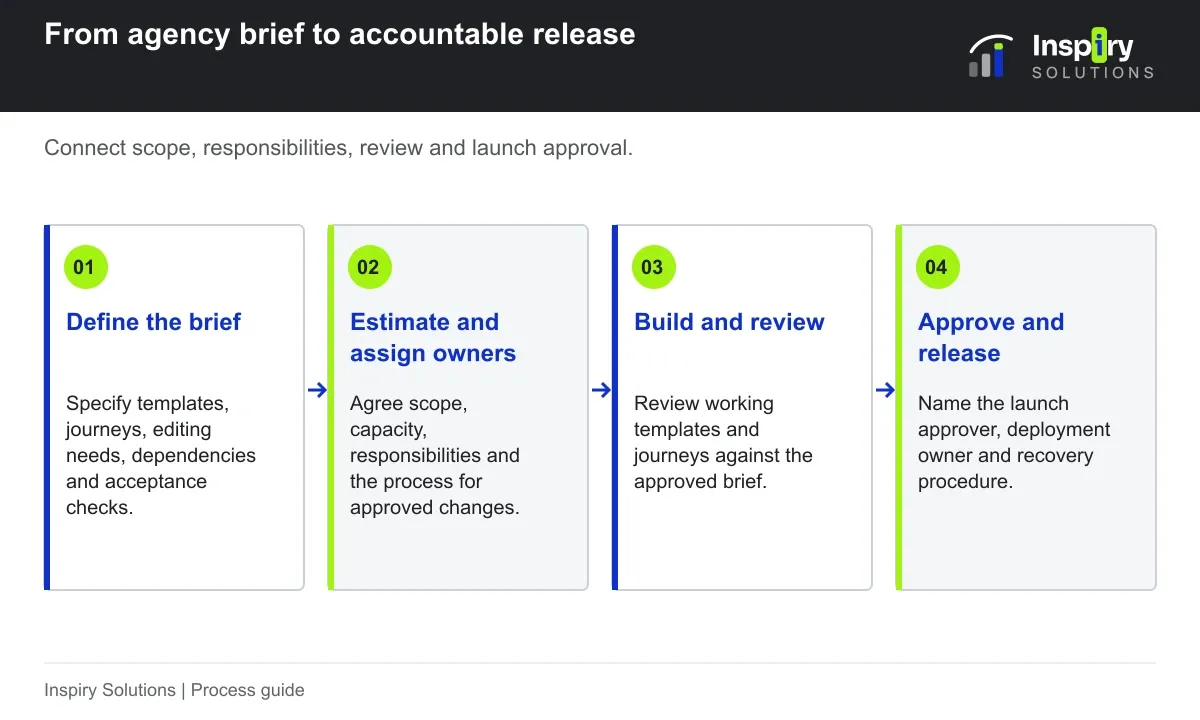
- Define acceptance. Agree the evidence for mobile behaviour, integrations, forms and launch readiness. An agency vs freelancer quote should include quality checks.
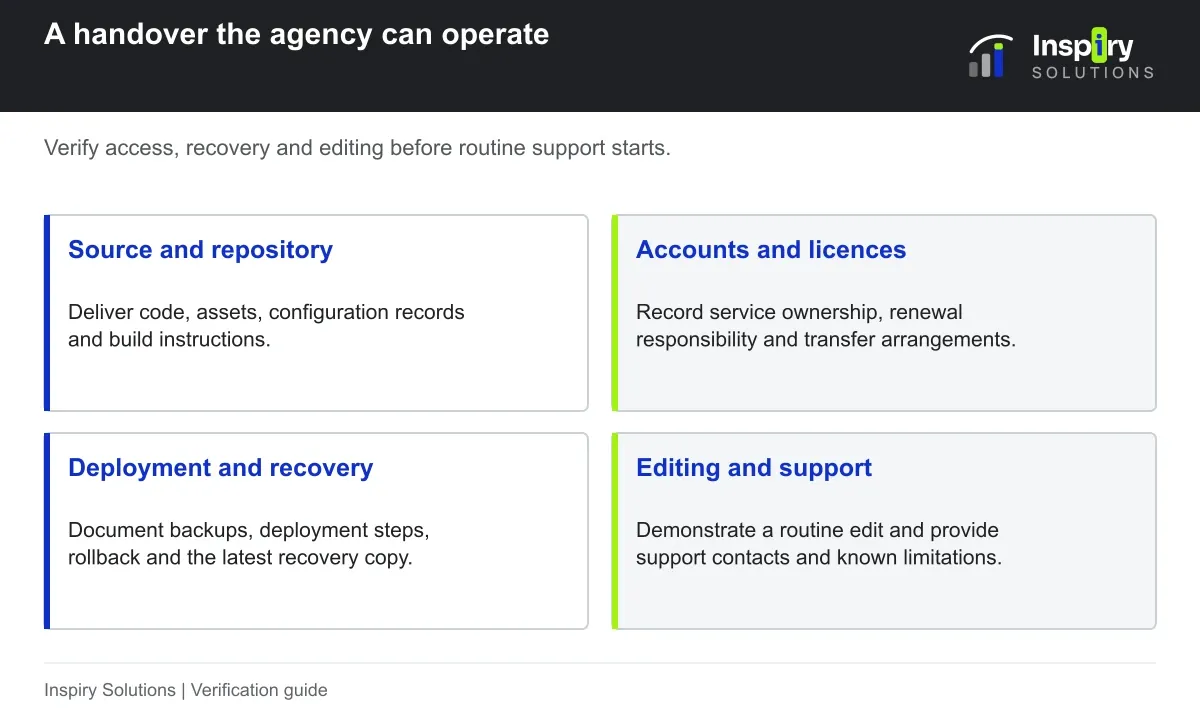
- Keep accounts usable. Establish who controls domain, hosting, source and supplier licences. Use appropriate access and a documented transfer process.
- Plan continuity. Ask who can deploy, recover and support the site if the main implementer is unavailable. Inspect handover documentation rather than accepting a verbal assurance.
- Price ongoing work. Separate defect support, routine maintenance and new features. The agency vs freelancer decision should include the months after launch.
Use a small delivery test in the agency vs freelancer decision
A clearly paid, limited discovery or implementation task can reveal how a provider asks questions, estimates work and communicates uncertainty. Define an outcome rather than requesting speculative free design. Compare the explanation and verification evidence, not only speed.
For example, ask the provider to map an enquiry flow and identify what a successful test needs to prove. A strong answer covers form validation, delivery to the correct team, tracking boundaries and recovery if an external service fails.
For a WordPress project, the official update guidance provides a useful starting point for asking about backup and change responsibility. Your provider still needs business-specific checks. Compare the care scope and the subscription delivery model before deciding how continuing capacity should be purchased.
Whichever model you choose, the outcome depends on scope and preparation. Our WordPress development service works from a fixed quote after a free audit, and our guide on what to prepare before you hire a WordPress developer lists what to gather first.
Common questions
Should I hire an agency or a freelancer to build my website?
Choose the provider with suitable skills, available capacity and clear ownership. A freelancer may suit focused work; an agency may offer specialist coverage; a studio may combine direct access with a small team. Validate the actual people and handover in the agency vs freelancer comparison.
What questions should I ask before hiring a web developer or agency?
Ask who implements the work, what happens if that person becomes unavailable and which support is included after launch. Request specific evidence: a representative project, a release process, usable documentation and a clear escalation contact.
Is an agency vs freelancer comparison mainly about price?
No. Price matters, but compare scope, expertise, capacity and support with the same requirements. A lower fee may exclude necessary work, while a larger organisation may not assign the specialists you need.
What continuity evidence should I request in agency vs freelancer hiring?
Ask for source access, deployment notes, dependency records and a backup contact or transfer process. The aim is a site another competent person can operate if the main implementer becomes unavailable.
Can a freelancer work with an agency team?
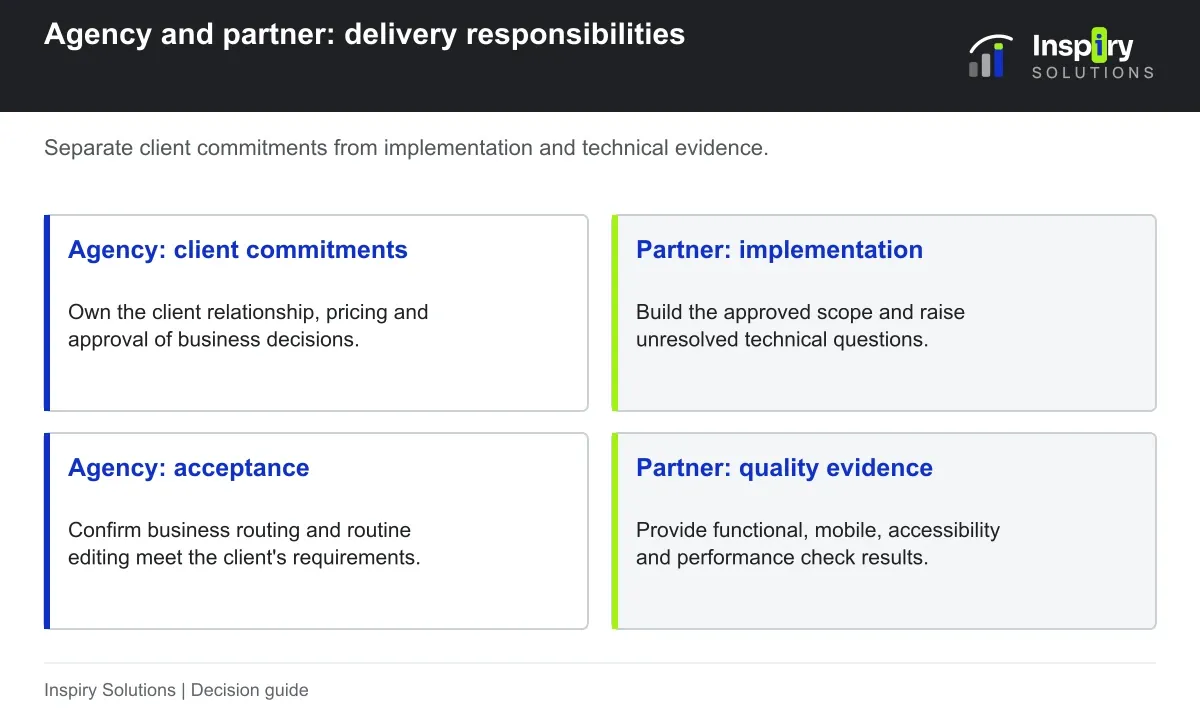
Yes. Agree implementation, review and client-approval responsibilities explicitly. Mixed delivery can work well when access, decisions and handover are clear; it creates confusion when each side assumes the other owns testing.
How should I compare agency vs freelancer support after launch?
Separate defect correction, maintenance, incident response and new development. Ask for support hours, response targets, exclusions and rates. The original build price rarely answers every ongoing question.
Your next step
The agency vs freelancer decision should end with an accountable delivery plan. Choose the people who can demonstrate capacity, continuity, ownership and a practical handover for your particular project.