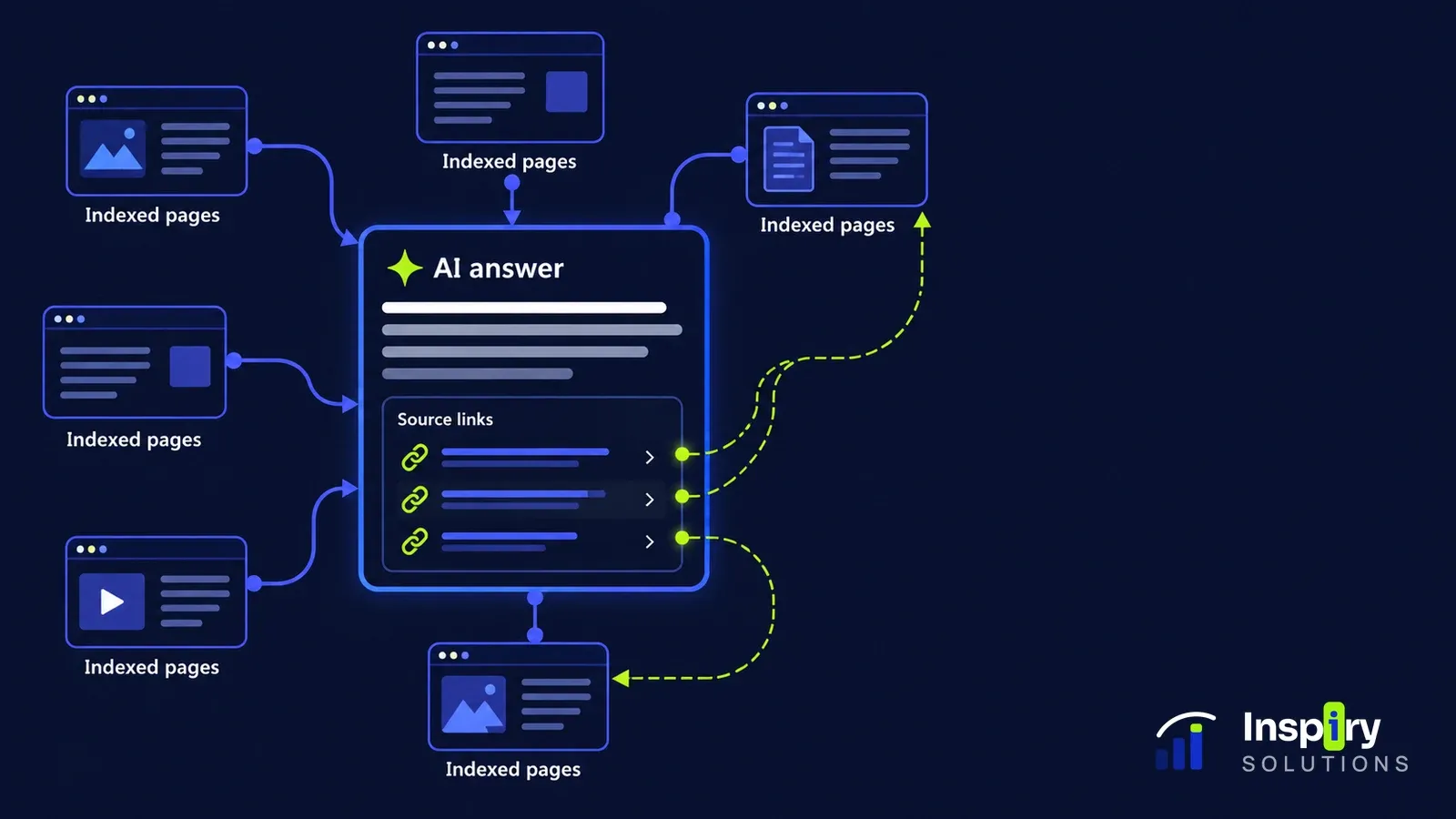
Answer engine optimization starts with clear, self-contained answers. To create pages AI systems can quote accurately, put the direct answer in the first one or two sentences of each important section, then explain the conditions, evidence and limitations. This approach is called answer-first content. It helps readers understand your service without searching through vague introductions, while giving systems that generate answers a clearer passage to interpret. No writing format guarantees that an AI tool will quote your website, but you can reduce ambiguity and make important facts easier to verify.
If you write or commission service pages, this guide gives you a practical section template, before-and-after rewrites and a misquotation self-check. You can apply the process to existing pages without redesigning your website or replacing useful content.
What answer-first content means
Answer-first content gives readers the information they need before explaining the background. A section starts with a clear response to a specific question, followed by supporting details, qualifications and evidence.
For example, a visitor looking for a website migration service wants to know whether their existing content and URLs can be preserved. They should not have to read several paragraphs about the agency’s history before finding that information.
A useful opening might be:
“Website migrations can preserve existing URLs and content, provided the new website supports the required structure and redirects are planned before launch.”
That sentence identifies the service, explains the possibility and includes a condition. The next paragraphs can cover the migration process, technical checks and circumstances that require additional work.
This is the difference between giving an answer and making a broad promotional claim.
Put the useful information first
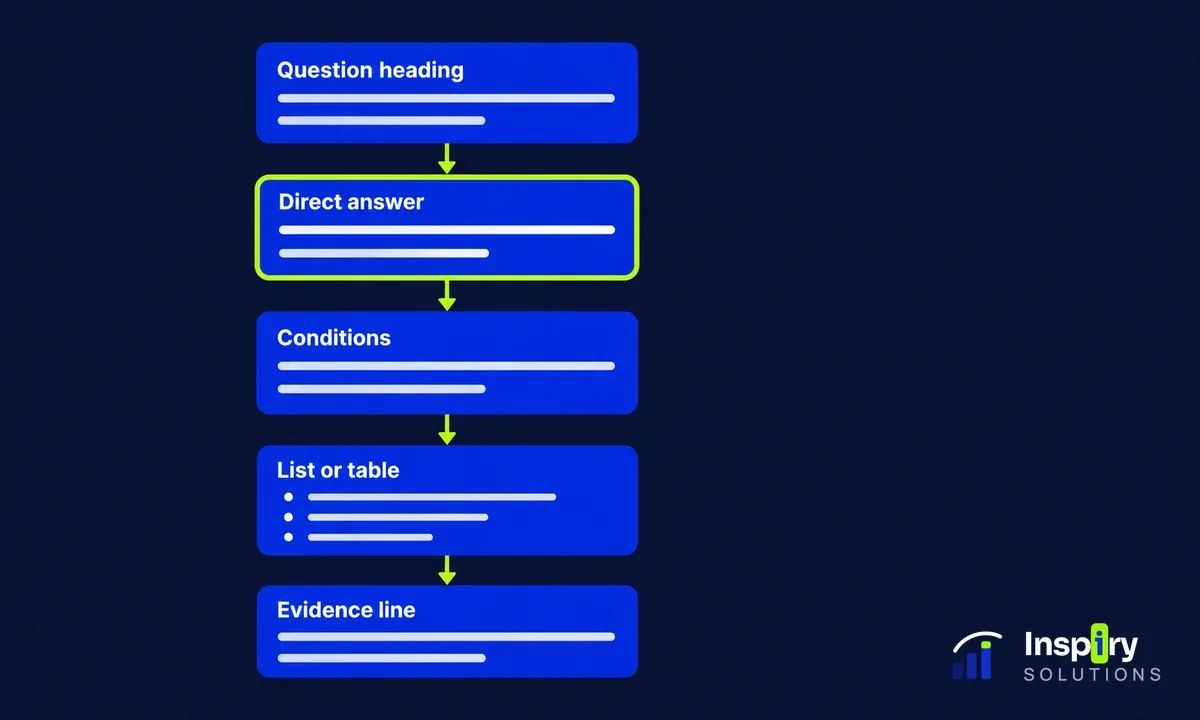
An answer-first section typically follows a predictable sequence:
- State the direct answer.
- Explain what changes or limits that answer.
- Provide relevant evidence or examples.
- Tell the reader what to do next.
Write for readers before extraction
Google’s guidance on helpful, people-first content emphasises substantial, useful information that meets the reader’s needs.
For service businesses, publishing answers customers use to choose is particularly important. Visitors often compare providers using practical questions about eligibility, prices, timescales, deliverables and limitations.
It does not guarantee a quotation, a citation or inclusion in AI-generated responses. Those decisions remain outside the website owner’s control.
Why AI systems misquote pages
AI systems can produce incomplete or misleading descriptions of a service when the source material is ambiguous, outdated or contradictory. These problems are observable in the content itself, even without knowing how a particular model processes passages.
Common sources of ambiguity
Five recurring problems deserve attention:
- Buried answers: The useful fact appears after several promotional paragraphs.
- Separated conditions: A price appears in one section while important exclusions appear elsewhere.
- Undated information: A fee or timescale has no clear effective date.
- Unclear references: Sentences repeatedly use “it”, “this” or “they” without identifying the subject.
- Image-dependent facts: Important terms appear only inside a graphic or screenshot.
Contradictory pages introduce another problem. If a pricing page gives one figure and a service page gives another, readers cannot easily determine which is current.
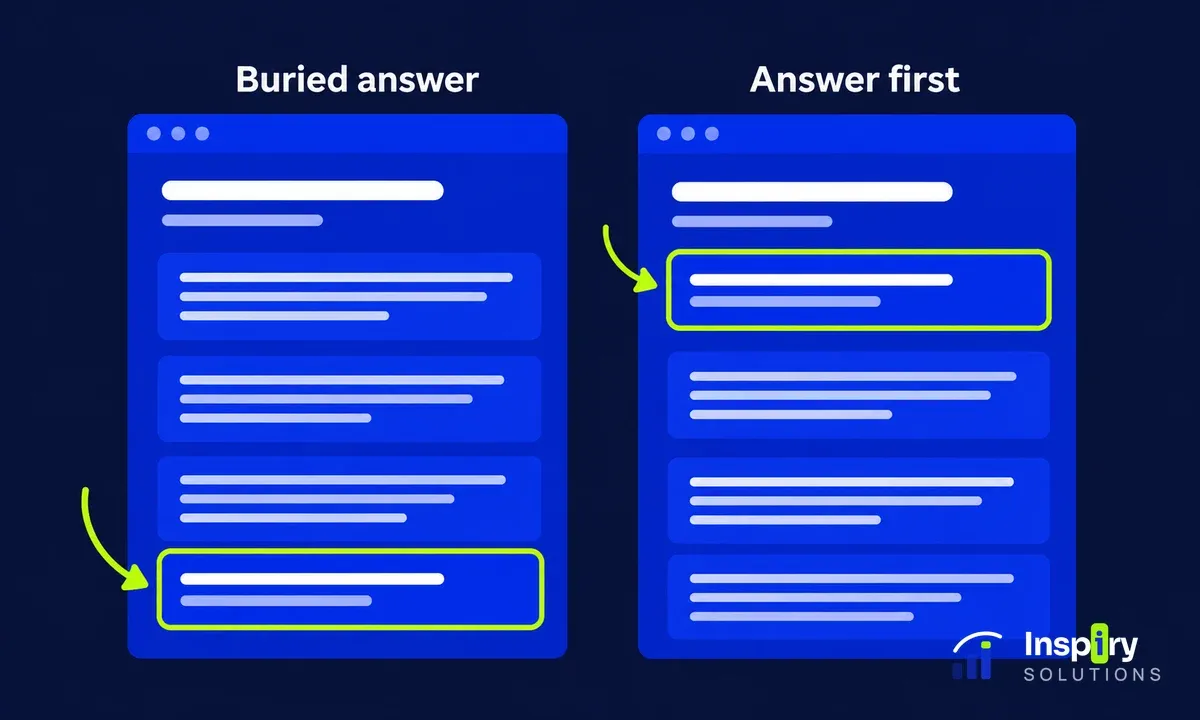
Consider a paragraph saying:
“Our plans are flexible. It normally takes a few weeks, although this varies.”
What does “it” mean? Is the statement about an audit, a development project or ongoing support? What determines the timescale?
Google explains aspects of how its AI features use web content. For a wider explanation of search visibility, read how Google picks AI Overview sources.
If these issues affect commercially important pages, an AI visibility service can review the source content, identify unsupported statements and prioritise clearer wording.
The answer engine optimization section template
The most practical answer engine optimization method works at the section level. Instead of rewriting an entire website around AI search, improve the passages that address important customer questions.
Use the following three-step template for aeo content writing.
1. Lead with the answer
Start with a question-shaped H2 or H3 that reflects something a customer genuinely wants to know.
For example:
“How long does a technical SEO audit take?”
Follow it immediately with a clear statement:
“A technical SEO audit typically takes 2-4 weeks, depending on the website’s size, technical complexity and access requirements.”
Those statements postpone the information the visitor requested.
The first sentence should answer the heading without requiring another paragraph. If the question has no universal answer, explain the decision rule rather than inventing a fixed figure.
2. Add the conditions
After the direct response, write two to four sentences explaining when the statement applies.
Describe the requirements that affect the outcome. For a technical audit, these might include access to analytics, crawling restrictions, the website’s configuration and whether the business operates several websites.
When several variables affect a decision, use a list:
- Website size and number of templates
- Access to relevant systems
- Technical issues requiring investigation
- Additional platforms or integrations
Keep each condition attached to the claim it qualifies.
3. Show the evidence
Finish the section with something the reader can check.
For an audit section, an evidence line might read:
“Deliverable: a technical audit with a prioritised list of recommended fixes.”
If the information changes, include an appropriate date or link to its maintained source.
Be specific about whether the statement describes a standard offering, an estimate or an individual quotation.
Never present an illustrative scenario as a completed client result.
A useful final sentence explains the next step, such as requesting an audit or providing a URL for assessment.
The complete pattern is:
Question heading → Direct answer → Conditions → Comparison where useful → Evidence → Next step
Before and after: rewriting a service page section
Hypothetical example
An electrician’s service page contains the following paragraph:
“Prices vary depending on your requirements. We offer reliable electrical work at competitive rates. Our experienced team provides excellent service. Get in touch today for a personalised quote.”
The copy sounds familiar but leaves important questions unanswered.
Before: vague service copy
Suppose a customer asks:
“How much does a consumer unit replacement cost?”
The original paragraph cannot support a reliable price answer. It only suggests that a quotation is required.
The problem is that the page does not explain why.
After: an answer-first rewrite
How is a consumer unit replacement priced?
“A standard domestic consumer unit replacement is quoted after a site visit because the final price depends on the property’s existing electrical installation.”
“The electrician checks three factors before confirming the quotation: the condition of the existing installation, the number of circuits and any remedial work identified during inspection.”
“The written quotation explains the proposed work and any necessary additional checks.”
“Information reviewed: 13 October 2026.”
“To request a quotation, provide your property details and arrange an initial assessment.”
This is illustrative wording, not a published service policy or verified electrician quotation. A real business must check the procedure, technical claims and date before using it.
The rewrite improves four things:
- Explicit subject: It identifies consumer unit replacement.
- Date: It makes the review date visible.
- Conditions: It names the factors affecting the quotation.
- Next step: It explains how a customer requests an assessment.
In this hypothetical scenario, a later AI-generated response quotes the site-visit requirement and its conditions rather than using an unrelated competitor’s figure.
Six patterns worth correcting
| Problem pattern | Weak version (description) | Answer-first fix | Why it helps a reader and a quoting system |
|---|---|---|---|
| Buried answer | Several introductory paragraphs appear before the useful fact. | Put the direct response immediately below the heading. | Makes the answer easy to locate and understand independently. |
| Undated price | A fee appears without an effective date. | Identify the price, scope and date of validity. | Helps distinguish current information from outdated figures. |
| Pronoun-only subject | “It usually takes a few weeks.” | Name the service and state the relevant timescale. | Removes uncertainty about the subject. |
| Fact only in an image | An infographic contains the only copy of a service condition. | Repeat the essential condition in visible page text. | Makes the information accessible without interpreting the image. |
| Conflicting figures across pages | Different pages publish different fees for the same service. | Maintain one authoritative source and align supporting pages. | Reduces ambiguity about which figure applies. |
| Vague “it depends” | A response says circumstances vary without naming them. | List the specific variables and explain the quotation process. | Provides useful conditions without inventing certainty. |
The table also works as a practical editing guide.
Facts, numbers and dates AI can rely on
A precise sentence containing an outdated price is still misleading. Improving the formatting cannot correct a factual error.
Keep important facts in visible text
This supports content that supports a full decision, where customers can understand the offering and its limitations before making contact.
Date information that changes
Examples include:
- Prices and promotional terms
- Service availability and coverage areas
- Delivery or completion timescales
- Software features and integrations
- Regulations, policies and eligibility requirements
If a service price changes, update the applicable date alongside the revised terms.
Otherwise, a page can appear current while retaining outdated claims.
Maintain one source of truth
Choose one authoritative page for each important business fact.
For example, a detailed service page might maintain the current technical SEO audit scope, while a comparison article summarises the offering and links to it.
When prices or conditions change, update the authoritative page first, then check pages that repeat the information.
Good linking service pages together helps customers move from a summary to the maintained details.
Structure and markup that support answers
Start with descriptive headings. A heading such as “What does a technical SEO audit include?” communicates more than “Our Approach”.
Choose the right content format
Use paragraphs for explanations, lists for discrete conditions and tables for meaningful comparisons.
An answer-first paragraph should not become a list simply because you want to target AI systems.
Use FAQs for questions customers actually ask.
Understand FAQ structured data
Structured data is machine-readable markup that describes information on a webpage. FAQPage structured data identifies question-and-answer content when implemented correctly.
It does not replace visible content or create a guarantee that a page will appear in an AI-generated response.
Google previously restricted FAQ rich results to well-known, authoritative government and health websites. It discontinued the FAQ rich result feature in May 2026 and removed the documentation in June 2026.
The former eligibility rules should therefore not be treated as a current optimisation opportunity.
The former FAQ structured data documentation now redirects to Google’s documentation updates, which record the removal.
If an SEO plugin generates FAQ markup, make sure the questions and answers match the visible content. Do not add fabricated FAQs or rely on markup alone to improve AI citations.
Good content remains valuable without a special search appearance.
Use snippet controls deliberately
Google documents controls such as nosnippet, max-snippet and data-nosnippet.
For example, data-nosnippet can exclude a selected text region from Google’s snippets and applicable AI features.
Google’s snippet controls documentation explains these options and their effects.
Before applying a restriction, check the consequences. Excluding important service information may prevent that information from appearing in the very search experiences you want to reach.
A misquotation self-check before publishing
Before publishing an answer-first page, review it as if someone might extract a single paragraph without the surrounding explanation.
Use the following five checks for every commercially important section.
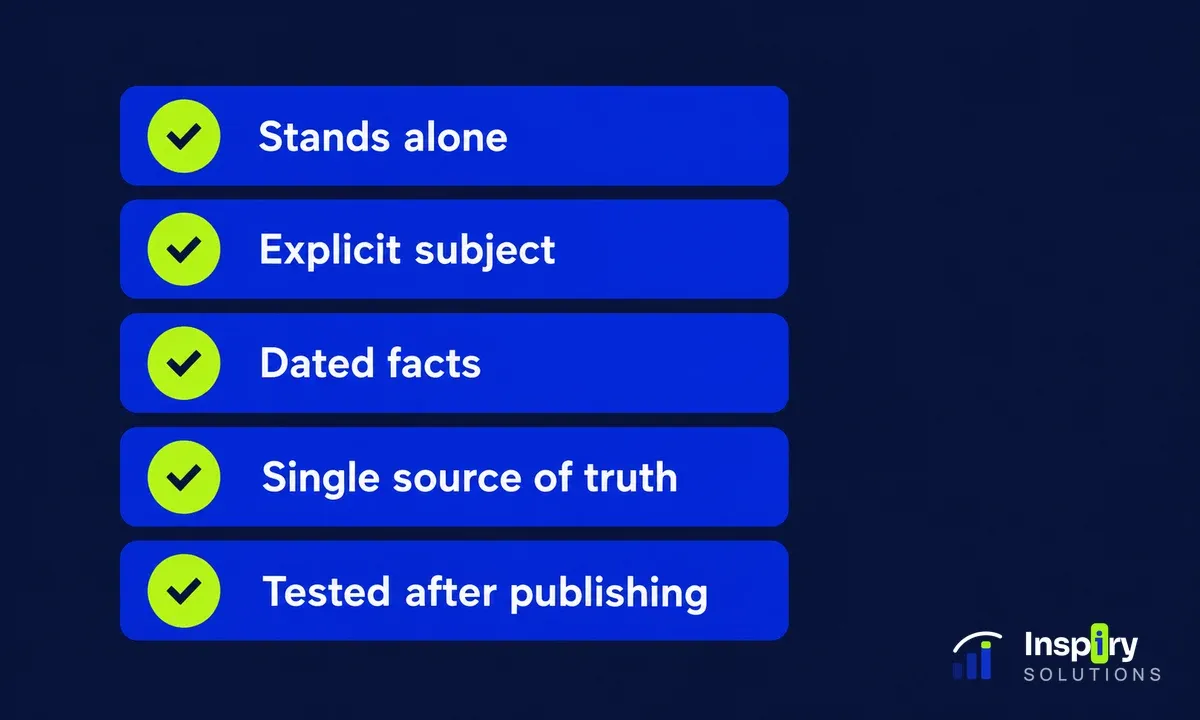
1. Does the answer stand alone?
Read only the heading and the first sentence.
Can you understand the statement without the previous paragraph, neighbouring image or page introduction?
If not, add the missing subject or condition.
For example, replace “This is included with every plan” with a sentence naming the specific service and what is included.
Do not remove essential qualifications just to make the statement shorter.
2. Is the subject explicit?
Look for ambiguous words such as “it”, “they”, “this service” or “these options”.
Identify the important subject at the beginning of a standalone claim.
3. Are changeable facts dated?
Check figures, coverage areas, product details and service conditions.
Do not insert a date merely for appearance. Confirm the underlying information before changing it.
4. Is there one source of truth?
Search your website for the exact service name, relevant prices and important terms.
Correct contradictions before publication.
If several pages describe one offering, decide where the authoritative details will be maintained.
5. Have you tested the published answer?
After publishing, ask a small set of real customer questions in the AI tools your audience uses.
Record:
- The question and tool tested
- The date of the test
- The generated response
- Any cited or linked source
- Whether the description is accurate
- Any missing qualification or incorrect figure
Repeat selected tests after substantial page updates.
Correct what you control and document what remains outside your control.
Common questions
What is answer engine optimization?
Answer engine optimization means writing and structuring content so systems that generate answers can find, understand and quote it accurately. It builds on normal SEO and helpful, people-first content rather than following a separate technical rulebook. The practical work involves direct answers, clear conditions, reliable evidence and consistent facts. None of these changes guarantees inclusion in AI-generated responses.
Is answer-first content bad for engagement?
No. Readers still need the explanations, examples and conditions that follow the direct answer. Starting with useful information helps people decide whether to keep reading. Someone who discovers that a service does not meet their requirements can move on, while a suitable customer can explore the details. Engagement should reflect meaningful interest, not difficulty finding basic information.
Should every page be a list of FAQs?
No. FAQs are useful for genuine customer questions, but they should not replace a well-structured service page. Visitors still need context, evidence, a description of the process and clear next steps. Use question-shaped headings where they fit naturally. Keep comparison tables, case-specific conditions and service explanations in the format that communicates them most clearly.
Does FAQ schema help AI search?
FAQ structured data is not a citation guarantee. Google previously limited FAQ rich results to certain government and health websites, but discontinued the feature in May 2026. Its current documentation no longer offers FAQ rich results as an optimisation opportunity. Any FAQ markup should accurately represent visible content. Focus on useful answers rather than adding schema solely to influence AI search.
Can I stop AI tools quoting part of a page?
Google documents data-nosnippet and other snippet controls that apply to Google Search, including applicable AI features. These settings can restrict how selected content appears, but their effects should be reviewed before implementation. Other AI providers have their own controls and policies to check. There is no universal setting that guarantees every AI tool will avoid quoting a particular passage.
Apply it to your top pages first
Start with the five pages that drive the most valuable enquiries, rather than rewriting your entire website.
For each page, identify the questions customers need answered before contacting you. Review the relevant sections and apply the answer engine optimization template: a direct response, clear conditions and supporting evidence.
Then complete the misquotation self-check, publish the changes and record how selected questions are answered in AI tools.
If your key pages bury the answer customers need, send your URL for a free audit. Our AI visibility service rewrites priority sections answer-first and checks how they are quoted.
Send your URL to hello@inspirysolutions.com and receive a plain-language reply within two working days.