AI SEO changes how businesses investigate discovery, explain their expertise and measure visibility in generated answers. It still depends on accessible pages and useful information. In 2026, the practical additions are platform-specific controls, answer-level checks and broader attribution. Traditional rankings and qualified website enquiries remain important alongside AI mentions and citations.

The term needs a clear definition. Here, AI SEO means improving visibility in AI-assisted search experiences. It does not simply mean using an AI writing tool. A team can automate keyword research without addressing AI discovery, or improve AI discovery using entirely human research and writing.
1. Discovery includes conversational questions
Traditional SEO often starts with a search query and the pages competing for it. AI-assisted search adds an answer that can combine information from several sources. The customer’s question may also include multiple constraints that would previously have required several searches.
That changes the AI SEO research brief. Alongside short service terms, collect questions about suitability, trade-offs, implementation and exceptions. Ask what the buyer needs to understand before making contact, and what details would rule your business out.
Hypothetical example: a retailer asks which ecommerce platform suits a small catalogue that also needs trade pricing and internal stock management. The useful response depends on requirements, integrations and maintenance responsibilities, not simply a list of popular platforms.
Use this AI SEO insight to improve a comprehensive decision page rather than create one URL for every wording variation. Google’s generative AI guidance describes related-query retrieval while retaining SEO foundations. It does not require a special content format or separate AI website.
2. Access controls require separate decisions
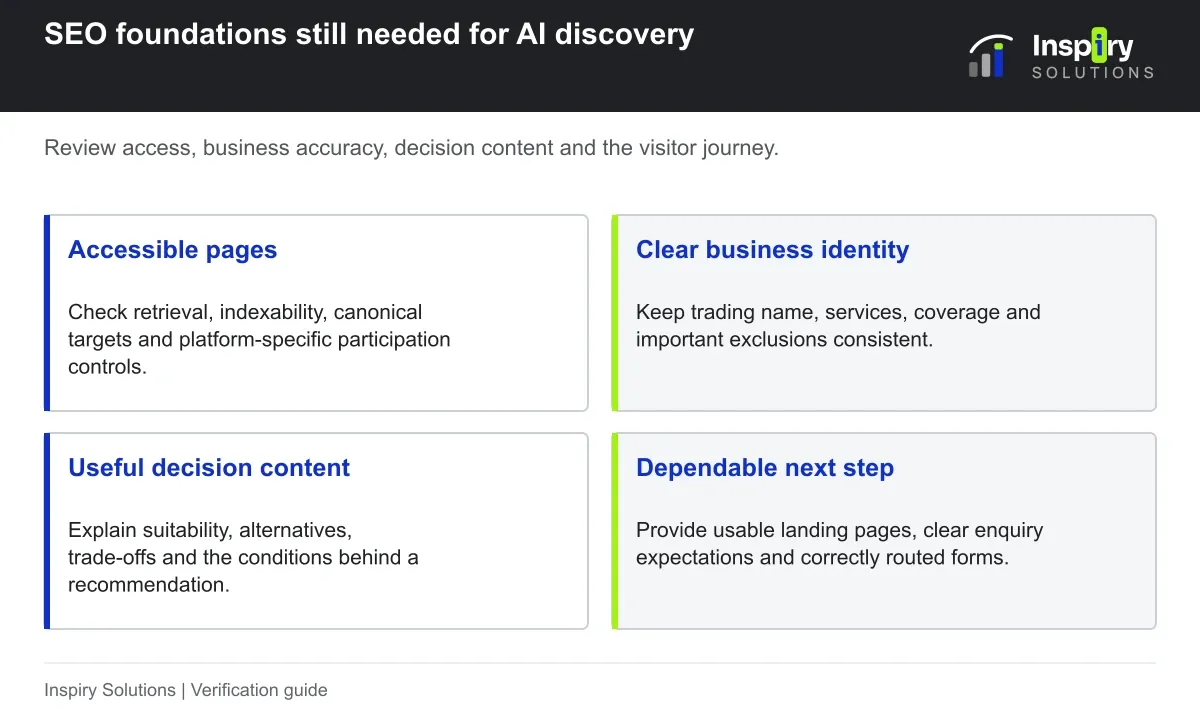
Traditional technical checks still matter: can the page be fetched, indexed and understood? Add an AI SEO inventory of platform controls so a general instruction to allow AI does not produce unclear or unintended settings.
OpenAI documents separate crawler roles for search, potential training and user-triggered visits. Record the business decision for each role, then check whether robots.txt and infrastructure settings implement it. One blanket crawler rule can obscure these distinctions.
Google now provides a Search generative AI control in Search Console. Review whether your property is included or inherits a parent property’s choice. This is an additional governance check when the business wants its pages to appear in those features.
A technical SEO audit should explain the consequence of each setting and verify important pages after changes. Do not assume a robots.txt edit resolves a firewall challenge, a noindex directive or a canonical pointing to the wrong destination.
Keep a dated AI SEO access record of these decisions. It makes future troubleshooting easier when hosting, security or agency responsibilities change.
3. Content needs to support a complete decision
An AI SEO content review can reveal pages that rank for a topic yet leave buyers unsure whether the advice applies to them. Review the actual answer: does it identify the relevant conditions, explain alternatives and distinguish facts from recommendations?
For useful AI SEO content, write a direct opening answer, then expand with reasoning. Include a comparison table where options differ along meaningful dimensions. Explain what would change the recommendation and what information remains unknown.
Hypothetical example: a website brief compares a standard theme with a bespoke build. The recommendation changes when unusual workflows, editor permissions or complex integrations become essential. A useful page makes those conditions visible instead of presenting one approach as universally superior.
The custom WordPress theme versus template comparison belongs naturally in this type of customer journey. It lets readers investigate a specific design decision rather than sending every question straight to a sales form.
An AI SEO brief should resist producing many lightly rewritten pages to cover possible prompts. Maintain an evidence register, identify who can verify the advice and update the source material when services change. AI writing assistance still needs editorial ownership.
4. Business identity becomes an audit item
Check whether an answer describes the correct organisation. Similar names, old addresses and inconsistent service descriptions can produce an apparently positive mention that introduces the wrong facts.
Ground AI SEO research in a reference sheet for your trading name, website, services, areas covered, contact routes and limitations. Compare it with your own pages and important public profiles. Mark outdated claims for correction rather than adding more competing descriptions.
For agencies, include the client’s sign-off in this process. An account manager may know that a service exists but not that it is restricted to certain customers or locations. A verified limitation can be more useful than a broad claim.
Coordinate this review with local SEO when physical branches or service coverage matter. Website language should distinguish a place customers can visit from an area a team serves.
Measure factual accuracy separately from visibility in AI SEO reporting. A brand mentioned frequently with incorrect services needs a facts investigation. Publishing more promotional content before correcting those facts can increase the amount of conflicting information available.
5. Reporting must separate several kinds of visibility
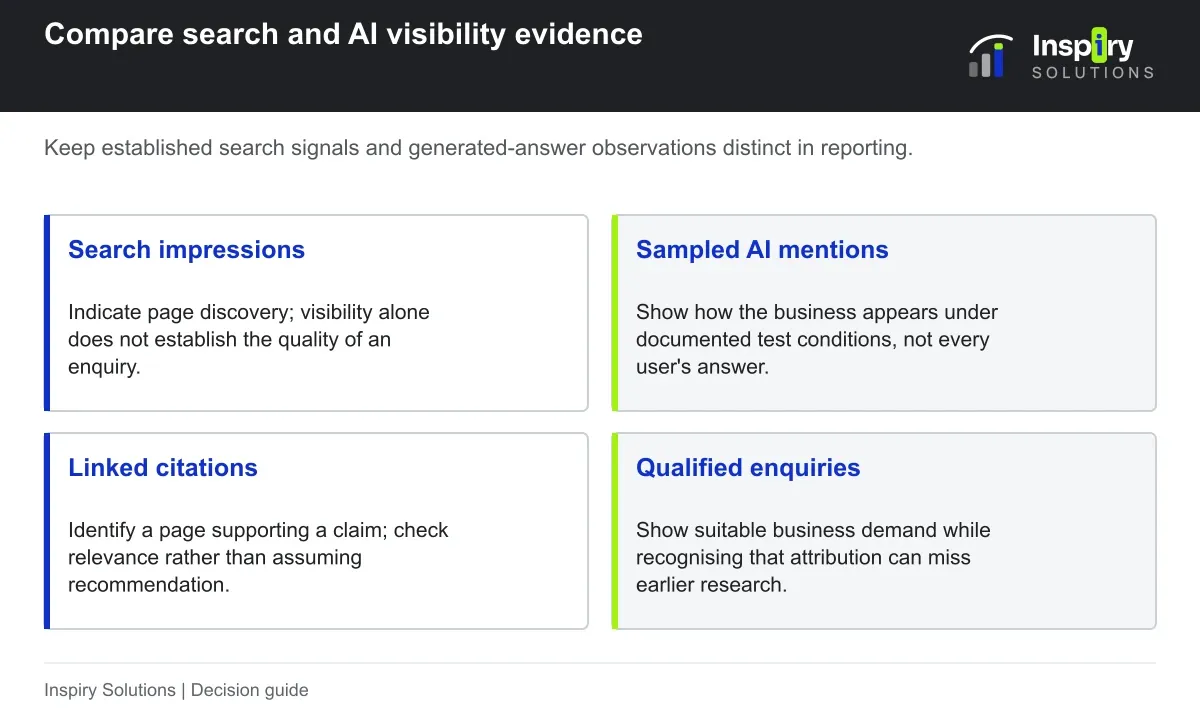
In AI SEO reporting, rankings, generated mentions, citations, referral visits and qualified enquiries are different observations. A report should show which one changed and how it was measured. Combining them into an unexplained AI score hides the questions a business needs answered.
| Measure | Useful question | Key limitation |
|---|---|---|
| Search impressions and clicks | Are our pages being discovered? | Visibility does not establish lead quality |
| AI mention tests | Is the business described in sampled answers? | Samples do not represent every user’s answer |
| Citation checks | Which page supports which claim? | A citation may not be a recommendation |
| Referral and enquiry data | Did identifiable visits become suitable leads? | Attribution can miss earlier research |
Google’s Generative AI performance report provides impressions for supported features, with dimensions such as pages, country and device. Check availability and data limitations in your own property. Do not describe it as a complete record of every conversation or customer journey.
For manual AI SEO tests, keep questions, market assumptions and search mode consistent. Save answers and check sources. Repeat tests over time, and show the sample size whenever you report a proportion.
6. Review the journey after an answer or citation
A visitor arriving from an AI answer may already have a shortlist or detailed requirements. Check whether the landing page helps them confirm suitability and move forward without repeating all their research.
Publish clear scope and a realistic next step. For a service enquiry, ask for the details needed to assess fit. Explain what happens after submission and which information the team still needs before confirming a price or timeframe.
Include website performance in the review. Usability, stable layouts and dependable forms matter regardless of the discovery channel. The Core Web Vitals business guide helps frame that discussion without treating a performance score as a guarantee of visibility.
Include the handover to sales in your AI SEO review and check it as carefully as the page. A relevant enquiry can be lost through the wrong notification address, unclear responsibility or missing context. Record the requested service and entry page so the team can respond appropriately.
7. AI SEO adds evidence checks to the existing workflow
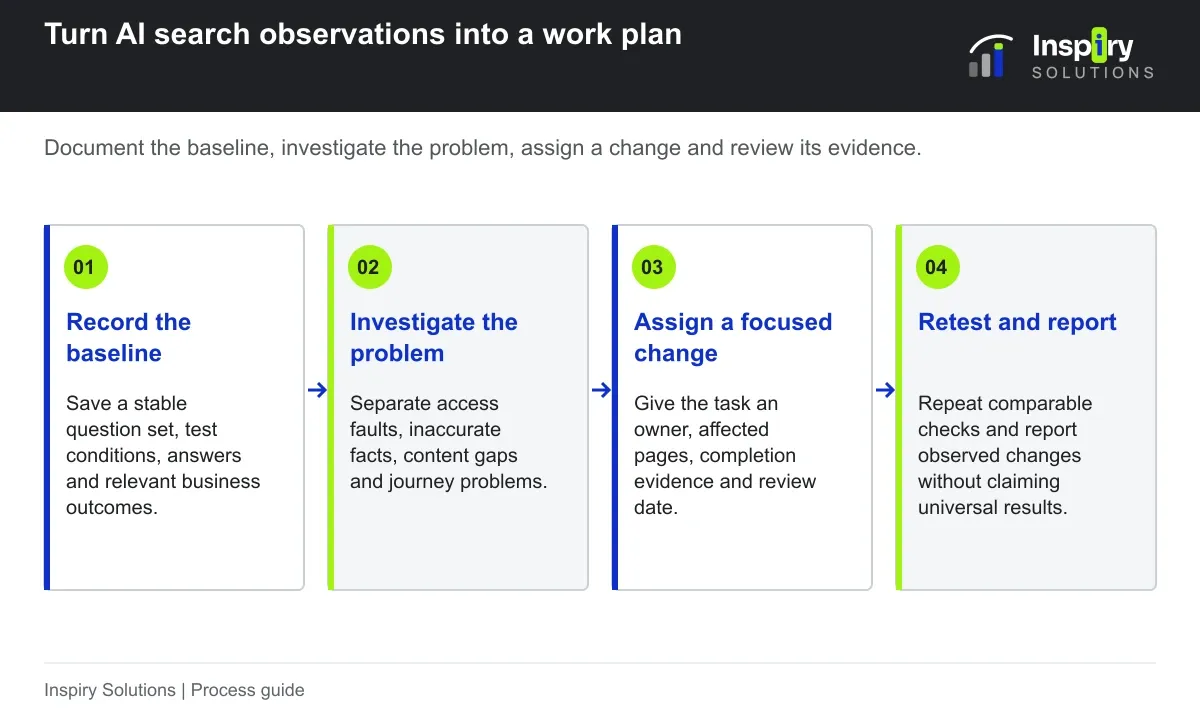
Keep a single prioritised backlog for AI SEO and existing search work. Label each task by the problem it addresses: access, factual accuracy, decision content, user experience or measurement. Add an owner, expected evidence of completion and review date.
Start with problems that prevent any useful outcome. A blocked service page, incorrect coverage claim or broken enquiry form deserves attention before speculative content experiments. Next, improve the pages linked to your most valuable customer decisions.
A practical first month can begin with a facts and access review, followed by revision of one important service page. Then run a controlled question sample and inspect referrals and enquiries. This is a proposed working sequence, not a predicted timeline for rankings.
Evaluate AI visibility services by their methods and deliverables. Ask for the question set, source checks, change log and reporting limitations. Useful support makes uncertainty visible and leaves the business with a repeatable process.
If you want these checks applied to your own site, our AI visibility service starts with an audit of how AI systems currently describe your business. For the practical side, read our AI visibility audit guide and our technical SEO audit checklist for WordPress.
Frequently asked questions
Does AI SEO replace traditional SEO?
No. Accessible pages, relevant information and a useful customer journey remain essential. AI discovery adds new places to inspect and new outcomes to measure alongside search traffic and enquiries.
Are AEO and GEO different services?
They are labels commonly used for answer and generative engine optimisation. Assess the actual work rather than the label: technical access, accurate business information, useful content and defensible measurement should be clear.
Does publishing AI-written content improve AI visibility?
The production method alone does not establish quality or relevance. Review accuracy, originality, audience fit and evidence. A large volume of similar pages is not a substitute for information customers need.
Do we need an llms.txt file?
Google says it does not use llms.txt for Search visibility. If another service documents a use for it, assess that requirement separately. Prioritise verified access and content problems before maintaining speculative files.
Can an agency guarantee an AI ranking?
No agency controls every generated answer. Contracts can specify audits, fixes, content and reporting, but should not promise a particular organic recommendation or universal visibility percentage.
How should a small business divide its budget?
Fund known access, accuracy and conversion problems first. Then choose a limited visibility experiment tied to commercially important questions. Expand the work when the evidence justifies it rather than assigning a fixed percentage to a new label.
Keep the foundations and expand the evidence
AI SEO in 2026 is an extension of disciplined search work. Review platform controls, improve decision content and inspect how your business appears in sampled answers. Keep rankings, citations and qualified enquiries distinct in reporting. That approach helps owners and agencies invest in observable problems while the search experience continues to change.
The ChatGPT visibility guide applies these principles to a practical question sample; the internal linking guide supports the underlying page architecture.