An AI visibility audit checks how your business appears in sampled AI answers, whether cited sources support the claims and whether search systems can access your website. Start with verified business facts and a fixed question set. Record results, inspect sources and prioritise corrections. An audit cannot reveal everything a model knows.
That limitation matters. A confident answer may contain an outdated detail, and a missing mention does not prove a technical block. Business owners need actionable findings; agencies need evidence that another team can reproduce and interpret. These eight checks create that shared process.
1. Define the AI visibility audit scope
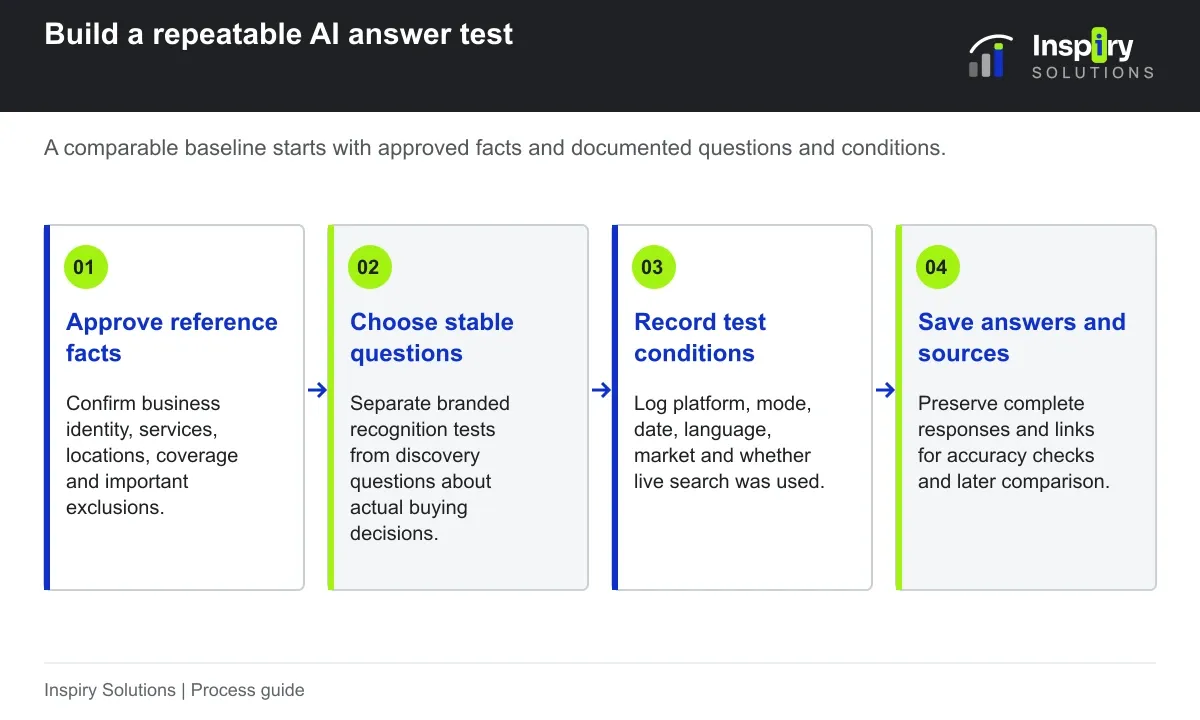
Create a signed-off business reference sheet for the AI visibility audit. Record trading name, domain, services, customer types, areas served, operating locations and important exclusions. Include sources for accreditations or partnerships that influence customer choice.
Build the AI visibility audit question set from actual buying decisions. Separate branded questions from discovery questions. Asking what your company does tests recognition; asking for a suitable provider in your market tests whether it appears without being introduced by name.
Hypothetical example: a maintenance company uses one question about its own coverage and another requesting commercial maintenance providers in its service region. The first checks factual accuracy. The second checks sampled discovery among other options.
Add constraints customers actually use, such as business size, appointment needs or specialist scope. Keep wording stable between audit rounds. Begin with a manageable sample that your team can review properly rather than a large set of vague prompts.
Give each AI visibility audit question a purpose before testing. This prevents a favourable answer from being counted as success when it does not address the business objective.
2. Record how each test was performed
For every AI visibility audit run, record platform, product mode, date, question, language and stated market. Note whether live search was used and whether the conversation contained earlier information about the business.
Use fresh conversations for comparable discovery tests in the AI visibility audit. Avoid telling the system about your company before asking it to suggest providers. That changes the context and makes the result unsuitable as evidence of unaided discovery.
Separate controlled tests from customer-like exploration. A follow-up conversation can reveal useful questions and objections, but its later answers are influenced by earlier messages. Keep that material as qualitative research rather than combining it with the fixed baseline.
Save each AI visibility audit response and its visible source links in a dated record. If the platform exposes a model or search mode, record it. If it does not, mark the field unknown rather than guessing.
A repeated answer is stronger evidence than an isolated screenshot, but it still represents sampled conditions. Do not translate a small internal test into a claim about every user’s experience.
3. Classify mentions, accuracy and recommendations
In your AI visibility audit record, use separate fields for brand presence, factual accuracy, citation presence and recommendation context. A response can mention the business accurately while suggesting that a different provider better suits the customer’s constraints.
| Field | What to record | Example finding |
|---|---|---|
| Brand presence | Whether the correct business is named | Named, absent or ambiguous |
| Accuracy | Facts checked against the reference sheet | Old service coverage stated |
| Citation | URL and linked claim | Service page supports the description |
| Recommendation | Why the business is presented | Suggested for a stated customer requirement |
| Action | Responsible owner and next investigation | Correct outdated public profile |
Check ambiguous business names carefully during the AI visibility audit. A similarly named business in another country is not a successful mention. Record unsupported claims even when they sound flattering, such as invented awards or facilities.
For a visibility proportion, show the numerator, denominator and question set. Hypothetical reporting example: six mentions from twelve documented tests describe those tests only. Do not label the result an overall market share or an official platform score.
4. Inspect the sources behind the answer
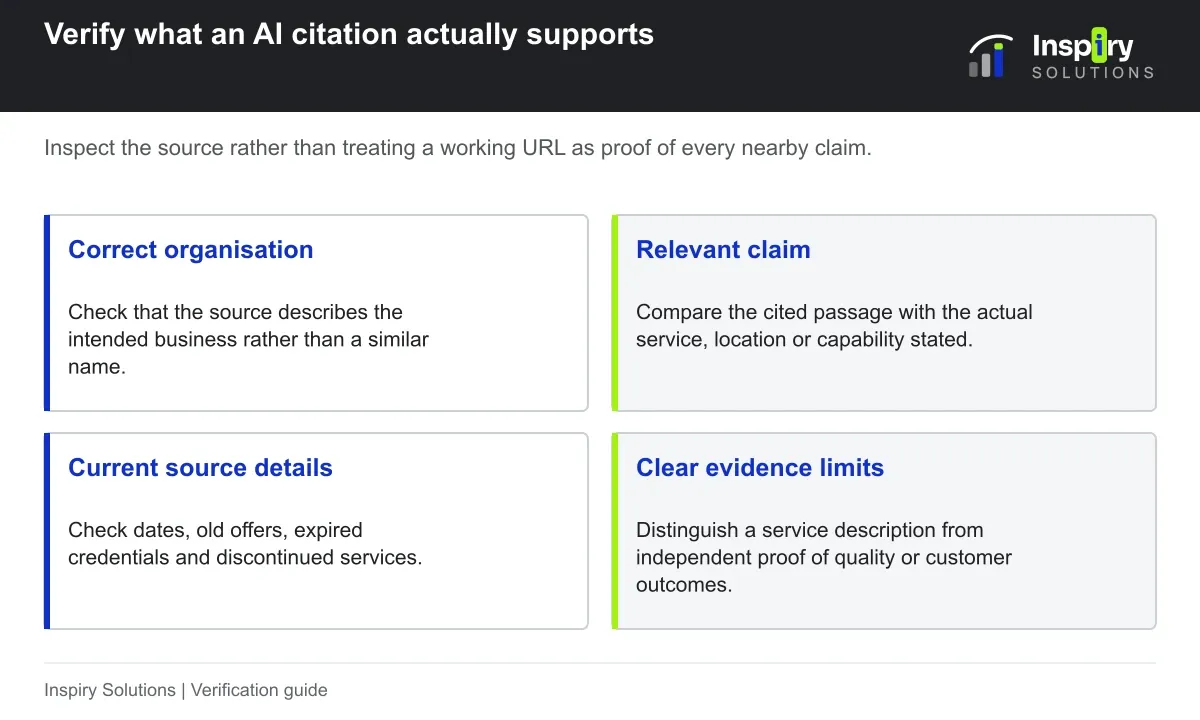
During the AI visibility audit, open every relevant citation and compare it with the claim it is supposed to support. Check the organisation, page topic, date, service scope and location. A legitimate URL can still be irrelevant to the sentence beside it.
Distinguish your website from independent sources. A citation to your service page may support what you offer. A directory entry may introduce contact details. Neither automatically verifies a claim about quality, leadership or customer outcomes.
Hypothetical example: an answer states that a company offers weekend appointments, but its cited page mentions only office hours. The audit records the statement as unsupported and investigates where the appointment information originated.
Turn AI visibility audit findings into a source-correction list. Start with pages your team controls, then request corrections to important outside profiles through their normal processes. Keep the observed claim, correction request and outcome together.
Do not assume removing an inaccurate page immediately removes every occurrence of the information. Retest later and report the observed outcome. An AI visibility review should preserve that distinction between a correction and a confirmed answer change.
5. Check the access and inclusion controls
Make access testing part of the AI visibility audit and inspect important URLs independently of prompt results. Check response status, indexability, canonical targets, internal links and whether meaningful content is available without a login. Investigate infrastructure blocks and security challenges with the hosting team.
OpenAI’s crawler documentation distinguishes OAI-SearchBot search crawling, GPTBot potential training use and ChatGPT-User visits. A user-triggered fetch is not evidence of routine search crawling. Verify crawler identity using published information before interpreting logs.
For Google, review the Search generative AI control and its inherited setting where relevant. Record the business’s intended participation and the actual configuration. Check indexing separately rather than assuming inclusion alone makes a page eligible.
Have technical SEO specialists turn confirmed problems into reproducible tickets. Include affected URLs, observed response, expected behaviour and retest instructions. A vague instruction to unblock AI is difficult to verify.
Coordinate with WordPress development when themes or plugins produce incorrect metadata. Retest after deployment and note what changed rather than relying on a settings screenshot.
6. Compare the available public information
Extend the AI visibility audit to the homepage, about page, important services and contact information, comparing each with the reference sheet. Look for inconsistent descriptions, old addresses, discontinued offers and claims lacking evidence. These are actionable findings even if no sampled answer currently repeats them.
Check important external profiles for the same facts. Concentrate on sources customers plausibly use, such as professional memberships, genuine partner listings and relevant directories. Do not turn the audit into a campaign for artificial mentions.
For local businesses, align the review with local SEO. Distinguish branches from service areas and make limitations clear. An inaccurate location claim can create unsuitable enquiries as well as misleading answers.
Record content gaps as customer questions, not just missing keywords. A service page may name the offering but fail to explain suitability, exclusions or the quotation process. Those gaps suggest a useful revision brief.
7. Inspect identifiable traffic and enquiry quality
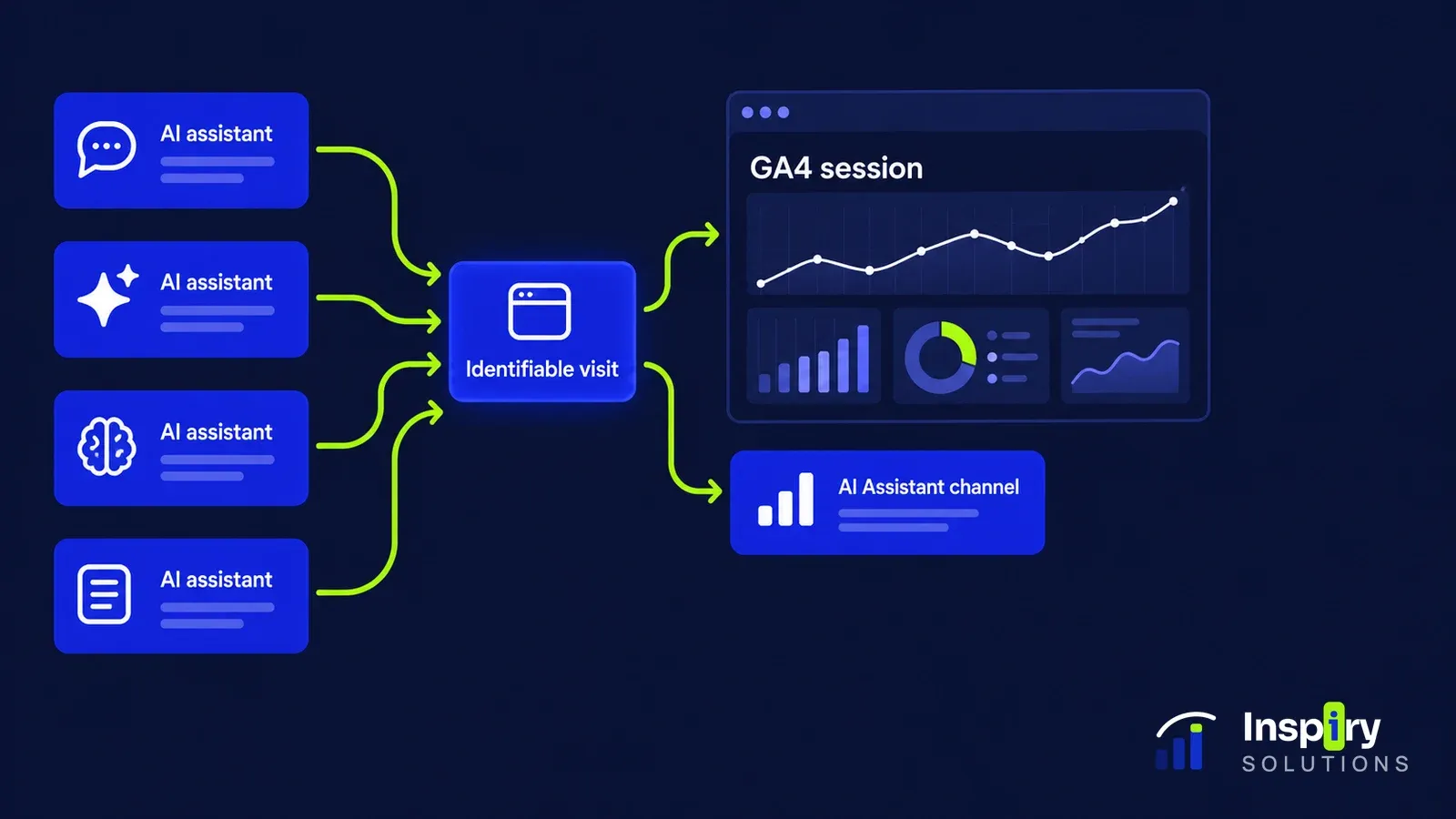
OpenAI’s publisher FAQ explains that ChatGPT adds utm_source=chatgpt.com to referral URLs. Review your analytics setup for identifiable visits and check whether redirects preserve useful tracking information.
Google’s Generative AI performance report provides impressions for supported Search features. Use available page, country and device views, and document missing or limited data. Impressions are a visibility signal, not proof of completed sales.
Connect landing pages to enquiry records where your measurement setup permits. Assess requested service, coverage fit and outcome. Ask leads how they discovered you, while recognising that their journey may involve several channels.
Test the destination experience as well. A slow page or unreliable form can weaken a promising referral. Include website performance and use the Core Web Vitals business guide to frame usability investigations.
8. Turn the audit into a prioritised action plan
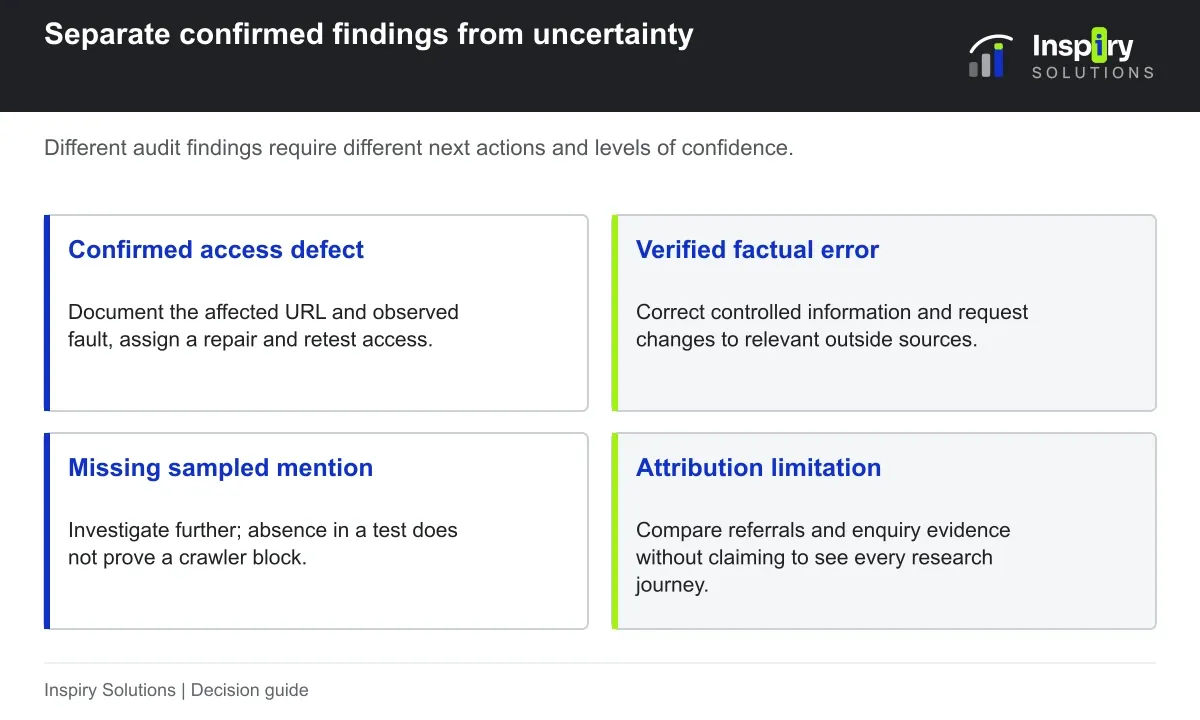
In the AI visibility audit findings, separate confirmed defects from hypotheses. A blocked page is a technical finding. A missing mention despite working access is an observation requiring further investigation. Keep both, but assign different actions and levels of confidence.
Prioritise inaccurate customer-facing facts, blocked important pages and broken enquiry routes. Next address weak decision content and incomplete evidence. Place speculative experiments after these known problems, with a defined question and review date.
For each AI visibility audit action, record the owner, affected page, proposed change and completion evidence. Use a controlled migration process if the remedy changes URLs. Preserve the baseline so a later team can assess the result.
Repeat the same AI visibility audit sample after meaningful changes and at an agreed interval. Report the new observations, the work completed and remaining uncertainty. This makes the audit useful for decisions without implying that one change caused every subsequent mention.
If you would rather have the audit done for you, our AI visibility audit service follows the same steps and ends with a prioritised action plan. For background, read what changes between AI SEO and traditional SEO and how to get your business mentioned in ChatGPT and AI search.
Frequently asked questions
Can an audit reveal everything ChatGPT knows?
No. It observes answers under documented conditions and checks public sources and access. It cannot inspect a model’s complete internal knowledge or predict every future response.
Should we test with live search enabled?
Yes, when assessing search-based discovery. Record that mode and keep non-search tests separate. Otherwise you may confuse an answer generated without live retrieval with current website visibility.
Is zero referral traffic evidence of zero visibility?
No. Someone may read a mention without clicking, or return through another channel. Check sampled answers, available impressions and enquiry feedback alongside analytics.
Do we need a paid monitoring tool?
A documented manual sample can establish a useful baseline. Tools may help manage repeated tests, but inspect their question selection, market settings and evidence. An unexplained aggregate score is difficult to act on.
How often should we repeat the audit?
Choose an interval that matches your capacity and rate of change, such as monthly review plus checks after important corrections. Frequent repetition without new evidence can consume time without improving decisions.
Can an audit guarantee future mentions?
No. It can identify problems, establish a baseline and support a measured improvement programme. Source selection and generated responses remain outside the business’s direct control.
Use the audit to make better decisions
A useful AI visibility audit combines repeatable answer tests with source verification, technical checks and enquiry evidence. Keep mentions, citations and referrals distinct. Correct confirmed problems first, then retest and report the limits. The result should be a practical work plan that another person can understand and maintain.
Use the ChatGPT visibility guide for implementation priorities and the AI SEO comparison to keep this work aligned with existing search fundamentals.