FAQ schema in 2026 can still describe questions and answers on your website, but it no longer produces Google’s expandable FAQ rich results. Google restricted those search features in 2023 and discontinued them in May 2026. That does not mean every business must delete its FAQPage markup. Valid markup can remain useful as structured information, while clear, visible answers continue to help visitors make decisions. The practical choice is to keep, fix or remove the markup based on what each page actually contains, rather than expecting a search appearance benefit that Google no longer offers.
What changed for FAQ rich results
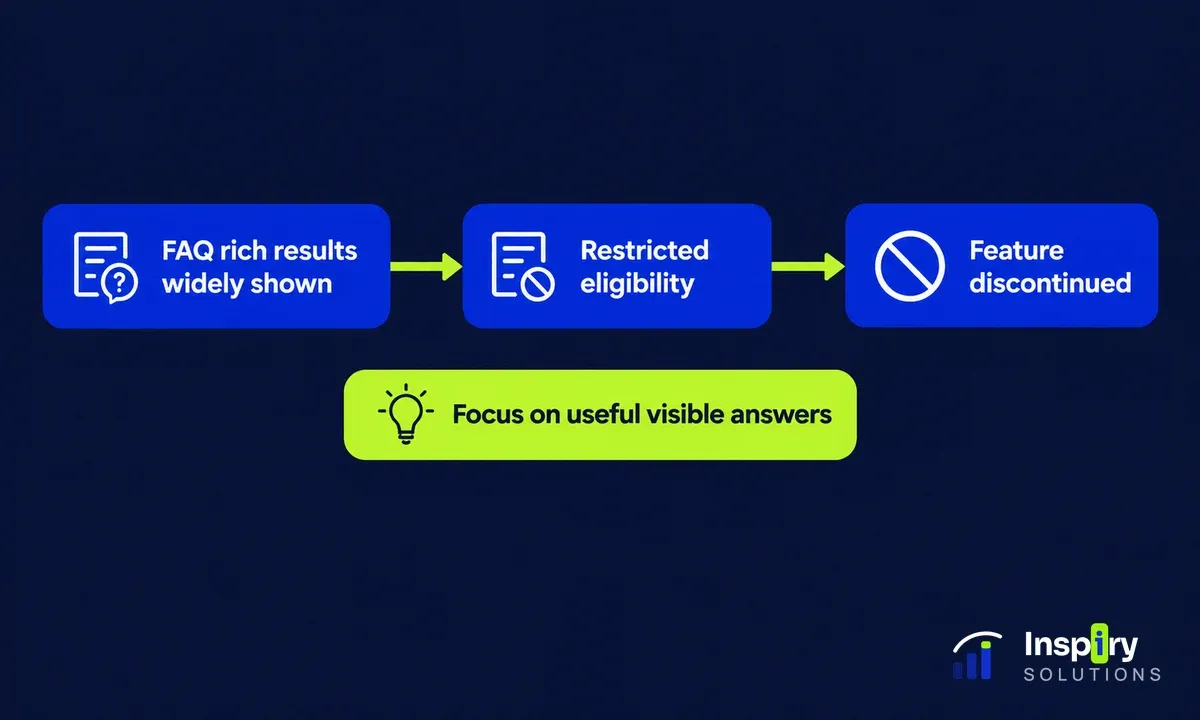
FAQ rich results were expandable question-and-answer sections that Google sometimes displayed beneath ordinary search listings.
In September 2023, Google updated its FAQ documentation to say the feature would only be shown for well-known, authoritative government and health websites, so most business sites stopped seeing expandable FAQ snippets. In May 2026, Google added a deprecation notice stating that FAQ rich results would no longer appear in Google Search from 7 May 2026, and in June 2026 it removed the FAQ rich result documentation. The Google Search documentation updates page records both changes, so check it for the current position, as Google’s features can change again.
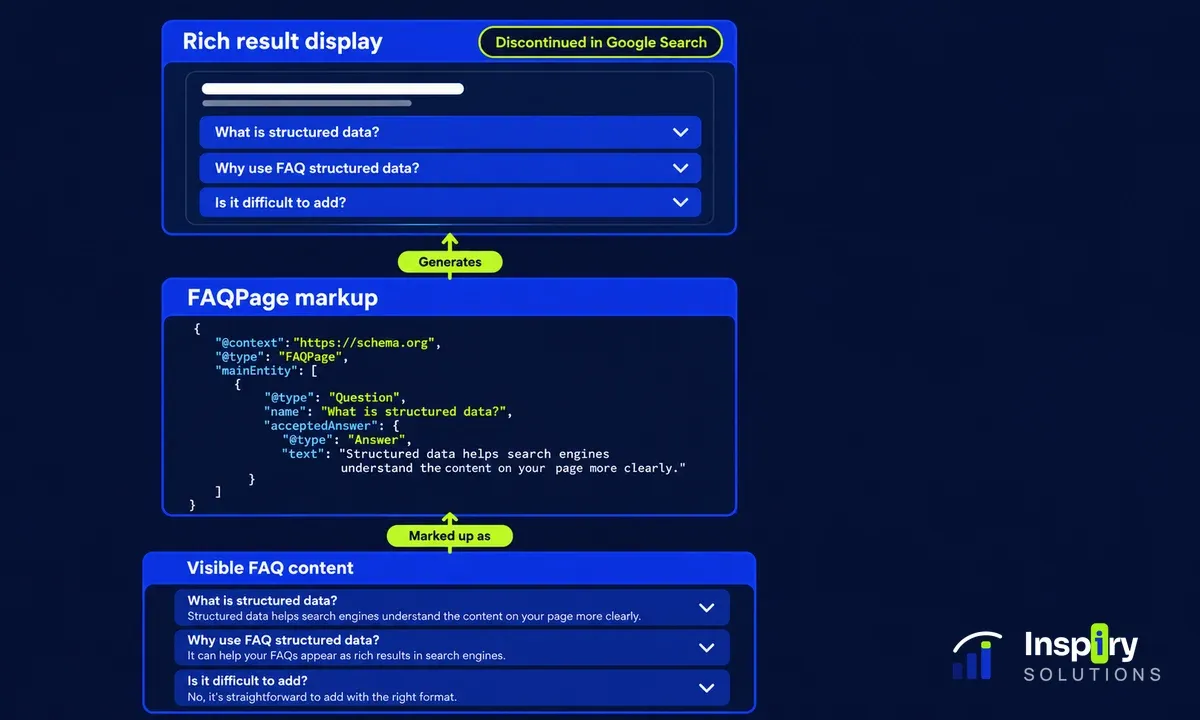
The distinction matters because three separate things are often treated as one:
- Visible FAQ content: Questions and answers that visitors can read on your website.
- FAQPage markup: Machine-readable structured data describing those questions and answers.
- FAQ rich result display: The additional presentation that Google previously offered but has now retired.
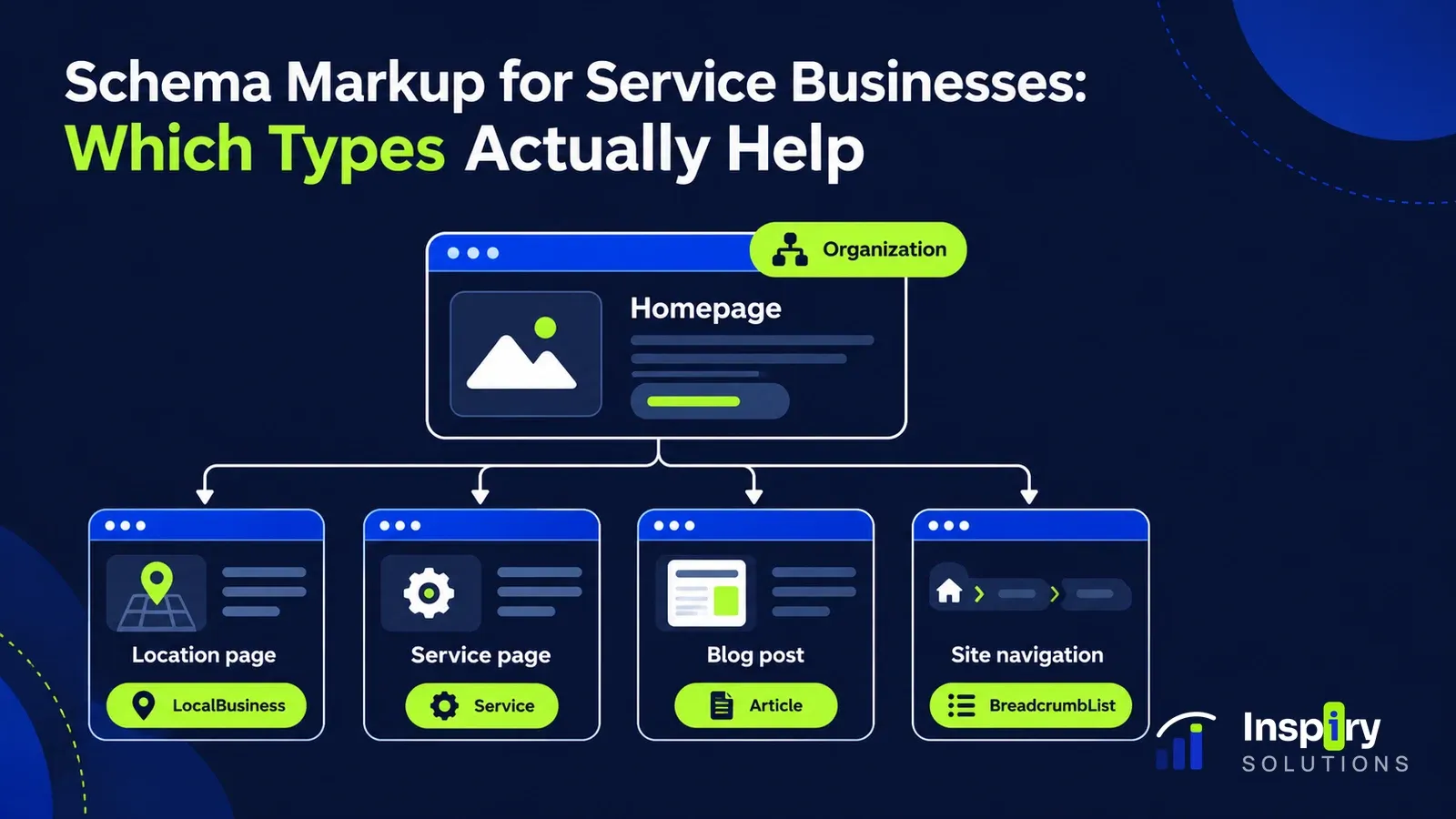
Google’s wider structured data guidance explains how markup helps its systems understand page content and why correct implementation matters.
For businesses reviewing older technical recommendations, our technical SEO and structured data work starts by identifying which changes still have a practical purpose.
What FAQ schema can still do
FAQ schema remains a recognised way to describe questions and answers using structured data.
It can describe existing information
Suppose a service page includes questions about appointment availability, cancellations and what customers should prepare.
Valid markup is not automatically a problem
A business does not need to urgently remove every instance of FAQ schema simply because Google retired the corresponding rich result.
Google recommends that structured data accurately represent page content.
It does not guarantee AI citations
Another claim deserves particular attention: adding FAQ schema does not guarantee that your website will appear in Google AI Overviews, AI Mode or ChatGPT answers.
Google’s guidance for AI features says that no additional AI-specific structured data is required to appear in its AI search experiences.
Our AI visibility service focuses on assessing what a website communicates, how accessible its information is and which improvements can be verified, without promising citations.
Why the visible FAQ section matters more than the markup
A visitor cannot make an informed buying decision from markup they never see.
Answer questions customers genuinely ask
Good FAQ content begins with customer uncertainty.
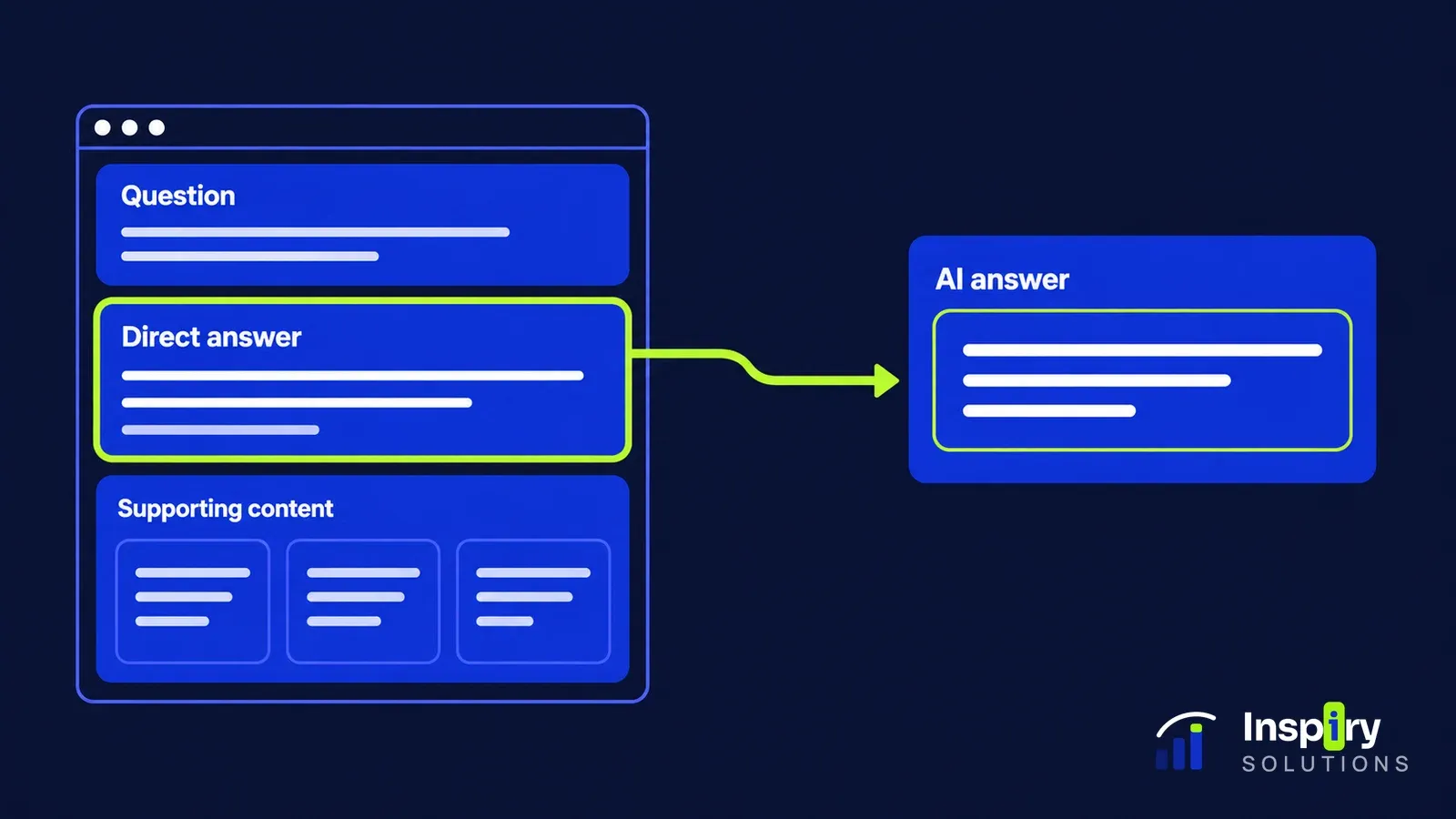
This approach aligns with writing answer-first content and helps create information that can stand on its own.
Use answers to remove buying objections
A useful FAQ section can support the enquiry process without sounding like a sales pitch.
This is the principle behind answers that help customers choose.
Keep information visible and accessible
Questions should appear as readable page content, not exist only inside JSON-LD code.
However, avoid placing essential answers behind interactions that do not work reliably on mobile devices.
Check that headings are understandable, buttons operate correctly and the answers remain readable when the layout changes.
An FAQ section with excellent markup but poor usability still fails its visitors.
Avoid keyword-only questions
Repeating a search phrase across several artificial questions is not a useful content strategy.
For instance, a local service business does not need numerous questions that differ only by inserting nearby town names.
That approach can create repetitive text without helping customers.
Instead, include a question only when its answer introduces something relevant.
A page covering one specific service should explain that service rather than reproduce a generic FAQ from every other page.
This distinction is also relevant to what AI search changes for SEO. Clear explanations remain useful regardless of whether a visitor arrives through conventional search or an AI-powered interface.
When to use FAQ schema now
The decision to use FAQ schema should begin with the page content, not with an SEO plugin’s recommendation.
FAQPage markup makes sense when a website contains a genuine, business-authored collection of questions and answers.
It is optional rather than a requirement for ordinary service pages.
Appropriate situations
A dedicated FAQ page may explain booking procedures, account requirements, service limitations or recurring customer concerns.
A service page may include a smaller set of relevant questions specific to that offering.
In both situations, structured data can accurately describe information already present.
The content should be maintained alongside other page information.
A maintenance process is more valuable than simply enabling a schema setting once.
Situations to avoid
FAQPage is not the right type for forum-style discussions in which users submit answers to a question.
It is also not a substitute for genuinely useful content.
Do not add repeated FAQ markup across every URL simply because a template allows it.
Avoid inserting questions primarily to repeat commercial keywords, advertise unrelated offers or create the appearance of additional information.
A genuine FAQ can still have a commercial purpose.
When in doubt, publish the useful answer first and decide whether additional markup is worth maintaining afterwards.
Keep, fix or remove: 3 options for each page
The best FAQ schema decision is made at page level.
A sitewide setting may appear convenient, but different pages can have very different requirements.
Use this table as the starting point for an audit.
| Situation | Decision | Reason |
|---|---|---|
| Genuine FAQ visible on page and markup matches | Keep | Markup accurately describes existing information |
| Markup present but FAQ hidden or missing | Fix or remove | The structured data must represent accessible page content |
| Same FAQ repeated on every page | Remove from most pages | Avoid unnecessary duplication and irrelevant markup |
| User forum-style questions | Use QAPage instead | FAQPage does not describe user-submitted answer discussions |
| Two plugins outputting FAQ markup | Fix, keep one | Duplicate output can create inconsistent or unnecessary markup |
| FAQ written only for keywords | Rewrite content first | The answers should help visitors before being marked up |
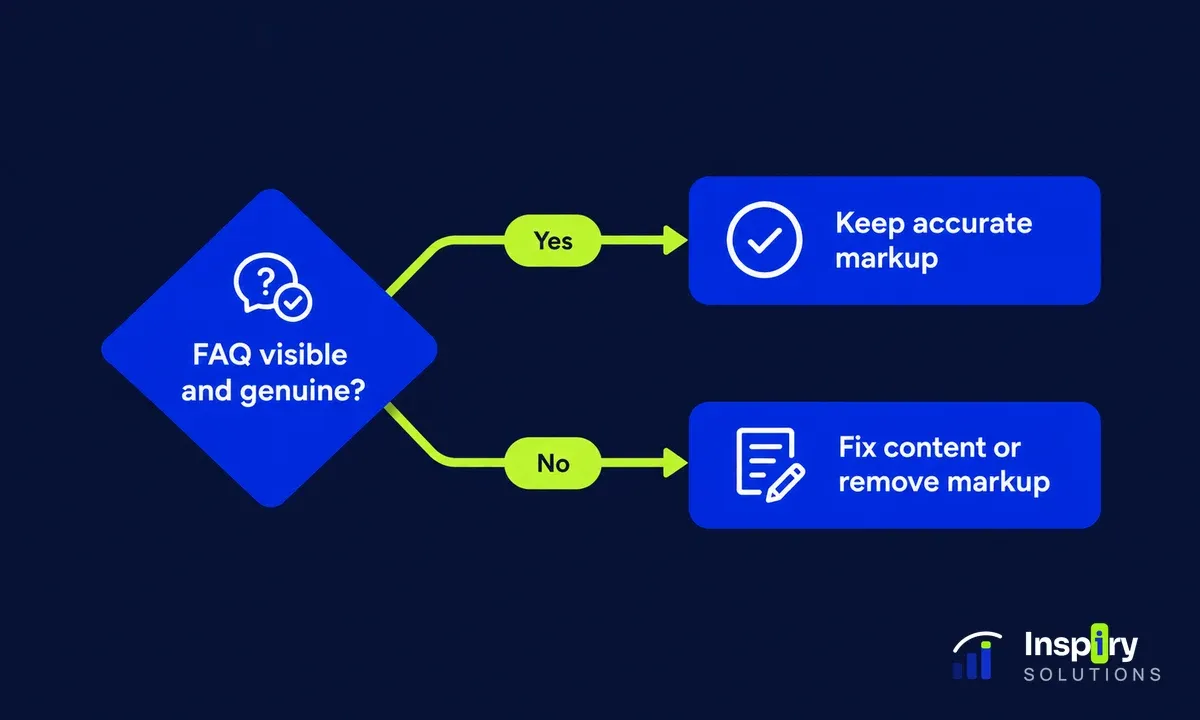
Keep it when the markup matches a genuine visible FAQ
Keep FAQPage markup if the page contains useful questions, the answers are visible and the structured data represents them accurately.
There is no need to remove valid markup merely because Google no longer displays FAQ rich results.
However, the presence of valid code is not a business benefit on its own.
If the existing implementation requires no additional maintenance, leaving it can be reasonable.
Check that the questions are relevant, the answers are current and the schema is generated by one clearly identified component.
Document which plugin or custom implementation controls it.
Fix it when the markup and the page disagree
Sometimes an SEO plugin continues outputting FAQ schema after an editor deletes the visible FAQ section.
Another common issue occurs when the written answer changes but the structured data retains an earlier version.
Both situations require attention.
Compare the source markup with what a visitor actually sees.
If the content is still needed, restore or update the visible answer and synchronise the markup.
If the content has been permanently removed, remove its structured data too.
Where multiple components produce overlapping FAQPage output, choose one source of truth.
Remove it when it is repeated sitewide or written only for keywords
A generic FAQ injected across every service page rarely provides useful page-specific context.
The content may be technically valid, but repeating the same questions everywhere can create unnecessary maintenance work.
Remove redundant markup where there is no meaningful FAQ section to describe.
If the page contains artificial questions written only to target keywords, address the content first.
Replace them with genuine answers where appropriate, or remove the section if it serves no useful purpose.
Do not confuse deleting unnecessary schema with deleting genuinely helpful information.
The goal is a cleaner, more accurate website, not reducing markup simply for the sake of it.
FAQPage, QAPage and HowTo: which is which
These schema types describe different kinds of content.
| Type | Appropriate content | Practical example |
|---|---|---|
| FAQPage | Questions answered by the website | A company’s booking and cancellation FAQs |
| QAPage | A specific question with answers submitted by users | A community support question |
| HowTo | Instructions explaining a sequence of steps | A guide to completing a practical task |
FAQPage is intended for questions where the website itself provides the answers.
QAPage is associated with a question-and-answer format in which users can contribute answers.
HowTo describes instructional content organised into steps.
Google discontinued HowTo rich results in 2023.
This history illustrates why choosing schema purely to obtain a particular search appearance is risky.
The underlying schema vocabulary and Google’s support for a search feature are separate matters.
A format may remain valid even when Google stops displaying the associated enhancement.
Before implementing any structured data type, check whether the target platform currently supports the feature you expect.
For a business website, the most useful starting point is usually accurate content and markup that reflects what the page actually offers.
Adding FAQ schema on WordPress
WordPress provides several ways to add FAQPage markup, including SEO plugins, compatible FAQ blocks and custom development.
The right method depends on how the page is built and which component already manages structured data.
Adding another plugin without inspecting the existing output can create unnecessary complexity.
Start with the visible questions
Create the FAQ section in the WordPress editor or page builder.
Keep each question specific and provide a straightforward answer.
Check the published page on desktop and mobile before enabling additional markup.
If the page uses an accordion, confirm that expanding and collapsing the answers works correctly.
The visible content should be useful independently of any SEO settings.
Choose one markup source
Some SEO plugin FAQ blocks can generate structured data directly from their visible question-and-answer content.
That approach can reduce the risk of the page and markup becoming inconsistent.
However, not every FAQ block produces schema, and not every accordion is designed to do so.
Check the actual output rather than relying on the block name.
If a page uses Elementor or another builder alongside an SEO plugin, verify whether both are producing FAQPage data.
Where duplicate markup exists, disable one implementation or adjust the configuration so the content has a single authoritative source.
Validate the published output
Use Google’s Rich Results Test to inspect structured data associated with supported Google search features.
Because FAQ rich results have been discontinued, this tool should not be treated as confirmation of FAQ rich result eligibility.
For general schema syntax and vocabulary checks, the Schema Markup Validator can help identify problems beyond Google’s supported rich result types.
Inspect the rendered page and its structured data directly.
Confirm that each marked-up question exists on the page, each answer matches the visible text and there are no unnecessary duplicate entries.
A technically valid result does not guarantee a search feature, ranking change or AI citation.
Test updates before applying them widely
If FAQ markup appears across many WordPress pages, avoid changing everything at once.
Select representative pages, including a service page, a dedicated FAQ page and any page using a different builder template.
Record their current output.
Make the adjustment on staging where possible, then compare the published content and structured data after deployment.
Check caching layers as well.
Finally, record the decision and the plugin or template responsible.
This makes future maintenance easier, especially when an agency hands the site to another developer.
Hypothetical example: one FAQ block on 40 pages
Hypothetical example: A dental practice has the same eight-question FAQ block with FAQ schema on all 40 pages.
The questions cover general opening hours, appointment enquiries, cancellations and payment arrangements.
The FAQ block appears on the homepage, treatment pages and other informational pages because it was added through a shared website template.
Although the questions are genuine, they are not equally relevant to every page.
The practice decides to review the implementation rather than automatically deleting all FAQs.
First, the full eight-question section is kept on one dedicated FAQ page.
That page becomes the main location for general practice information.
Second, treatment pages receive short, page-specific questions where these would help visitors.
For example, a particular treatment page might explain what an initial consultation involves or what information patients should prepare.
Answers are written carefully, with any clinical or procedural claims checked by the practice.
Third, repeated FAQPage markup is removed from pages that no longer contain an appropriate FAQ section.
The practice also confirms that the dedicated FAQ page has one consistent markup implementation.
A developer checks the resulting structured data and verifies that the visible answers match it.
The work produces a more maintainable content structure.
It also reduces unnecessary repetition while allowing each treatment page to answer questions relevant to its subject.
There is no assumed ranking improvement, traffic increase or additional search appearance.
The benefit being pursued is clearer information, more relevant pages and easier maintenance.
The example demonstrates a broader lesson: a sitewide FAQ block can be convenient during development, but convenience does not automatically make it appropriate for every page.
Common questions
Does Google still show FAQ rich results?
No. Google restricted FAQ rich results to well-known, authoritative government and health websites in 2023, meaning most business sites stopped receiving them. Google then stopped showing them in Search from 7 May 2026. FAQPage markup remains a schema type, but it no longer produces Google’s expandable FAQ search listings. Check Google’s current documentation and updates before relying on older implementation advice.
Should I remove FAQ schema from my site?
Not necessarily. Valid FAQ schema that accurately matches genuine, visible page content is not automatically harmful. Keep it if there is a clear reason to maintain it. Fix or remove markup that describes missing content, conflicts with the page or is unnecessarily repeated across the website. Audit the implementation before making sitewide changes.
Does FAQ schema help with AI Overviews or ChatGPT?
There is no published guarantee that FAQ markup leads to citations in Google AI Overviews or ChatGPT. Google does not require special structured data for its AI search features. Clear, visible answers are content that readers and systems can access, although their presence does not guarantee inclusion or citation. Prioritise useful information over speculative AI optimisation techniques.
What is the difference between FAQPage and QAPage?
FAQPage describes questions and answers provided by the website itself, such as a company’s service FAQs. QAPage describes a page centred on one question with answers that users can submit, such as a community forum discussion. The distinction depends on the page’s content model, not the number of times the word “question” appears.
Decide page by page
FAQ schema is no longer a shortcut to extra space in Google search results.
For business websites in 2026, the sensible approach is to review what exists, keep accurate markup where appropriate and remove configurations that no longer serve a useful purpose.
Begin by identifying pages that output FAQPage structured data.
Then compare each page’s markup with its visible content.
Check whether the questions are genuinely useful, whether answers remain correct and whether any plugin or builder is producing duplicated information.
Assign a keep, fix or remove decision to each page.
For important service pages, prioritise clearer customer answers before spending time on schema adjustments.
If your website has other structured data opportunities, review the schema types worth adding first rather than assuming FAQPage should be the priority.
Good technical SEO work requires separating obsolete search features from useful implementation practices.
That prevents unnecessary changes and keeps attention on what customers can actually read and understand.
If your site carries FAQ markup from an old plugin setting, we can audit it page by page and clean it up as part of our technical SEO work. Send your URL for a free audit.