Schema markup for service businesses is most useful when five types are mapped to the right pages: Organization, LocalBusiness, Service, Article and BreadcrumbList. Some help search engines understand your business, while others make pages eligible for enhanced search appearances. None guarantees higher rankings or a special result. The sensible approach is to describe information already visible on your website, avoid irrelevant types and validate the output before publishing.
If you run a law firm, dental practice, trade business, consultancy or agency, this guide explains which schema types deserve attention, what to skip and how to brief your developer without paying for unnecessary markup.
What schema markup for service businesses does, and does not
Schema markup is code that labels webpage information so search engines can understand its meaning. It uses the Schema.org vocabulary to describe organisations, services, locations, articles and other entities.
For example, a plumbing company might offer emergency repairs across several towns. Structured data can identify the service, its provider and the geographical area served.
According to Google’s introduction to structured data, appropriate markup helps Google understand content and can make pages eligible for certain rich results.
Rich results are search appearances containing additional information beyond a standard text listing.
Three limitations matter:
- Valid schema does not guarantee a rich result.
- Schema markup is not a general ranking shortcut.
- Only supported types qualify for Google’s specific search features.
A Schema.org type can be valid without producing any special Google appearance.
Markup must also represent information visitors can find on the page. Adding fictional locations, unsupported ratings or services that the business does not provide creates misleading data.
For most businesses, accuracy matters more than the number of schema types installed.
The 5 types worth adding first
These five types cover the main needs of structured data for small business websites: identity, location, services, editorial content and navigation.
Their benefits differ. Some support visible Google features, while others clarify business relationships.
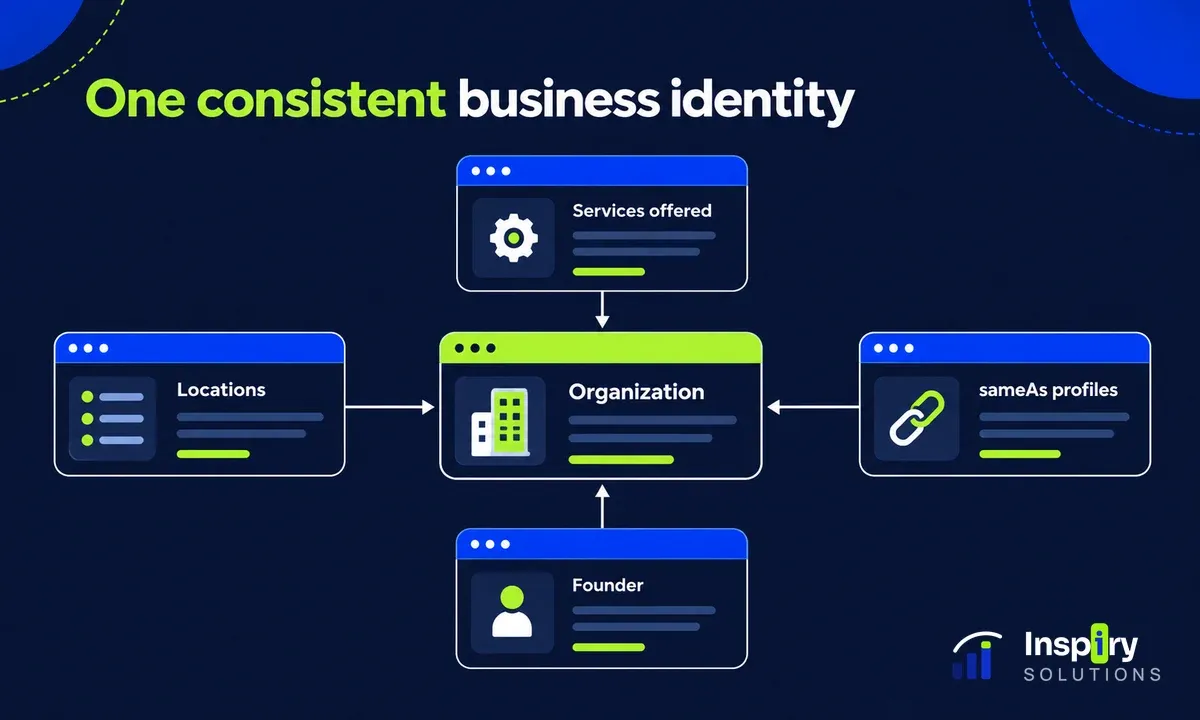
Organization on the homepage
Organization identifies the business behind a website.
It can describe the official name, website URL, logo and public profiles. The sameAs property connects the organisation to established profiles representing the same business.
The homepage is normally the right place to establish this identity. Other pages can reference the same organisation rather than generate conflicting descriptions.
Use accurate business details and genuine profiles. Organization markup supports entity understanding and certain eligible organisation information, but does not guarantee a dedicated search result.
LocalBusiness or a more specific subtype
LocalBusiness describes a business with a genuine local presence or service operation.
Relevant properties include its name, address where applicable, telephone number, opening hours and geographical details.
More specific types may be appropriate. An accounting practice might use AccountingService, while a dental practice might use Dentist.
Choose the closest accurate type rather than a category that merely sounds appealing.
Google’s LocalBusiness structured data documentation explains supported properties and eligibility requirements.
Do not invent an office address for a service-area business.
For companies targeting several towns, local SEO for service businesses also requires accurate location information, useful pages and consistent contact details.
LocalBusiness markup supports that work. It does not replace it.
Service on each service page
Service describes an actual offering, such as roof repairs, commercial cleaning or employment law advice.
Useful properties include the service name, description, provider and area served.
Google does not currently provide a dedicated Service rich result. Its main value is clarifying business offerings and their relationships.
Add it to genuine service pages, using information already published for visitors.
Avoid presenting unrelated keywords as individual services.
Article on insights posts
Article describes editorial content such as guides, industry updates and educational posts.
It can identify the headline, author, publication date, modification date and images.
For businesses publishing advice, Article markup distinguishes informational content from commercial service pages.
Google supports article-related structured data for applicable search features, although display is not guaranteed.
Most WordPress SEO plugins can generate Article markup automatically. Confirm that the author, dates and headline match the published content.
BreadcrumbList for clearer result paths
BreadcrumbList describes the hierarchy connecting a page to broader website sections.
For example:
Home > Services > Technical SEO
Google can use eligible breadcrumb data when presenting navigation paths in search results.
Breadcrumb markup is useful for websites containing numerous services, locations or article categories.
Keep the hierarchy consistent with actual website navigation.
The following schema priority matrix separates search feature eligibility from practical value.
| Schema type | Where it goes | Can show a Google rich result? | Value for a service business | Priority |
|---|---|---|---|---|
| Organization | Homepage | Can support eligible organisation information features | Establishes business identity | High |
| LocalBusiness (and subtypes) | Business or location pages | Yes, for supported local features | Describes local presence | High where relevant |
| Service | Service pages | No dedicated Service rich result | Clarifies offerings | High for clarity |
| BreadcrumbList | Pages with meaningful hierarchy | Yes, for supported breadcrumb appearances | Explains navigation | High |
| Article | Insights posts | Yes, for supported article features | Identifies editorial content | Medium to high |
| FAQPage | FAQ pages | Restricted to eligible government and health websites | Limited display benefit | Low |
| Review or AggregateRating on own pages | Business’s own review content | No self-serving stars for its own LocalBusiness or Organization | No eligible self-serving stars | Avoid for that purpose |
| Product | Genuine product pages | Yes, when requirements apply | Usually unsuitable for services | Conditional |
| Event | Genuine event pages | Yes, for qualifying events | Relevant for actual events | Conditional |
A type without a rich result can still provide useful context. An eligible type adds little when its underlying content does not exist.
For broader implementation, technical SEO implementation should assess markup alongside indexing and page templates.
Service schema: useful context, not a rich result
Service deserves attention because its benefits are frequently overstated.
The Schema.org Service definition provides properties for describing services and their relationships.
Common properties include:
name: the recognisable service name.description: a concise explanation.provider: the organisation offering it.areaServed: the geographical coverage.serviceType: the service category.
Consider a plumbing company offering emergency repairs, boiler servicing and bathroom installations.
Each service page can describe its specific offering while referencing the same provider.
That is clearer than placing one Service object containing every keyword on the homepage.
What Service markup cannot do
Service schema does not automatically produce a Google listing displaying your services, prices or coverage areas.
Selling it as a guaranteed route to enhanced listings is misleading.
Its value is accurate context, provided the receiving system uses it.
The same caution applies to AI search. Service markup may communicate business relationships, but it cannot guarantee AI recommendations or citations.
Keep the service description consistent
Generate markup from information already maintained on the page.
If commercial cleaning is offered across three cities, do not claim nationwide coverage without supporting content.
Avoid inserting fixed prices when customers must request quotations.
Accurate relationships and consistent descriptions make service schema markup easier to maintain as offerings change.
Types that rarely help service sites
Schema plugins offer many types, but that does not mean your website needs them.
Unnecessary markup can create conflicting information or expectations Google’s policies do not support.
Self-serving review stars
A business may display genuine testimonials without becoming eligible for review stars in Google’s organic results.
Google’s review snippet documentation excludes self-serving reviews of LocalBusiness and Organization entities from review rich results.
This restriction also covers relevant embedded third-party review widgets.
Do not manufacture ratings or repeat AggregateRating markup across service pages hoping to obtain stars.
Keep authentic testimonials useful to visitors and maintain appropriate third-party review profiles.
FAQPage on ordinary service websites
Google limits FAQ rich results to eligible well-known, authoritative government and health websites.
For most solicitors, tradespeople and agencies, FAQPage markup should not be treated as a way to obtain expanded listings.
Frequently asked questions remain valuable because they help visitors understand pricing, processes and services.
Their usefulness does not depend on a rich result.
Product markup on non-products
Product schema is intended for suitable product content meeting Google’s requirements.
An ordinary consultation, legal service or bespoke building project should not be represented as a retail product solely to pursue pricing enhancements.
Some offerings may have product-like characteristics. Assess their actual content and eligibility rather than assuming every priced service qualifies.
Every plugin option switched on
Enabling every available schema type can produce unrelated objects, duplicate organisations and outdated properties.
Before enabling a type, ask:
- Does the page contain this information?
- Does the type accurately represent it?
- Who will maintain its values?
If those answers are unclear, leave it disabled.
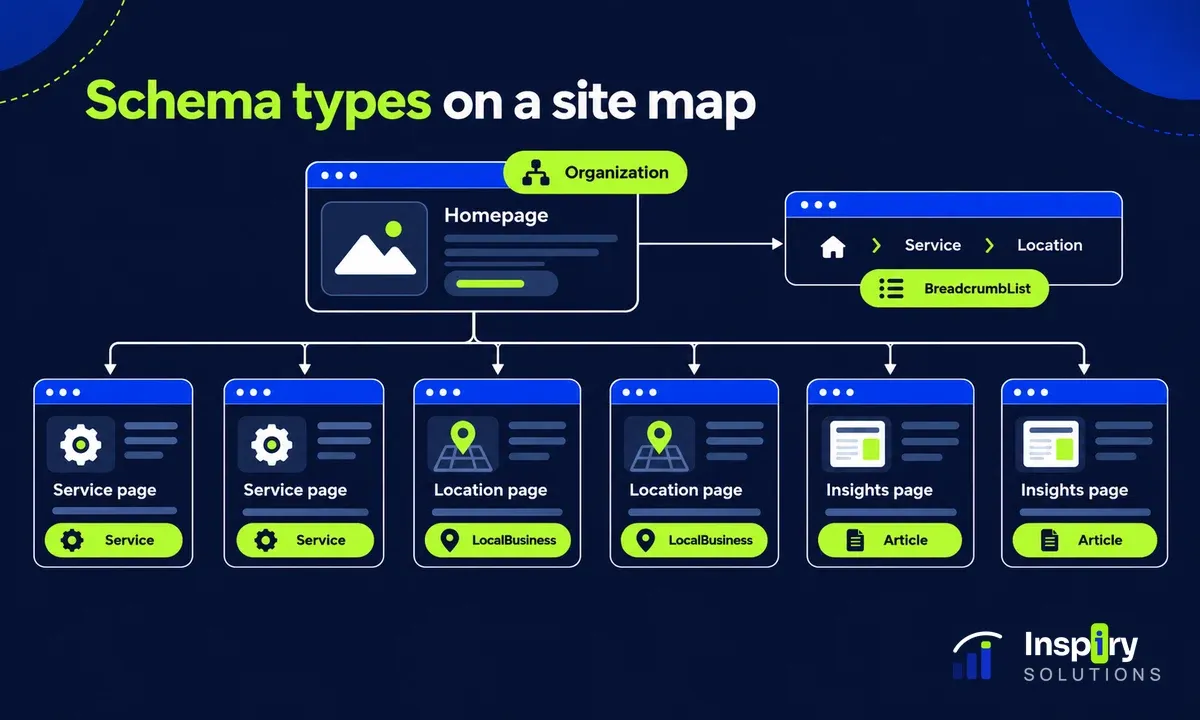
Map schema to your page templates
A maintainable implementation maps schema markup to reusable website templates rather than configuring each URL separately.
For example, a law firm’s practice areas may share one template, while its offices use another.
Each generates relevant structured data from actual page content.
| Page template | Main schema type | Fields populated from content |
|---|---|---|
| Homepage | Organization | Business name, logo, URL, public profiles |
| Service page | Service | Name, description, provider, area served |
| Location page | LocalBusiness or subtype | Genuine location details, telephone, hours |
| Article page | Article | Headline, author, dates, image |
| Contact page | Reference existing Organization or LocalBusiness | Consistent contact details |
BreadcrumbList can accompany templates with meaningful navigation.
The aim is not literally one type per page. Multiple related objects are appropriate when they describe genuine information and reference consistent entities.
Match the location model to reality
A company with three staffed offices needs a different structure from a contractor serving three towns from one base.
When building pages for several locations, distinguish genuine premises from service coverage.
Creating a LocalBusiness entity for every town does not establish additional offices.
Reuse identifiers across templates
A stable @id identifier helps connect references to the same business.
For example, Service objects can reference an existing organisation identifier as their provider.
This avoids treating one company as unrelated entities and reduces duplicated information.
Check for duplicate output
Inspect what your theme and SEO plugin already generate before adding custom markup.
Two Organization objects are not necessarily invalid, but conflicting names, logos or identifiers create ambiguity.
Choose one authoritative source for business information and reuse consistent references.
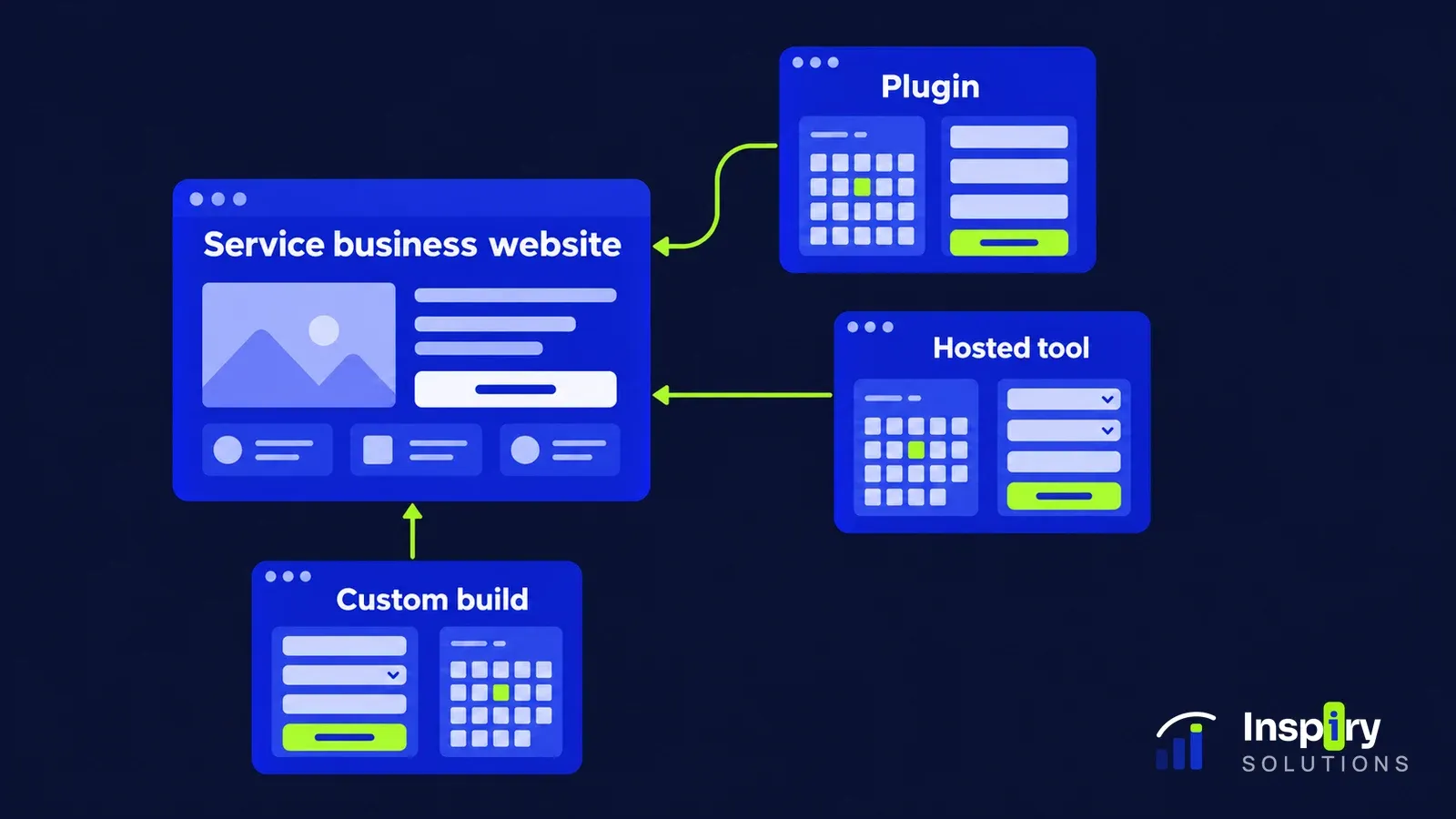
Adding schema on WordPress
For many WordPress websites, an established SEO plugin is the sensible starting point.
Plugins can generate common markup using site settings, post titles, authors and existing content.
A schema markup WordPress plugin is not automatically better because it offers more settings.
When an SEO plugin is enough
An SEO plugin often handles Organization, Article and BreadcrumbList without additional development.
Check the organisation name, logo, profiles and breadcrumb settings.
Inspect a live homepage and article to confirm which objects are generated.
An enabled checkbox does not prove the resulting markup is correct.
When custom JSON-LD is cleaner
JSON-LD is a format for embedding structured information in webpages. Google generally recommends it for implementation.
Custom JSON-LD is useful when service or location templates rely on fields that the SEO plugin cannot map.
For example, a service template might store the offering’s name, coverage and provider in dedicated WordPress fields.
A developer can generate Service markup directly from those values.
Keep custom implementation in a maintained theme component or plugin, with clear responsibility for updates.
Maintain one source of truth
Store business identity consistently and populate service and location properties from their corresponding records.
Document which component controls each schema type.
This makes changes to names, locations or offerings easier to apply accurately.
Test representative templates rather than assuming a successful homepage test validates everything.
Hypothetical example: two Organization blocks and stray review stars
Consider a hypothetical accounting firm’s WordPress website.
Its theme generates an Organization object using an outdated trading name. Its SEO plugin generates another using the current business identity.
A separate plugin inserts AggregateRating data on every service page to represent testimonials.
The markup may be syntactically valid, yet the organisation information conflicts and self-serving reviews are ineligible for Google review stars.
The first task is identifying which component produces each object.
The cleanup keeps one authoritative Organization block with accurate details and a stable identifier.
A suitable LocalBusiness subtype is added to the genuine office page, using correct contact information.
Individual accounting service pages receive Service markup referencing the existing business entity.
Self-serving review markup is removed, while genuine visible testimonials remain.
Finally, the homepage, office page and representative service pages are validated again.
This hypothetical example illustrates clearer relationships and fewer contradictions, not guaranteed ranking improvements.
Test and monitor
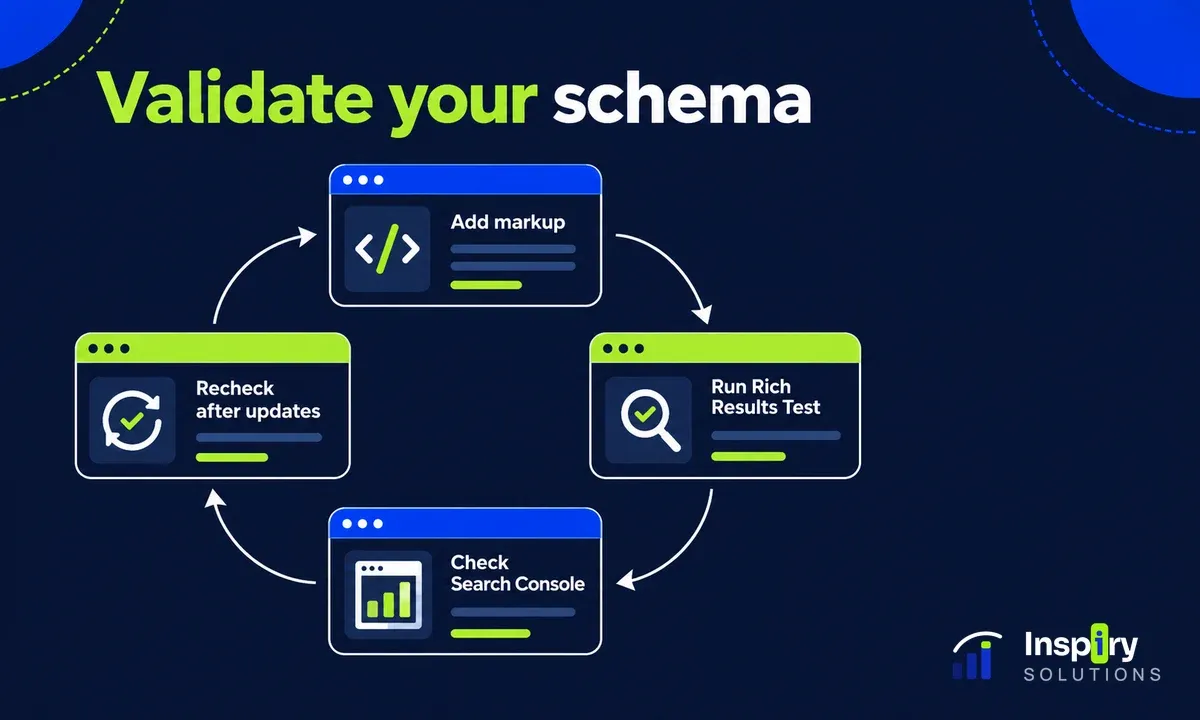
Schema implementation is incomplete until rendered pages have been tested.
Saving WordPress settings does not prove Google can interpret the intended information.
Check Google-supported features
Start with the Google Rich Results Test.
Enter a public URL and inspect detected supported types, errors and warnings.
Errors can prevent eligibility for supported features. Warnings may indicate missing recommended properties.
Do not invent business details simply to eliminate warnings.
Valid Service markup may not appear because Google has no dedicated Service rich result.
Validate the broader schema vocabulary
Use the Schema Markup Validator to inspect general Schema.org markup, including types without Google rich results.
Confirm expected objects exist, values are accurate and entity references are consistent.
General schema validity and Google eligibility are different tests. Passing one does not replace the other.
Monitor Search Console
Review relevant Google Search Console enhancement reports after deployment.
They can reveal problems with supported structured data on discovered or indexed pages.
Not every schema type has an enhancement report. Its absence does not mean markup is missing.
Recheck after changes
Theme updates, plugin updates and custom field changes can affect generated markup.
Retest after significant updates or changes to business details.
Check the homepage, a service page, a genuine location page where applicable and an article.
Common questions
Does schema markup improve rankings?
Google does not treat structured data as a general ranking boost. It helps search engines understand page content and can make pages eligible for supported rich results. Eligibility is not a guarantee that Google will display a feature. Prioritise accurate markup alongside useful content, accessible pages and sound technical SEO rather than expecting an immediate ranking improvement.
Which schema should a small service business add first?
Start with Organization on the homepage. Add LocalBusiness where there is a real address or appropriately defined service area. Configure breadcrumbs and Article markup through your SEO plugin where relevant. Then consider Service for individual offerings. The right order depends on your website’s templates, local presence and existing structured data.
Can I add review stars to my service pages?
Google does not show review rich results for self-serving reviews of your own business on your own site when the reviewed entity is your LocalBusiness or Organization. Adding AggregateRating does not bypass that restriction. Keep authentic testimonials visible where useful, and maintain reviews on your Google Business Profile and appropriate third-party platforms.
Is a schema plugin enough?
For most websites, an SEO plugin covers Organization, Article and breadcrumb markup. Service and location templates often require custom fields or JSON-LD, depending on their structure. Before installing additional plugins, inspect the output from your theme and existing SEO plugin. Duplicate or conflicting business information is more important to correct than adding additional schema types.
Does schema help with AI search tools?
Clear structured data supports a consistent description of your business identity, services and locations. However, no one can promise it will produce AI mentions or citations. If you are exploring getting mentioned in AI search, treat schema as supporting technical information alongside useful content, accessible pages and accurate business details.
Get schema working across the site
Start with the homepage and one representative service page.
Inspect existing output, identify duplicates and confirm business details match what visitors see.
Then extend the approach to genuine location pages, articles and breadcrumbs.
Send your developer this brief:
- List existing schema types across important page templates.
- Identify duplicate, conflicting or irrelevant objects.
- Confirm which component owns each type.
- Map Organization, LocalBusiness, Service, Article and BreadcrumbList to appropriate templates.
- Populate properties from maintained content and accurate business details.
- Validate representative URLs and document retesting after updates.
Ask for development help when plugins generate overlapping markup, custom fields require mapping or location relationships are difficult to represent.
Do not pay for a fixed number of schema types without confirming what your website needs.
We add and validate schema as part of our technical SEO work, mapped to your page templates so it stays correct as content changes. Send your URL for a free audit and we will tell you what your current markup says.