Law firm local SEO works best when each practice area explains the service clearly, each staffed office has a useful location page, and both are connected. A potential client should be able to find the right legal service, understand who provides it, identify the appropriate office and know what happens next. Effective local visibility also depends on accurate Business Profiles, trustworthy lawyer information and compliance with professional advertising rules. The goal is not to create a page for every keyword. It is to build a website that answers genuine client questions.
This guide is for managing partners and marketing leads at UK and US practices, particularly firms with several services or offices. It explains which pages to create, how to connect them and what to check before investing in more content.
How people search for a lawyer locally
Legal searches follow different patterns. Someone may know the service they need, describe a problem without legal terminology or search for a recommended firm.
Understanding these differences helps a law firm organise its website around client needs.
Practice area plus location searches
These combine a legal service with a place:
- Family solicitor in Bristol
- Employment lawyer in Manchester
- Divorce attorney in Austin
- Personal injury lawyer in Chicago
These searches suggest someone is looking for a relevant local provider. A clear practice area page, connected to the appropriate office, helps establish whether the firm can assist.
Problem-led searches
Other people begin with their circumstances:
- My employer has not paid me
- How do I arrange child custody?
- Can I challenge a workplace dismissal?
These queries may suit an explanatory guide linking to the relevant legal service.
Firm name searches
Someone receiving a recommendation may search for the firm’s name, a lawyer or an office address. Accurate contact details, professional biographies and consistent listings help confirm its identity.
Language matters too. UK audiences commonly search for solicitors, while US audiences often use attorneys or lawyers. Solicitor SEO and attorney local SEO should reflect the intended audience and jurisdiction.
Legal services involve serious decisions. Prospective clients may compare qualifications, fees and processes before making contact.
A service page saying only “contact our experienced team” leaves those questions unanswered.
Practice area pages that answer five client questions
A practice area page should help someone decide whether the firm handles their problem and whether a conversation would be worthwhile.
For law firm practice area pages, five client questions provide a practical content checklist.
Google’s guidance on helpful, reliable content encourages clear expertise, useful explanations and content created primarily for people.
What the matter involves
Start with a plain-English explanation of the legal issue. Describe common situations, what the work involves and distinctions clients should understand.
A family law page might distinguish divorce proceedings from financial arrangements and child-related matters. An employment page could explain dismissal, discrimination and contractual disputes.
Avoid statements that mislead readers about their rights. Legal processes depend on jurisdiction and individual circumstances.
Use terminology clients recognise without repeating city names or keywords unnecessarily. Useful explanations matter more than forcing search phrases into paragraphs.
How the process works
Explain the typical stages from initial enquiry to the next decision point.
Depending on the service, this may include a discussion, document review, preliminary advice, negotiations, formal proceedings or completion.
Describe what clients should prepare and which stages depend on other parties.
Where timing varies, explain the influencing factors rather than promising a fixed outcome.
A short process description reduces uncertainty and prepares clients for an informed conversation.
How fees are approached
Clients should understand the firm’s charging approach before enquiring.
Explain whether the service involves fixed fees, hourly billing, staged payments or another permitted arrangement. If costs vary, describe what information is needed before providing a quote.
Mention additional expenses, such as court fees or third-party charges, where appropriate.
Do not imply every matter carries the same cost when complexity affects pricing.
UK and US requirements differ, and some services have additional transparency obligations. Check applicable rules before publishing.
Who will handle it
Name responsible lawyers where appropriate and link to professional biographies.
A useful lawyer profile should identify:
- Full name and professional title
- Relevant qualifications and admissions
- Jurisdictions where the lawyer may practise
- Principal practice areas
- Office affiliation and responsibilities
- A route to contact the team
Be precise about credentials. Avoid claiming someone is a certified or accredited specialist unless accurate and permitted.
Connect each legal service to the professionals responsible for that work. Verifiable information is more useful than unsupported expertise claims.
Who the service suits
Explain which individuals or organisations the service is intended to help.
An employment practice may advise employees, employers or both. A property team might handle residential transactions but not complex commercial work.
State geographic and jurisdictional limits. Having an office in one state does not automatically authorise practice in another.
Finish with an appropriate next step, such as requesting a consultation.
Avoid guarantees of successful claims, settlements or court outcomes. Professional advertising rules may restrict misleading promises.
If your pages need improvement, our local SEO for professional firms service can assess the architecture and identify practical changes.
Office location pages for multi-office firms
A multi-office law firm needs more than a contact page listing addresses.
Each genuine office should have a useful location page explaining where it is, who works there and which services are available.
Include the correct office name, postal address, telephone number, appointment arrangements and directions. Add transport or accessibility information when helpful.
Show the associated team and link to their biographies and practice areas.
Avoid duplicating descriptions between offices. Each page should communicate meaningful differences, such as staffing, consultation options or services offered.
Our guide to office pages without duplicate content explains how to avoid repeated generic copy.
A firm operating in two cities should not automatically create every possible practice-and-city combination.
A dedicated practice area plus city page may be appropriate where a location has a substantial team, distinct services or genuinely useful local information.
Otherwise, connect an informative central practice page to the relevant office pages.
For cities without a physical office, exercise care. Google’s search spam policies identify doorway abuse, including substantially similar pages created primarily to capture searches.
Our guide to office pages versus area pages explains the distinction.
Page type plan
| Page type | Purpose | Must include | Common mistake |
|---|---|---|---|
| Practice area page | Explain a legal service | Scope, process, fees, responsible lawyers | Generic sales copy |
| Office page | Establish a real location | Address, team, services, directions | Repeated city-swapped text |
| Practice area plus city page | Answer a distinct local need | Substantial local information and practitioners | Thin keyword variations |
| Lawyer profile | Establish professional identity | Qualifications, admissions, services, office links | Unsupported expertise claims |
| Guide or FAQ article | Answer a client question | Accurate explanation, jurisdiction, next steps | Repeating the service page |
Not every legal topic needs a new landing page. Give each page a distinct purpose.
Site structure for law firm local SEO
Good site architecture makes relationships between services, offices and lawyers understandable to visitors and search engines.
The structure should reflect how the practice operates rather than how many keywords it targets.
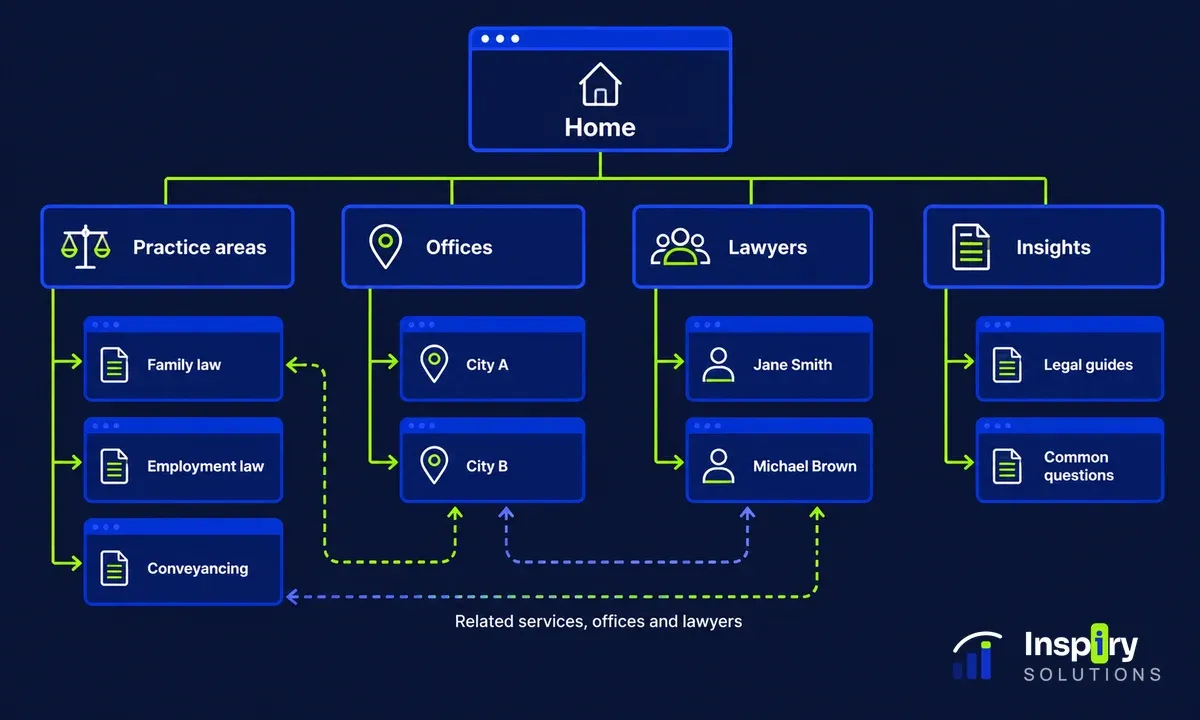
A multi-office law firm might organise content as:
- Home
– Practice areas: Family, Employment, Conveyancing
– Offices: City A, City B
– Lawyers: Professional biographies
– Insights: Legal guides and common questions
Navigation provides access to main sections. Contextual internal links connect related information.
A family law page should link to offices offering that service and the responsible lawyers. Each office page should link to its relevant practice pages.
Lawyer biographies should connect to their services and associated offices.
These relationships are more useful than placing every link in a crowded footer.
Keep URL patterns consistent. Examples include /practice-areas/family-law/, /offices/city-a/ and /lawyers/jane-smith/.
If a dedicated local service page is justified, /offices/city-a/family-law/ is one possible pattern.
The exact structure matters less than consistency and avoiding competing pages.
Breadcrumbs show a page’s position within the website, helping visitors return to broader sections.
Our guide to internal linking for service websites explains how to connect important pages.
Before restructuring, inventory existing URLs. Record each page’s purpose, responsible team and intended relationships.
This identifies duplication and missing links. When changing established URLs, plan appropriate redirects to preserve working pathways.
Business Profiles for each office
A law firm Google Business Profile connects an eligible business location with information shown across Google’s local services.
For multi-office firms, the model is generally a separate profile for each eligible staffed office, linked to its matching location page.
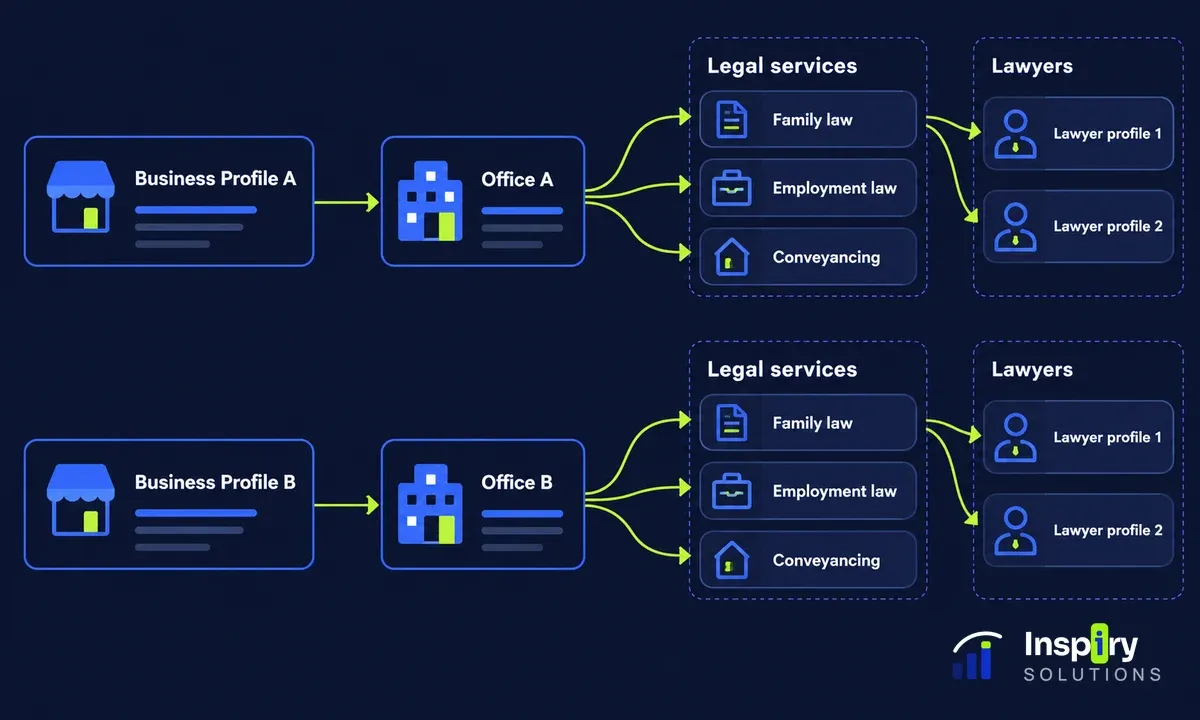
Google’s Business Profile eligibility and practitioner guidelines explain location requirements and when individual professionals may maintain profiles.
An office must satisfy eligibility conditions. An unstaffed virtual office or occasional meeting room should not be represented as a permanent location.
For each eligible office:
- Confirm its real-world business name and address.
- Check the public telephone number and hours.
- Select the most relevant primary category.
- Add justified secondary categories.
- Link directly to the matching office page.
Categories must describe the business accurately. A family law practice should not add unrelated categories simply to target searches.
Someone viewing City A’s profile should reach City A’s office information, with paths to relevant services and lawyers.
Individual practitioner profiles require care. Google’s guidelines permit them in some circumstances, but eligibility, naming and overlap with the firm’s profile should be checked first.
Do not automatically create profiles for every employee.
Review profiles whenever hours, contact details or staffing change. Website and profile information should remain consistent.
Reviews, directories and professional rules
Trust matters in legal marketing, but every trust signal must be accurate and compatible with confidentiality duties.
Client reviews help people evaluate reported experiences. They do not replace professional credentials or guarantee legal outcomes.
A firm may request feedback through a respectful, consistent process where permitted.
An approved follow-up message after a matter concludes could invite feedback without pressuring someone to leave a positive rating.
Do not incentivise favourable reviews or imply that feedback will influence a legal matter.
Confidentiality governs every public reply. A reviewer may disclose sensitive information, but that does not authorise the firm to confirm their identity or discuss their case.
A response can acknowledge feedback without revealing a client relationship or legal details.
Professional body listings and reputable legal directories help people verify a firm’s identity and qualifications.
Check names, addresses, telephone numbers and practitioner details. Correct inaccuracies rather than pursuing low-quality directory listings.
UK solicitors and US attorneys operate under different professional frameworks. Rules concerning testimonials, specialist designations and advertising vary by jurisdiction.
Ask the firm’s compliance lead to review relevant claims before publication.
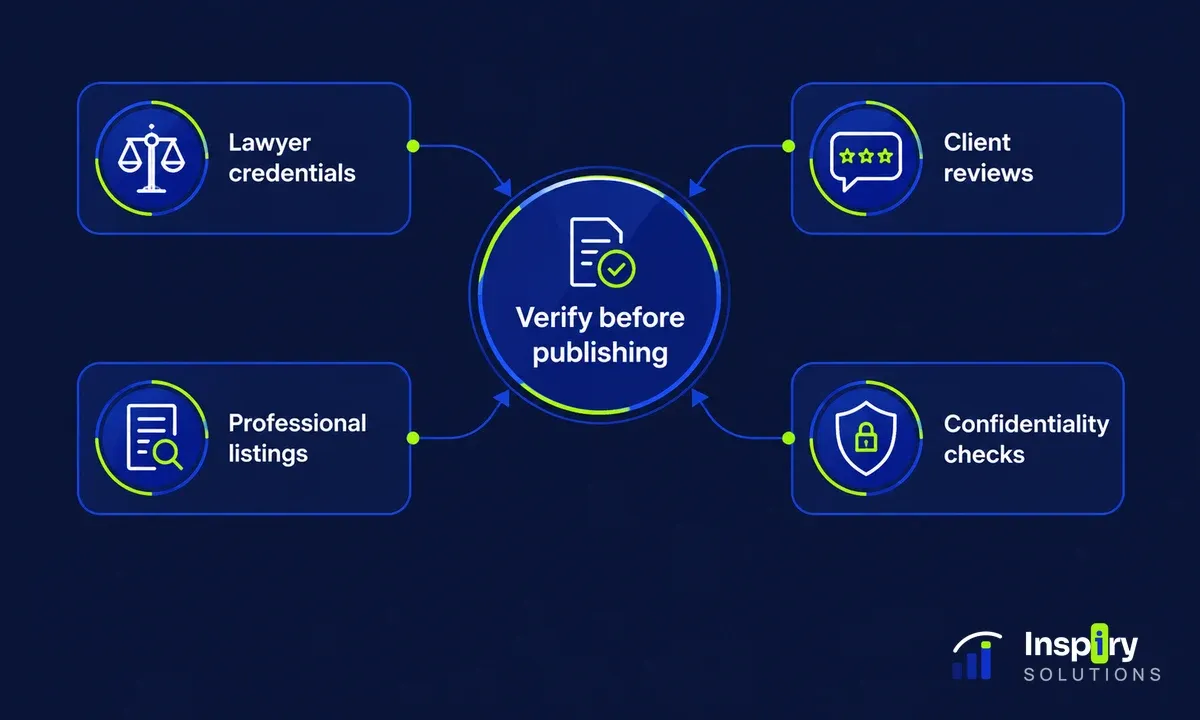
Trust comes from verifiable information and responsible communication, not repeated claims about being the best practice.
Schema and technical basics
Structured data is code describing visible webpage information in a machine-readable format.
For law firms, Schema.org’s LocalBusiness vocabulary provides relevant types, including LegalService and Attorney.
Choose the most accurate type for the business. Each office page should contain its own coherent location-specific business entity block.
Relevant properties include the name, address, telephone number, URL and opening hours.
Lawyer biographies may use Person markup describing accurate names, roles and organisational relationships.
Structured information must match the visible page. Do not add unsupported qualifications or office details in code.
Schema is not a replacement for useful content, nor does it guarantee improved rankings or enhanced search appearances.
Technical local SEO also includes mobile usability and reliable enquiry routes.
Check whether visitors can read practice pages, locate offices, use telephone links and submit forms on mobile devices.
Review oversized images, intrusive popups, inaccessible navigation and missing form confirmations.
Legal enquiries may contain sensitive information. Forms should collect only necessary details and use appropriate privacy and security controls.
A technically sound website makes contacting the practice straightforward without requesting unnecessary confidential information.
Hypothetical example: a two-office family law firm
Hypothetical example: A family law firm with offices in two towns has one generic “Family Law” page and a contact page listing both addresses.
The practice serves clients through both offices, but its website does not clearly connect services, practitioners and locations.
Before restructuring, someone searching for family law in either town reaches the same description and must find local information separately.
The revised architecture keeps one substantial Family Law practice page and creates a location page for each town.
Each office page identifies its address, lawyers, appointment arrangements and services.
Each Business Profile links to its matching office page rather than the homepage.
The central practice page gains clearer sections covering the legal matter, process, fee approach and responsible lawyers.
Lawyer biographies connect to relevant office and service pages.
Before:
- Generic Family Law page
- Contact page listing two addresses
- Limited connections between services and lawyers
After:
- Detailed Family Law practice page
- Town A office page
- Town B office page
- Connected lawyer biographies
- Separate Business Profile destinations
The firm does not immediately create divorce, custody and financial settlement pages for both towns.
It first checks whether each topic deserves a distinct explanation and sufficient original content exists.
This is an illustrative architecture, not a claim about search results. Effectiveness should be assessed through usability, search visibility, enquiries and office information accuracy.
Common questions
Should a law firm have a separate page for each city?
Yes, each genuine staffed office should normally have its own useful location page. However, a firm does not need a page for every city it serves. City pages without an office need genuinely local content, relevant services and a distinct purpose. Otherwise, they risk becoming thin doorway pages created primarily for search visibility.
Can individual lawyers have their own Google Business Profile?
Google’s guidelines allow individual practitioner profiles in some circumstances, including eligible lawyers. They are not automatically appropriate for everyone working at a firm. Check the current guidelines before creating them, particularly when practitioners share an office or the firm’s main profile already represents the location. Avoid duplicate or misleading business identities.
Can law firms use client reviews on their website?
Generally yes, subject to the firm’s professional conduct rules and any applicable consent or advertising requirements. Reviews must not be misleading or imply guaranteed outcomes. Never reveal confidential details in reviews or replies, even if a reviewer has disclosed information publicly. Have the firm’s compliance lead review how testimonials are requested, selected and displayed.
What schema type should a law firm use?
Use a specific LocalBusiness subtype such as LegalService or Attorney, depending on which best describes the business. For a multi-office firm, use one coherent location-specific business entity block per office page. Lawyer biographies can also use Person markup. Keep structured information consistent with visible content and do not expect schema alone to improve rankings.
How much does law firm local SEO cost with Inspiry?
Local SEO is scoped to your website, so there is no single published price for every law firm. Work may involve practice area content, office architecture, Business Profiles, internal links and technical fixes. Start with the free audit by sending your website URL. You will receive a plain-language reply within two working days.
Where a law firm should start
Start by identifying gaps in existing pages rather than commissioning numerous city landing pages.
Review important practice area pages against the five client questions. Record missing process details, unclear fees, absent lawyer links and incomplete service descriptions.
Next, inspect each staffed office.
Check whether it has a useful location page, correct services and practitioners, and a Business Profile with an appropriate category and destination.
Then map internal links connecting services, offices and lawyer biographies.
Prioritise inaccurate information and broken enquiry routes before expanding content.
Use Search Console and available enquiry records to establish a baseline. Review relevant queries, page visibility and whether enquiries reach the intended office.
Architecture improvements can make information clearer and easier to discover, but they cannot guarantee rankings or enquiries.
If your practice area pages are not reaching clients in each office’s area, our local SEO service can restructure them, scoped to your website. Send your URL for a free audit and get a plain-language reply within two working days.