To respond to negative Google reviews, acknowledge the complaint, take responsibility where fair, explain what you will do and offer a direct way to resolve it. Keep your response short, calm and factual. You are not trying to win an argument. You are showing the next customer how your business handles problems. If the review breaks Google’s content policies, you can report it, but most genuine negative reviews will remain visible.
A one or two star review can feel personal.
Who your reply is really for
Your reply is not only for the unhappy reviewer. It is also for prospective customers deciding whether to trust your business.
Someone comparing local electricians, roofers, clinics or professional services may read negative reviews to understand how businesses handle problems. A calm response can reassure them. An aggressive response can reinforce the complaint, even when your business has a reasonable explanation.
Your response should demonstrate three qualities:
- Professionalism: You handle criticism without attacking customers.
- Accountability: You recognise problems within your control.
- Reliability: You offer a practical way to resolve complaints.
Wait until you are calm, but aim to reply within a few days. Check relevant appointment records, correspondence and staff notes before writing. Separate confirmed facts from assumptions.
Google’s guidance on managing customer reviews explains that business replies are public and reviewers receive notifications when responses are posted.
If managing reviews reveals wider visibility problems, local SEO support for your profile can help assess how your website and business information work together.
How to respond to negative Google reviews in four steps
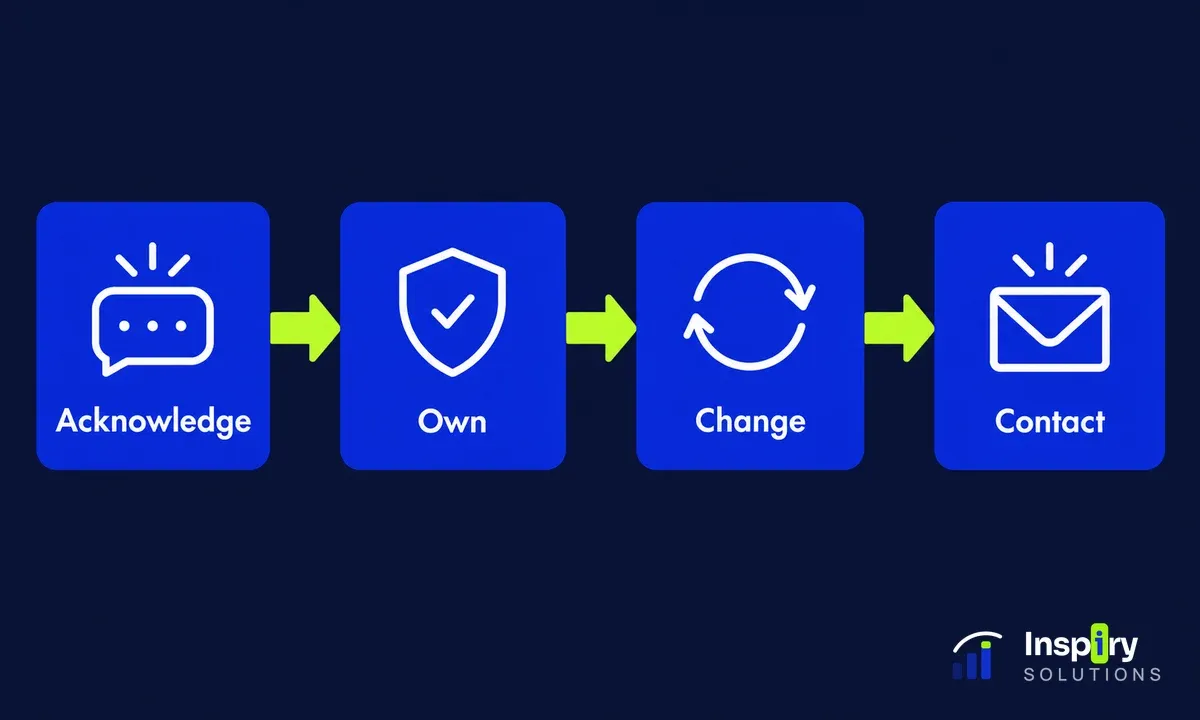
A useful response follows four steps: acknowledge the experience, accept responsibility where appropriate, explain your next action and offer direct contact.
This structure works for missed appointments, pricing disagreements, quality concerns and communication problems. It helps you write consistently without sounding automated.
Before drafting, establish which claims you can verify. You do not have to agree with every accusation to recognise that someone is unhappy.
Acknowledge without arguing
Start by recognising the customer’s disappointment. Acknowledgement does not mean accepting every allegation.
For example:
“Thank you for your feedback. We’re sorry your appointment did not meet your expectations.”
Avoid opening with “That is not what happened” or “You misunderstood our process.” Even accurate corrections can sound defensive.
If the review mentions several problems, acknowledge its main concern instead of repeating every accusation.
Use natural language, not formal corporate phrases. The opening should reassure future readers that your business listens before responding.
Own what is yours
Accept responsibility for confirmed mistakes, including delays, poor communication or unclear expectations.
For example:
“We should have explained the additional work before proceeding, and we apologise for the confusion.”
Specific accountability is more meaningful than a generic apology.
However, do not admit to something you have not investigated. If facts remain disputed, explain that you want to review the situation.
“We’d like to look into your appointment details so we can understand your concerns.”
Acknowledge the experience while accepting responsibility only for what you can reasonably confirm.
Say what you have done or will do
Explain one relevant action you have completed or genuinely intend to take.
“We’ve reviewed our appointment confirmation process to make arrival windows clearer.”
If the investigation is ongoing, say so:
“We’re reviewing the booking details and will discuss the next steps directly with you.”
Avoid claiming that staff have been retrained or procedures changed when that has not happened.
Offer a direct contact
Finish by providing a private way to continue the conversation.
“Please contact [team] at [business email] so we can discuss your appointment.”
Use a monitored inbox or working telephone number. Direct the customer to someone authorised to investigate.
Do not use “contact us privately” as a substitute for acknowledging the public complaint. Your response should already demonstrate that the concern matters.
Example replies for common complaints
The following negative review response examples are editable templates, not real customer experiences.
Replace bracketed details, verify every factual statement and remove commitments you cannot fulfil. Each reply should be specific enough to address the concern without disclosing private information.
Late arrival or missed appointment
A missed appointment wastes the customer’s time and may disrupt their work or other commitments.
Reply template:
“Thank you for your feedback. We’re sorry your appointment did not go as planned. We understand how frustrating delays can be. We’re reviewing what happened with our scheduling team and would appreciate the opportunity to discuss this directly. Please contact [team] at [contact details].”
Mention a scheduling review only if one is actually happening.
If the cause is confirmed, explain it briefly without blaming traffic, other customers or individual employees.
A useful follow-up might involve reviewing booking reminders or clarifying arrival windows. Never announce such changes before deciding to implement them.
Price higher than expected
Unexpected charges often reveal a gap between what customers understood and what the business believed it had explained.
Reply template:
“Thank you for raising your concerns about the final price. We’re sorry the cost was not as clear as you expected. We’d like to review the quotation and any additional work with you to understand where the confusion occurred. Please contact [team] at [contact details].”
Do not publish invoice amounts, payment information or private contractual details.
If your quotation was accurate, you can briefly explain your general pricing process without accusing the customer of failing to read it.
Check whether your website explains estimates, additional work and circumstances that could change the final cost. Clear expectations may prevent similar complaints.
Work quality issue already fixed
When corrective work has been completed, acknowledge the original inconvenience without pretending the customer was never affected.
Reply template:
“Thank you for your feedback. We’re sorry the initial work did not meet expectations. We appreciate the opportunity to return and address the issue, and we’re reviewing how we check completed work. If you have any remaining concerns, please contact [team] at [contact details].”
Use this template only when the work has genuinely been corrected.
A customer may remain dissatisfied even after a repair, so avoid declaring the dispute closed.
If you have changed inspection procedures, describe that improvement briefly. Otherwise, concentrate on the work completed and the contact available for remaining concerns.
Rude staff complaint
Complaints about employee behaviour require care because the full conversation may not be known.
Reply template:
“Thank you for bringing this to our attention. We’re sorry you felt uncomfortable during your interaction with our team. Respectful communication matters to us, and we’d like to understand what happened. Please contact [manager or team] at [contact details] so we can review your concerns appropriately.”
Do not name, blame or publicly criticise the employee.
Investigate privately by speaking with relevant staff and reviewing available records.
If the complaint is justified, address it through your normal management process. Avoid making public disciplinary promises or assuming the customer’s description establishes every fact.
Reviewer you cannot identify as a customer
An unfamiliar reviewer name does not prove the review is fake. Someone may have booked through another person or used a different account name.
Reply template:
“Thank you for your feedback. We’ve checked the information available to us but haven’t been able to identify the experience described. We’d welcome the opportunity to understand your concerns. Please contact [team] at [contact details] with information that will help us locate the relevant booking.”
Do not accuse the reviewer of lying or demand personal information publicly.
Check whether the complaint matches another booking, location or employee interaction.
If credible evidence suggests a policy violation, report the review through Google’s process while maintaining a neutral public response.
Choosing the right approach
Match your response to the complaint rather than automatically apologising or disputing every detail.
| Complaint | First line of reply | What to offer | Report it? |
|---|---|---|---|
| Late or missed appointment | “We’re sorry your appointment was disrupted.” | Scheduling review and direct contact | No, unless policy is breached |
| Price surprise | “We’re sorry the cost was unexpected.” | Private quotation review | No, if genuine |
| Quality issue | “We’re sorry the work fell short.” | Corrective work review | No, if genuine |
| Staff attitude | “Thank you for raising this.” | Manager contact | No, if genuine |
| Not a customer | “We cannot identify this experience.” | Private verification | If evidence supports a violation |
| Offensive or spam content | “We take feedback seriously.” | Contact if appropriate | Yes, if policy is breached |
Read your draft as a prospective customer. Does it show accountability or merely defend your reputation?
What never to put in a reply
The biggest mistake when handling negative reviews is turning criticism into a public argument.
Avoid these behaviours:
- Revealing personal information: Never publish appointment records, addresses, payment details, medical information or legal matters. This is especially important for clinics and law firms.
- Arguing over facts: Correct significant misunderstandings briefly, but investigate detailed disputes privately.
- Copying identical replies: Generic apologies make it difficult for customers to see whether you investigated their concerns.
- Promising unauthorised refunds: Never commit to compensation, replacements or additional services without approval.
- Pressuring reviewers: Do not demand that someone removes or changes a rating in exchange for resolving their complaint.
Google prohibits incentives offered in exchange for review changes or removal.
Also avoid sarcasm, threats, accusations and public criticism of employees.
When a review breaks Google’s rules
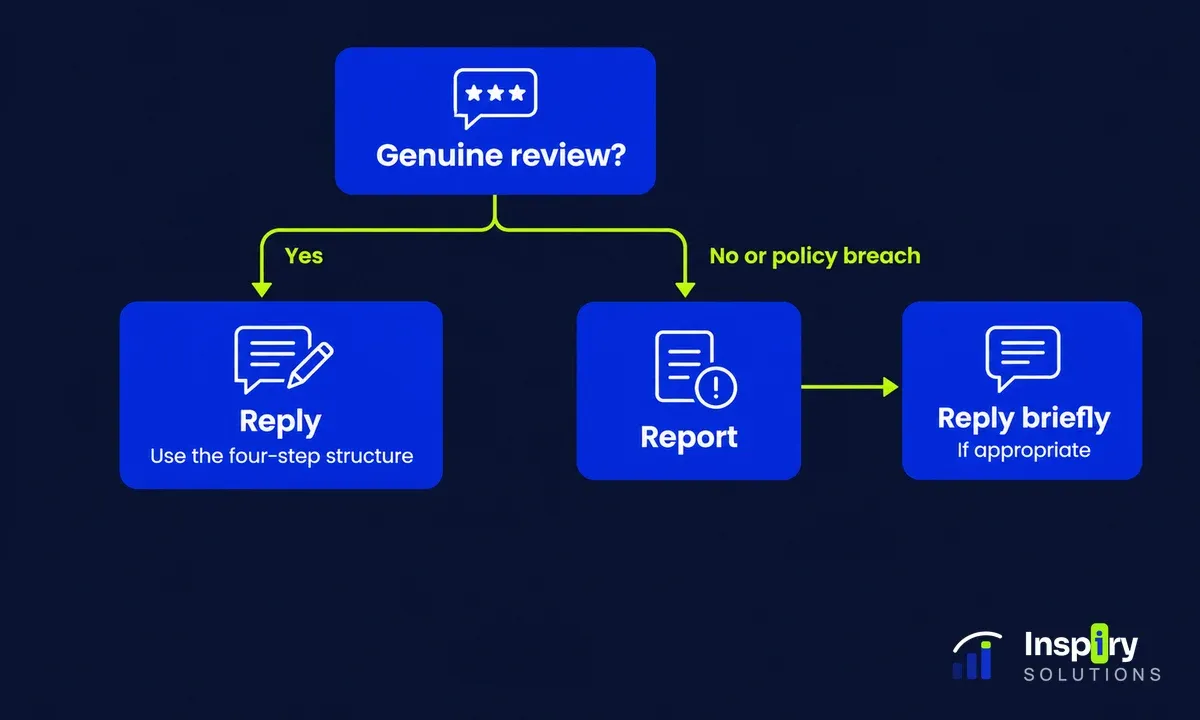
You can report a review when there is a credible reason to believe it violates Google’s content policies. Simply disagreeing with criticism is not enough.
Google’s prohibited and restricted content policy covers issues including:
- Spam or fake engagement: Content not reflecting genuine experiences.
- Conflicts of interest: Reviews influenced by employment, competition or other prohibited relationships.
- Off-topic material: Content unrelated to the business experience.
- Offensive content: Harassment, threats or other prohibited language.
These categories do not guarantee removal. Google assesses reported content against its policies.
How to report a Google review
Use the reporting option in your Business Profile or Google Maps:
- Find the relevant review.
- Select the available reporting option.
- Choose the most accurate policy violation.
- Submit the report and check its status.
- Use an available appeal option if Google rejects a legitimate report.
Keep supporting records privately. Do not repeatedly report genuine criticism without a policy-based reason.
What happens after you report it?
Reporting does not immediately remove a review. Google must assess whether the content violates its rules.
The review may remain visible throughout that process. Google may also decide that no policy violation occurred, leaving the review published.
This is the central limitation when researching how to remove a fake google review: believing that a statement is inaccurate is not necessarily enough. You need a policy-based reason supported by the available evidence.
What to do while the review remains visible
If you can respond safely and appropriately, consider publishing a short, neutral reply while Google assesses your report.
For someone you cannot identify, explain that you cannot locate the described experience and invite private contact.
For obvious spam or abusive material, avoid repeating allegations or engaging with provocations. Reporting without responding may be preferable.
If the complaint comes from a genuine customer, use the four-step structure instead of waiting for possible removal.
Using negative reviews to fix the cause
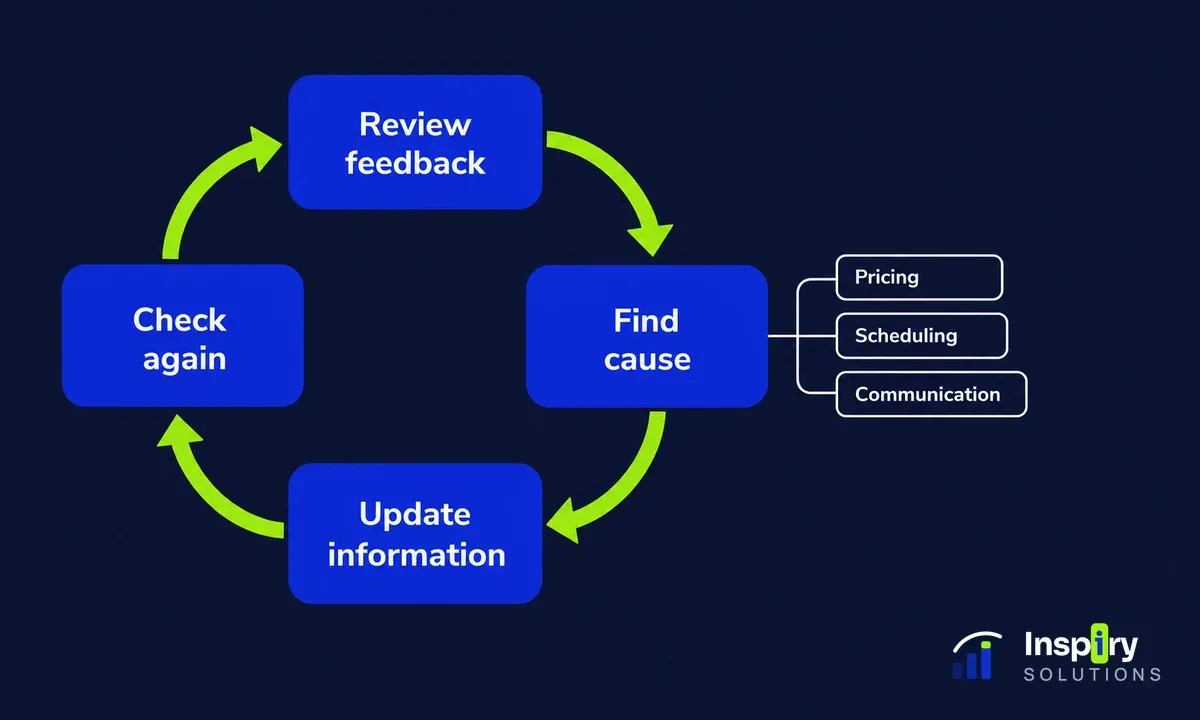
A good reply addresses the public complaint. A useful internal process investigates why the problem happened.
Record complaints in a simple log with the date, location, category, contact status and action taken.
Group feedback into themes such as scheduling, pricing, communication, work quality and staff behaviour.
Check whether similar complaints recur rather than treating every review as a separate incident.
Do not automatically assume that every allegation reflects an operational failure. Compare feedback with the evidence available.
Assign responsibility for genuine problems and check whether corrective action has been completed.
Check whether your website created the wrong expectation
Sometimes customers complain because the website promised something different from what the business delivered.
Review the page they likely visited before booking.
Are prices, additional charges, appointment windows and service areas explained clearly? Does the website suggest immediate availability when advance booking is required?
Compare published claims with actual procedures. Correct inaccurate wording and ensure staff communicate the same expectations.
Check that updated information appears clearly on mobile, not only on desktop.
Keep your local information consistent
Review opening hours, contact details, service descriptions and business categories across your website and Google Business Profile.
Use keeping the rest of your profile accurate to identify outdated information that could create misunderstandings.
If your business has several locations, check each one separately. An accurate main listing does not guarantee correct information elsewhere.
Customer feedback may also resurface in AI-generated answers and business summaries. Consider checking what AI tools say about you to identify inaccuracies or missing context, without assuming you can control those answers.
Verify that the change helped
After correcting a problem, check whether customers continue reporting the same concern.
Ask staff handling bookings, calls or enquiries whether the revised information has reduced confusion.
Inspect the published website to confirm the correction appears on relevant pages and devices.
If complaints persist, investigate further rather than repeatedly changing superficial wording.
Keep records of unresolved issues and assign an owner to each meaningful change.
Common questions
Can I get a negative Google review removed?
Only if it breaks Google’s content policy, such as spam, a conflict of interest or prohibited offensive content. You can report it, but a genuine unhappy customer’s review usually stays, even when you believe it is unfair. A good reply is your main tool for explaining your approach and reassuring prospective customers without escalating the disagreement.
Should I reply to a review I think is fake?
Report it first if you have credible evidence of a policy violation. A short, neutral reply saying you cannot find a record of the experience and inviting private contact is reasonable. Do not publicly accuse the reviewer of lying, reveal customer records or assume that an unfamiliar name proves the review is fabricated.
How quickly should I respond to a bad review?
Within a few days is a sensible target for most businesses. Take enough time to establish the facts, speak with relevant staff and calm down before writing. A respectful, accurate response is more valuable than an immediate defensive reaction. If the investigation takes longer, acknowledge the concern without claiming that unfinished checks are complete.
Can I offer a refund in exchange for removing a review?
No. Asking someone to remove or change a review in return for a refund, discount or other benefit conflicts with Google’s policy on incentives. You can offer an appropriate remedy when the complaint justifies it, but resolve the problem on its merits. Let the customer decide independently whether to keep, edit or remove their review.
Can a reviewer edit their review after I reply?
Yes. Reviewers can update or delete their own Google reviews, including after receiving a business response. Your reply does not prevent those changes. However, do not pressure customers to improve their rating or make changes a condition of resolving their complaint. Focus on addressing the issue, communicating respectfully and maintaining accurate public information.
Reply to the review sitting in your profile today
Open the review and draft your response using four steps: acknowledge, own, change and contact.
After posting, establish a weekly review check. Combine this with building a steady flow of reviews from genuine customers, without incentives or selective requests for positive feedback.
If reviews reveal wider problems with your local visibility, our local SEO service can help, scoped to your website.
Start with a free audit. Send your website URL and receive a plain-language reply within two working days.