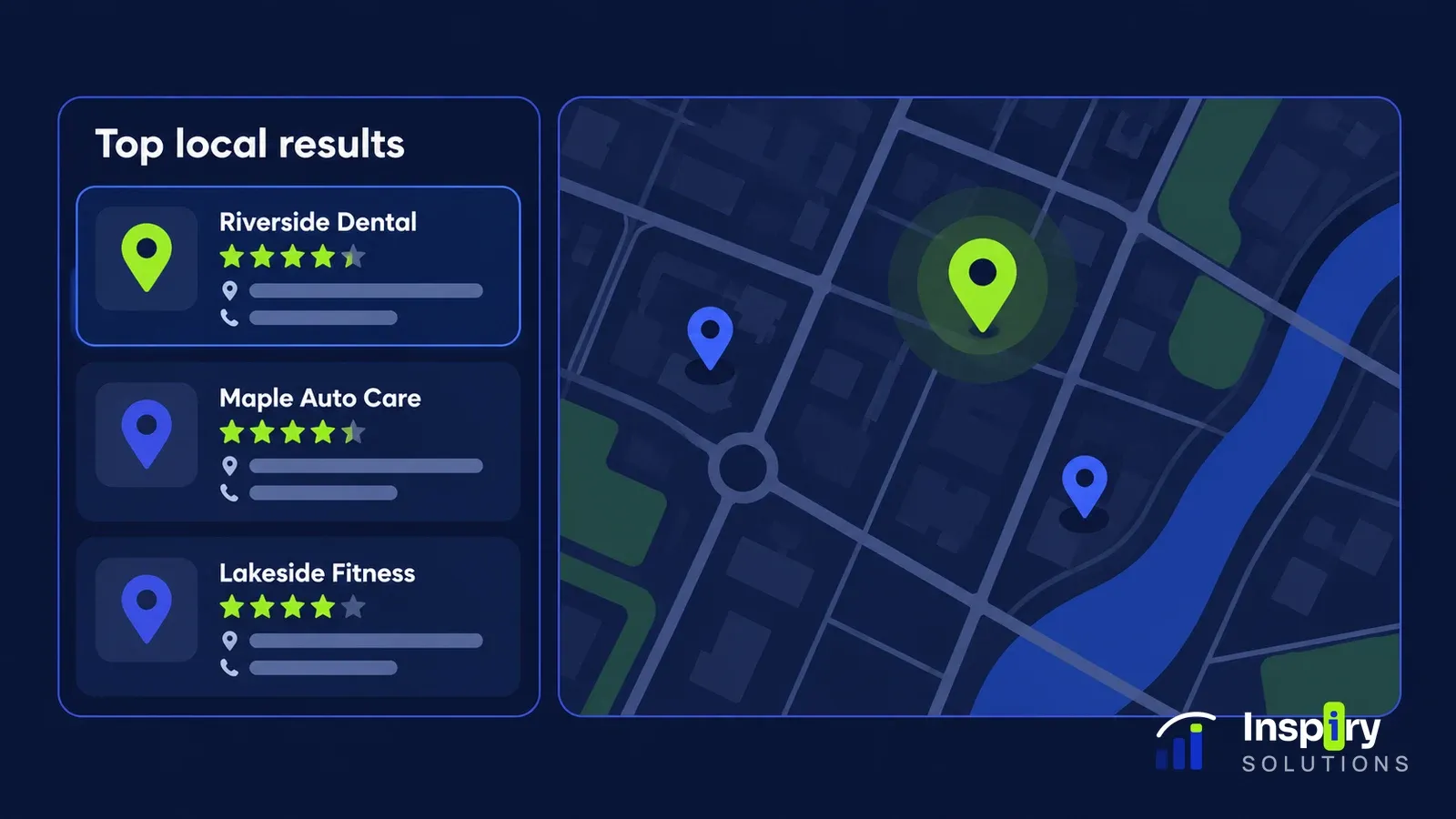
AI search for local business can recommend nearby services by drawing on business listings, website content, reviews and other publicly available sources. Different assistants use different methods and may return different businesses for the same question. To improve your chances of being accurately represented, keep your business details consistent, explain your services and locations clearly, and check what assistants actually say. There is no guaranteed position in an AI answer, but there are practical ways to find and correct missing or outdated information.
This guide is for tradespeople, clinics, professional firms and other service businesses. It explains which local signals matter, how to check your information across platforms and how to run a repeatable monthly test without treating AI recommendations as a fixed ranking.
How AI search for local business works
When someone asks an AI assistant to recommend a nearby electrician, solicitor or dental practice, the answer may involve several types of information. These include web search results, business listings, service pages, customer reviews and independent local articles.
How those sources are retrieved, selected and presented differs between providers and products. Some answers include links to supporting pages. Others give recommendations without showing enough evidence to identify where individual facts originated.
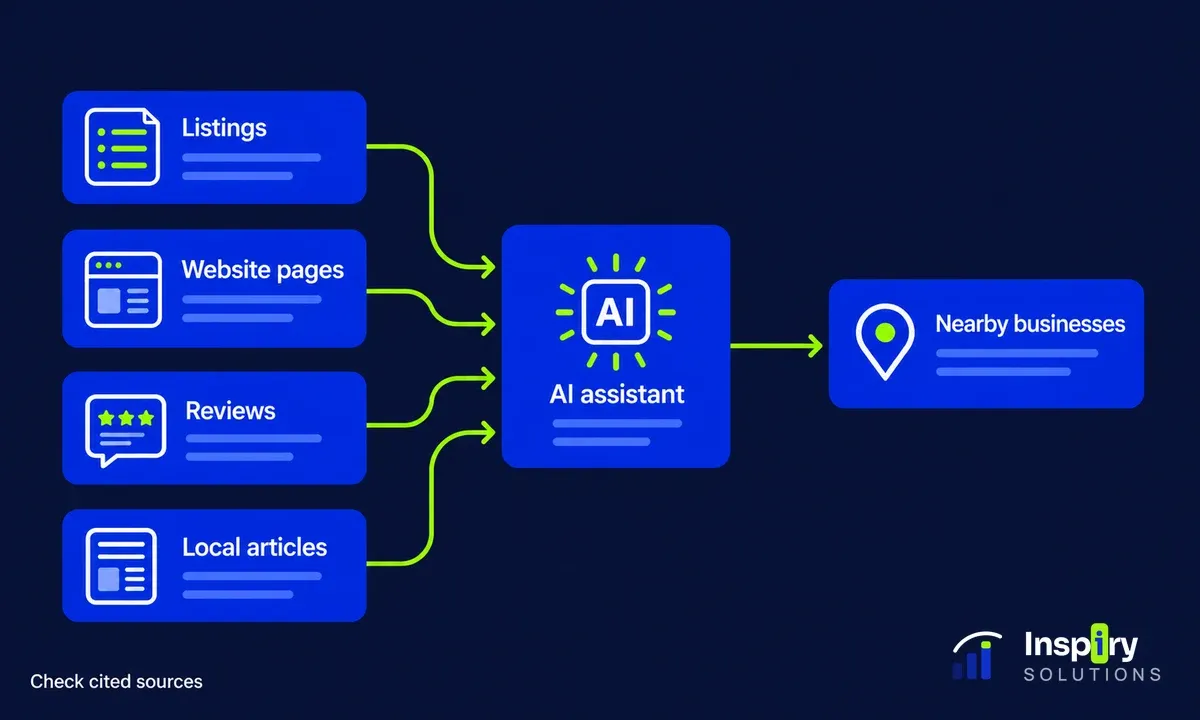
A recommendation might mention that a roofer handles emergency work. That statement could come from the company’s website, an old directory entry or another published page. It does not necessarily mean the assistant has independently checked the roofer’s availability.
For Google’s products, the official documentation on AI features in Search explains how website content can appear in AI-powered search experiences. It does not provide a universal formula for local recommendations across every assistant.
Answers can change for several reasons:
- Location: A person searching from central Bristol may receive different suggestions from someone outside the city.
- Question wording: “Emergency roofer” and “roof replacement company” describe different needs.
- Available sources: An assistant may find a directory, company page or local article that another assistant does not display.
- Timing: Websites, business details and the information available to search systems can change.
- Context: Previous conversation details or personalisation may influence an answer.
A useful test therefore records the question, location, date, named businesses and supporting sources. It does not assume that appearing first in one answer means holding a permanent position.
The local signals you control
Google documents three main factors used to determine local search rankings: relevance, distance and prominence. Its current guidance also describes prominence in terms of how well-known a business is.
According to Google’s local ranking guidance, the factors work broadly as follows:
| Factor | What it means | What you can influence |
|---|---|---|
| Relevance | How closely a business matches the search | Accurate categories, services and detailed business information |
| Distance | How far the business is from the search location | Accurate address or eligible service-area details |
| Prominence | How well-known the business is | Genuine reviews, reputation and useful references from other websites |
Relevance and prominence provide more practical areas for improvement.
For example, a plumbing company might have an accurate primary category but no clear explanation of boiler repairs, leak detection or emergency call-outs. Customers looking for those services may struggle to confirm whether the company is suitable.
For a broader explanation of conventional local results, read what influences the Map Pack. The Map Pack is Google’s group of map-based business results.
There are four useful controls for local SEO AI assistants:
- Accurate and complete business listings.
- Website pages explaining services and coverage.
- Authentic customer feedback and trustworthy mentions.
- Consistent information across all public sources.
For businesses wanting a structured review of how they appear across AI tools, our AI visibility service examines observable answers and the public sources behind them.
Make your listings accurate everywhere
Business listings are an obvious place to investigate when an assistant gives the wrong telephone number, opening hours or service location.
Your business name should reflect the actual organisation, not a different keyword-heavy version on each platform. Categories should describe the same core activity, although the available category labels may vary.
Use the correct public address where one is appropriate. A service-area business that operates from a private home should follow each platform’s rules about displaying or hiding that address.
Google’s guidelines for representing your business specifically require accurate real-world names and business details. Adding search phrases to a company name simply to attract enquiries can breach those rules.
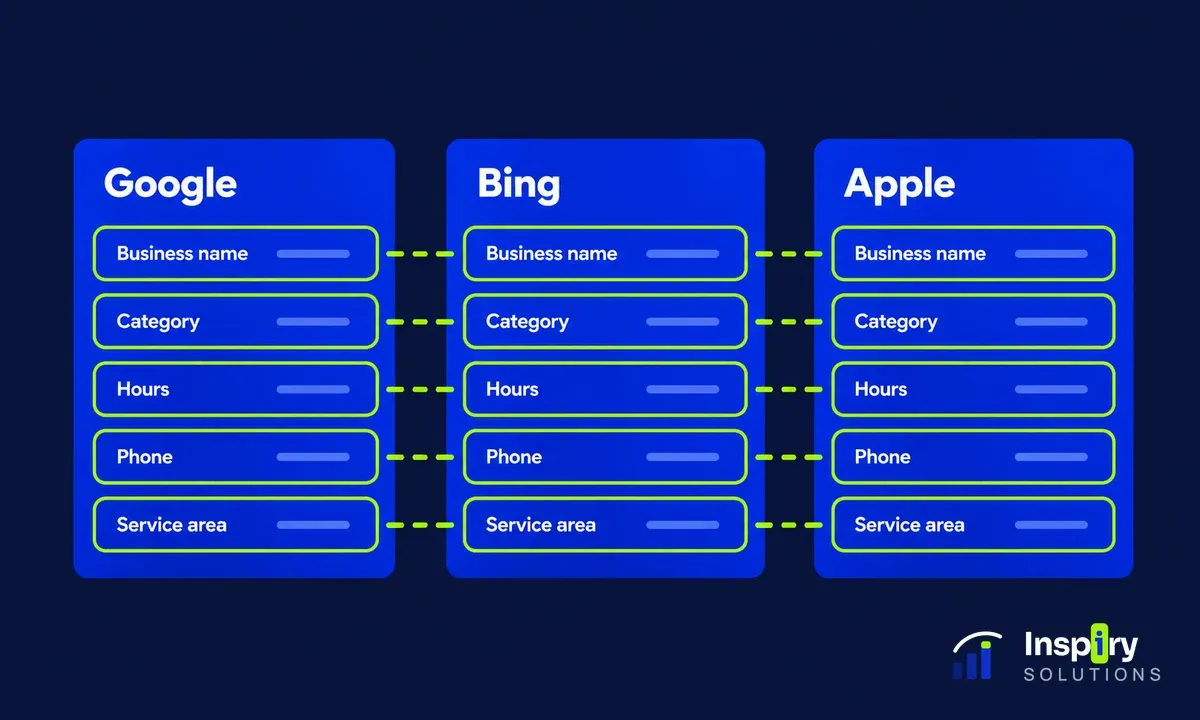
Review the three platforms at least quarterly and immediately after meaningful changes. If several profiles need correcting, local SEO help can be scoped to your website and the problems identified.
Google Business Profile
Check that your profile is verified, eligible and accurately describes the business.
Pay particular attention to holiday hours and temporary closures. An emergency contractor advertising normal office hours on its profile but different hours on its website creates uncertainty.
Use a Google profile optimisation checklist to review the details systematically.
Bing Places
Microsoft provides Bing Places for managing business information associated with Bing.
Check whether your business has an existing listing before creating another. Review the displayed name, category, address or service area, telephone number and website destination.
Bing Places deserves attention even when Google supplies most of your direct enquiries. The purpose is to prevent incorrect information remaining available elsewhere on the web.
Apple Business Connect
Apple’s business listing tools are available through Apple Business Connect, now reached through Apple’s business management platform.
Local listing accuracy checklist
Use this table for regular maintenance. The frequencies are practical recommendations, not requirements imposed by the platforms.
| Area | What to check | Where | How often |
|---|---|---|---|
| Business name and category | Real business name, appropriate core category | Google, Bing, Apple | Quarterly and after changes |
| Hours and holidays | Normal opening times, special hours, closures | Listings and website | Before holidays and when changed |
| Services list | Services actually offered and current availability | Business profiles and service pages | Quarterly |
| Service area | Towns genuinely covered and correct location details | Listings and website | Quarterly and after changes |
| Website link | Correct destination, working pages and contact options | All business profiles | Quarterly |
| Review responses | Unanswered feedback and inaccurate public information | Review platforms | Weekly |
| Service pages | Current services, areas, prices or price factors | Website | Quarterly |
| Monthly AI answer test | Named businesses, cited sources and incorrect details | Two or three AI assistants | Monthly |
Keep one internal record of your approved business details. This becomes the reference when updating platforms, directories or website pages.
Service and location pages that answer local questions
An electrician might have separate pages for consumer unit replacement, electrical inspections and emergency fault finding. Each page should explain the work instead of repeating a generic list of keywords.
Include information customers need before contacting you:
- The problem or service covered.
- The type of properties or customers served.
- The areas where the service is genuinely available.
- Prices, starting prices or factors affecting a quotation.
- Normal appointment availability or realistic response-time expectations.
- What happens after an enquiry.
- Qualifications or restrictions where applicable and verifiable.
Avoid promising a fixed emergency response time unless your business can consistently support it.
Our guide to choosing area or location pages explains how those approaches differ.
For a more detailed approach, see location pages without duplication.
Answer the questions people actually ask
Look at your call enquiries, contact forms and customer conversations.
A local business may regularly hear questions such as:
- Do you cover my postcode?
- Can someone visit this weekend?
- Is an initial consultation charged?
- What information should I prepare?
- Do you handle commercial properties?
- How soon can I expect a quotation?
Put the answers on the relevant page, using plain headings and direct explanations.
Make important details easy to find
Use meaningful page titles, readable headings and ordinary text.
Reviews and third-party pages
Reviews help potential customers judge a company’s reliability and service. Google also identifies reviews and ratings among the signals relevant to local prominence.
Do not assume that increasing your review count automatically produces more recommendations.
Ask customers for genuine feedback through methods permitted by the relevant platform. Do not purchase reviews, offer prohibited incentives or selectively request public feedback only from people expected to leave positive comments.
Review gating, where unhappy customers are diverted away from public review opportunities, is not a sound long-term approach.
When replying to feedback, add useful context without revealing private customer information.
For instance, a roofing company can explain its general inspection process or how customers can arrange follow-up work. A dental practice should avoid confirming confidential patient treatment details in public.
Responses should address the actual concern, not repeat promotional phrases.
Third-party listings deserve similar attention.
Prioritise sources that contain material errors or appear in your AI tests. Correcting those sources is more practical than submitting your business to every directory available.
Hypothetical example
A roofer in Bristol asks three AI assistants for “emergency roof repair near Bristol”.
Two answers cite a local directory that lists the firm’s old telephone number.
The roofer checks the directory and requests a correction. They also update Bing Places and Apple Business Connect, then add an emergency roof repair page explaining genuine service coverage and response times.
The business repeats the same questions monthly and records whether the incorrect number continues to appear.
This is a hypothetical example, not a client result or evidence that those updates guarantee a recommendation.
The useful outcome is a documented correction process: identify the inaccurate source, fix what is controllable and retest.
A monthly local AI check
It should be treated as an observation exercise, not an official ranking report.
Use the same core questions, location assumptions and recording format each month. Compare changes without assuming that every difference reflects improved or reduced visibility.
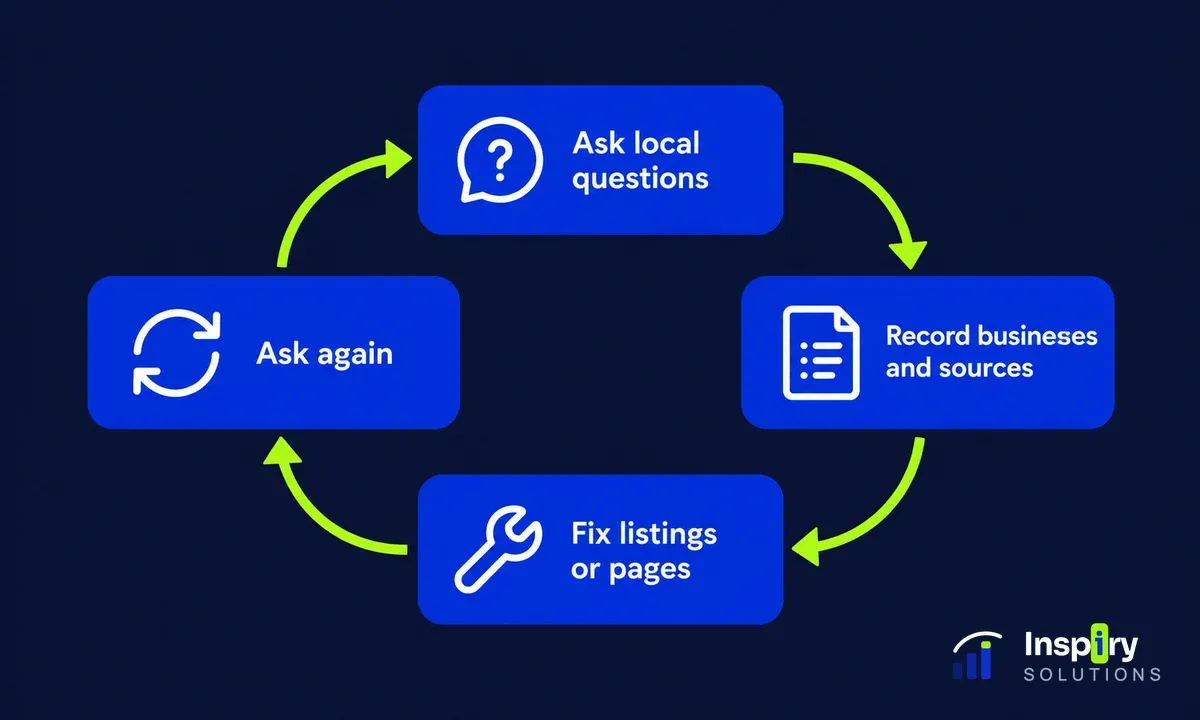
The routine has three checks.
Write the questions
Create eight to ten questions based on genuine customer enquiries.
For a roofing company, examples might include “Who repairs leaking roofs in Bristol?”, “Emergency roof repair near Bristol” and “Which local companies handle flat roof replacement?”
Include different service types and meaningful nearby locations.
Run the questions through two or three assistants. Where supported, specify the location clearly and record any relevant location setting.
Record answers and sources
Create a simple spreadsheet containing the date, assistant, exact question, location and businesses named.
Flag inaccurate claims, missing services, incorrect contact details and unsupported assertions.
Repeat the process monthly to build a record rather than relying on memory.
Act on inaccuracies
Choose problems you can verify and correct.
If an assistant cites an outdated directory, request a correction. If it misunderstands your service coverage, check the corresponding business profiles and website pages.
If an important service page is missing or unclear, improve it using accurate information.
Do not rewrite your entire website because one answer excluded your business.
Look for recurring errors across questions, dates and sources before assigning substantial work.
This distinction matters when investigating how to get recommended by AI near me searches. The measurable task is improving the accuracy of available information and observing subsequent answers, not purchasing a particular position.
What you cannot control
There are limits to every AI visibility strategy.
You cannot control the searcher’s physical location, all forms of personalisation or which sources a provider decides to retrieve.
You cannot force an assistant to include your company, link to your website or reproduce an updated directory entry immediately.
Model and product changes may also affect answers without any corresponding change to your business.
For Google AI Overviews local results, Google’s published guidance offers useful information about website participation in AI features. It does not promise that a particular local business will appear for a specific question.
The same caution applies to other providers.
A consultant claiming guaranteed ChatGPT recommendations should be asked to demonstrate the exact official mechanism behind that promise. A collection of favourable screenshots is not proof of a repeatable ranking method.
Focus instead on three measurable responsibilities: maintaining accurate public facts, giving customers useful website information and documenting what assistants actually say.
Keep evidence of errors and corrections so you can distinguish completed work from changes in an answer.
Treat each answer as a sample from one moment, one location and one question wording, not as a fixed ranking. Several dated tests over a few months give a fairer picture than reacting to a single response.
Success should not be defined solely by whether one assistant named you this month. Correct contact information, appropriate service descriptions and a working enquiry journey matter independently of AI visibility.
Common questions
How does ChatGPT decide which local businesses to recommend?
OpenAI does not publish a local business ranking formula in the sources used for this guide. ChatGPT may provide recommendations with supporting links, depending on the product and how the question is answered. Check the cited sources in answers to see what the assistant relied on. Do not assume recommendations use a single directory, map provider or fixed ranking system.
Does my Google Business Profile affect AI answers?
Google documents that Business Profile information affects local search results through factors including relevance, distance and prominence. That does not establish how every other assistant selects businesses. Other assistants may use different sources or methods, so keep your Google profile, Bing and Apple listings and website details accurate. Check individual AI answers before drawing conclusions about their sources.
Do I need Bing Places and Apple Business Connect?
Both are free business listing platforms run by Microsoft and Apple, although some related business services may have separate requirements. Keeping them accurate removes one potential source of wrong information. You should not assume that maintaining either profile guarantees inclusion in an AI recommendation. Treat them as part of ordinary business information maintenance alongside Google and your website.
Can I get recommended in a town where I have no address?
Service-area businesses can show genuine service areas on eligible business profiles, subject to platform rules. You do not necessarily need a customer-facing address in every town you serve. However, distance and relevance still apply and cannot be faked. Clearly explain your actual coverage, avoid false addresses and do not create misleading location pages or profiles.
How often should I check what AI says about my business?
Monthly is practical for most local firms. Record the date, exact question wording and location each time, together with the named businesses and any cited sources. Run additional checks after major changes to your address, services or business name. More frequent testing is useful only when the findings lead to meaningful actions rather than constant speculation about individual answers.
Start with listings, then pages
Start with the information customers and online services can already find.
First, review Google Business Profile, Bing Places and Apple Business Connect. Correct inaccurate names, categories, hours, contact details and service areas.
Then review genuine customer feedback and important third-party references. Correct misleading details where possible.
Finally, run the monthly AI check and maintain a record of answers and sources.
This gives you a manageable process for AI search for local business without assuming that an assistant’s recommendations can be directly controlled.
Want to know what AI assistants say about your business in your area? Send your URL for a free audit. Our AI visibility service runs the local checks and fixes the sources behind the answers. Email hello@inspirysolutions.com to get started. We will send a plain-language reply within two working days.