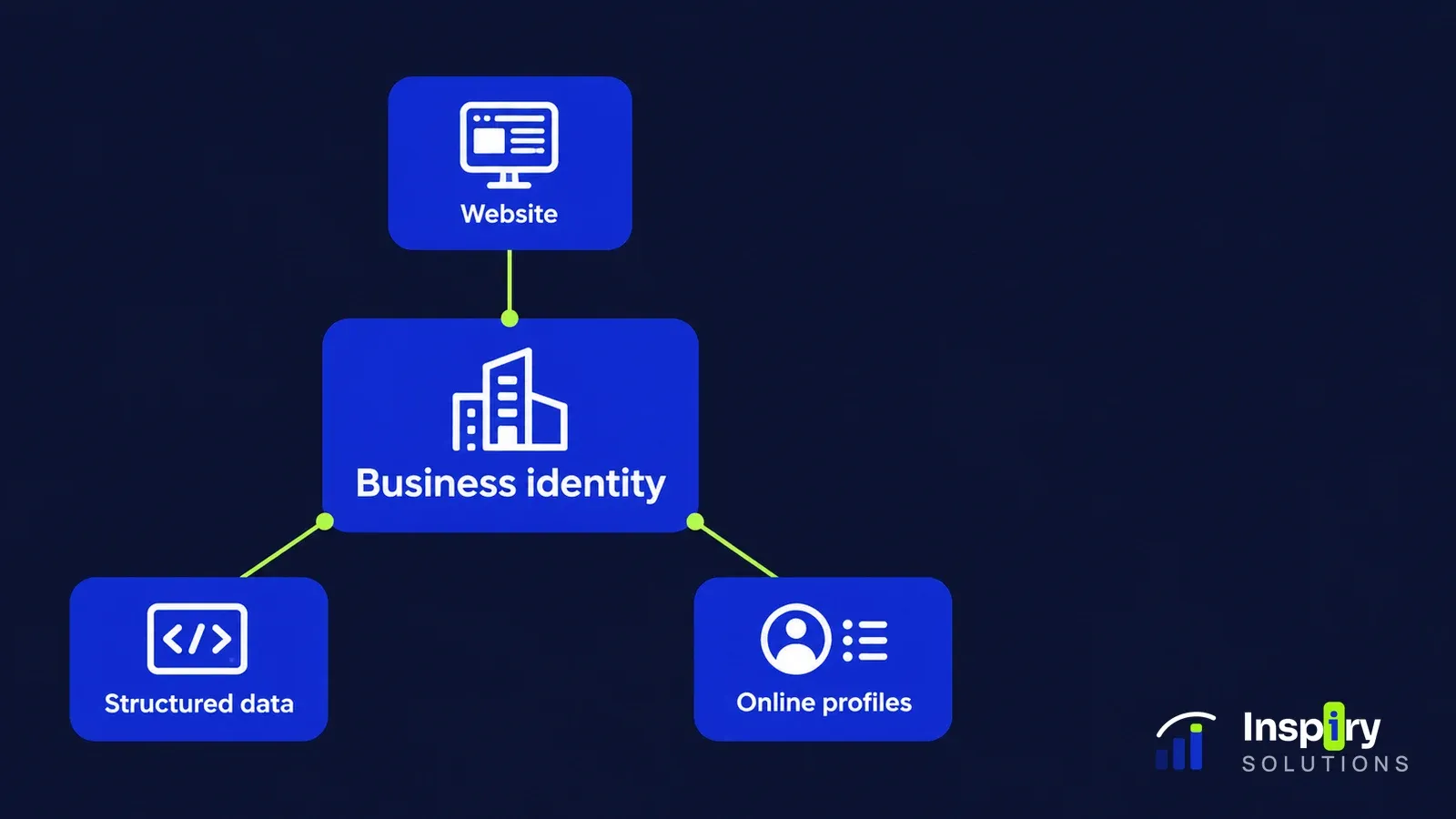
Brand mentions SEO is about where and how your business is named online, while backlinks are clickable links from other websites to yours. Google documents how links help it discover pages and assess relevance, but there is no equivalent published formula showing how much an unlinked mention influences rankings or AI recommendations. Both can create useful exposure. The sensible approach is to keep earning relevant links, examine which outside sources AI assistants actually cite, and invest in coverage that helps potential customers understand and trust your business.
Brand mentions SEO: how mentions and backlinks differ
A backlink is a clickable link on another website that leads to a page on yours.
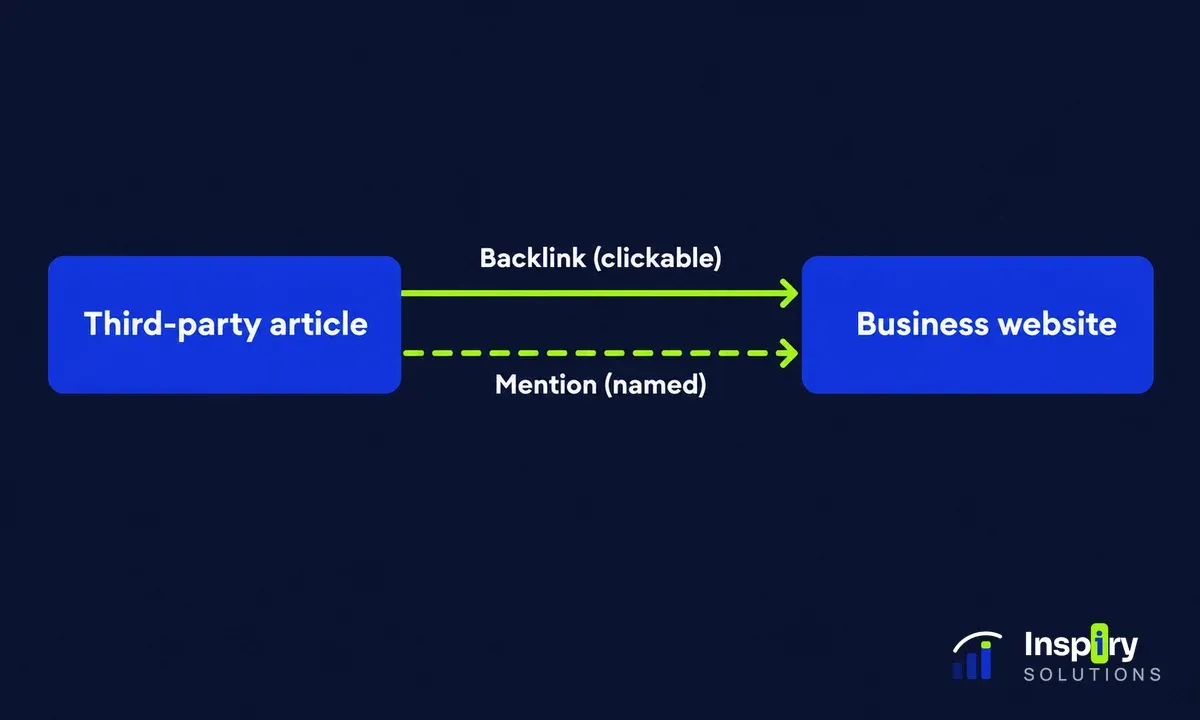
There are several practical differences.
- A backlink gives readers a direct route to your website.
- An unlinked mention requires readers to find you through another route.
- A link gives Google a documented signal for discovering pages and understanding relevance.
- A mention provides information about your business, but its independent ranking value is not quantified by the sources in this guide.
- Either can appear in a page that an AI assistant uses when preparing an answer.
What Google documents about links
Google provides clear guidance on the role of links in web search.
Its link best practices documentation explains that links help Google discover pages and serve as a signal when assessing relevance.
Why editorial context matters
Consider a roofing company linked from an article about roof maintenance in its service area.
Readers interested in maintaining or replacing a roof have a reason to follow that link, and the surrounding content explains why the company is relevant. A link from an unrelated page of commercial links offers far less. This is an editorial judgement, not a claim about how Google weights either link.
Paid links and link spam
Google’s spam policies identify links created primarily to manipulate rankings as link spam. Examples include buying or selling links for ranking purposes and excessive link exchanges.
That does not mean every paid placement is prohibited. Advertising and sponsorship can be legitimate, but Google’s link guidance asks for paid links to be marked with rel="sponsored" (or rel="nofollow"), and for user-generated links, such as forum posts, to use rel="ugc" (or rel="nofollow"). If you are buying placement chiefly to pass ranking signals rather than to reach a relevant audience, reconsider the spend.
What is known and unknown about mentions
The interest in brand mentions AI search comes from a reasonable observation: AI assistants can produce answers that name businesses and reference third-party sources.
What you can observe
You can record which businesses an assistant names for a particular customer question, open any cited pages and check whether they contain those businesses. A citation shows a visible source reference. It is not proof that the source alone determined the recommendation.
What remains uncertain
No source cited in this article quantifies how much unlinked brand mentions affect Google rankings or an AI assistant’s choice of businesses.
Treat claims such as “ten mentions equal one backlink” as unsupported unless the person making them provides evidence. Different assistants use different retrieval methods, and answers vary with wording, location and other factors.
Why descriptive context matters
Suppose an industry article identifies a business as specialising in commercial roofing inspections in a particular region.
That description tells a reader more than a bare company name in a long list.
The same principle applies to brand mentions.
Whether an AI system assigns additional weight to that context in a particular answer remains uncertain.
If you want help with AI visibility, start by inspecting the questions and sources in your market rather than purchasing a generic package of mentions.
Which kind of mention is worth having
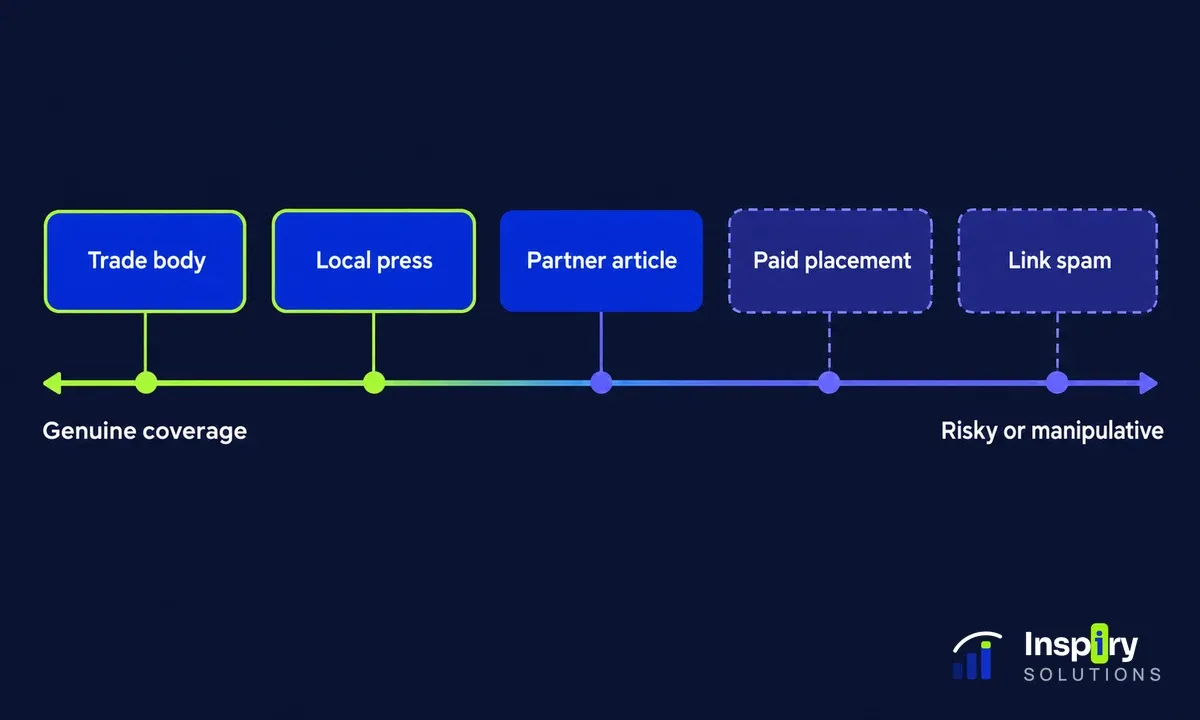
The most useful mentions usually come from sources that have an independent reason to discuss your business.
Think about where a prospective customer would look before making an enquiry.
Potential opportunities include:
- Trade bodies that maintain relevant member profiles.
- Local publications reporting genuine business news.
- Partners describing completed collaborations.
- Customer review platforms with authentic feedback.
- Specialist directories with meaningful editorial standards.
- Industry articles that include expert contributions.
- Awards or events with relevant participation criteria.
None guarantees improved rankings or AI recommendations.
For those placements, supporting your claims with evidence is more useful than repeatedly publishing unsupported promotional statements.
Compare the signals before buying
The table separates documented Google guidance from questions that remain unanswered.
| Signal | What it is | What is documented (with source) | What is uncertain | Risk if done badly |
|---|---|---|---|---|
| Editorial backlink | A naturally placed clickable link in relevant content | Google uses links for discovery and relevance. See Google’s link guidance. | Its exact contribution to a particular ranking | Irrelevant placements and manipulative outreach |
| Paid or exchanged link | A link arranged through payment or an exchange | Google’s spam policies restrict manipulative link practices. Paid links require qualification. | Whether a compliant placement produces useful traffic | Link spam, wasted spending and potential search consequences |
| Unlinked editorial mention | A business named in independent coverage without a clickable link | The cited sources provide no numerical ranking value for such mentions. | Their independent influence on rankings or AI answers | Paying for exposure that nobody relevant reads |
| Review platform mention | A business named in a customer review or profile | The cited sources do not quantify its AI ranking value. | Whether a specific review influences an answer | Fake reviews, inaccurate claims and damaged trust |
| Forum mention | A company discussed in a community conversation | Google documents link attributes for user-generated links. | How an unlinked discussion affects recommendations | Astroturfing, undisclosed promotion and moderation penalties |
| Directory listing | A company profile in a business or industry directory | Google’s link and spam guidance applies to links placed there. | Whether a particular directory influences AI selection | Duplicate, inaccurate or low-quality listings |
An editorial link can be valuable without being a ranking miracle.
The important question is whether a placement contributes accurate information, reaches relevant people and has a legitimate reason to exist.
Local and industry relevance
For a local service business, an accurate profile on a relevant industry site may be more useful than an unrelated article published solely to acquire a link.
Likewise, a regional publication covering a genuine project gives potential customers a reason to investigate the company.
Keep names, contact details and business descriptions aligned with your own website.
Our guide to directory listings and NAP explains why name, address and phone consistency matters when maintaining business profiles.
Avoid manufacturing authority
Mass-produced articles, undisclosed sponsored endorsements and directories created primarily to sell links are poor foundations for a visibility strategy.
Google recommends creating helpful, reliable, people-first content, rather than material designed primarily to influence search rankings.
Apply that principle to coverage you seek elsewhere.
If an article would have no reason to exist without the SEO payment, question its purpose.
If a publication has an interested readership and can present accurate, useful information about your business, the opportunity deserves consideration.
Find the mentions AI tools already rely on
Before changing your spending, conduct three checks.
Keep a simple spreadsheet with questions, assistants, dates, named businesses, cited pages and observations.
For a deeper process, see our guide to inspecting the sources behind AI answers.
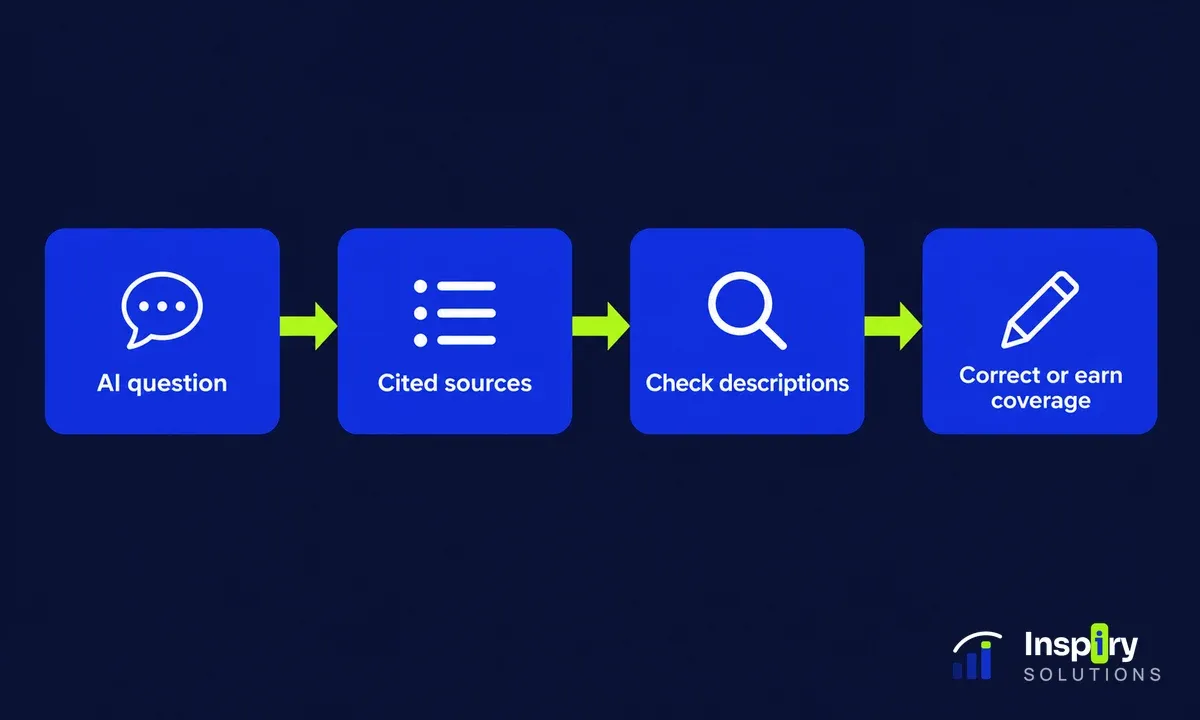
Run the questions
Start with questions a potential customer might actually ask.
For an architecture practice, these might include:
- Which architecture practices design sustainable offices in my area?
- How can I find an architect experienced in commercial refurbishment?
- Which local architecture firms have relevant industry recognition?
- What should I check before choosing a commercial architect?
Use questions that match your services and target market rather than repeatedly asking an assistant to recommend your own brand.
Run the same questions in the assistants you want to evaluate.
Record the date, exact question, assistant and any relevant settings you can control.
Note which businesses appear, where they appear and whether the answer includes visible citations.
A single test is a snapshot, not a reliable trend.
List the sources
Open the third-party pages cited in each answer.
Record the publication name, page URL, type of source and the businesses it discusses.
Look for patterns.
That makes the awards publication worth investigating, but it does not prove that entering those awards will secure future citations.
Separate directly cited pages from businesses merely named in the answer.
Also check whether a source is independently edited, genuinely useful and relevant to the question.
Do not assume that being listed on every cited website is either possible or desirable.
Prioritise opportunities that have a credible editorial reason to include your company.
Check the description
Read how each relevant source describes your company or its competitors.
Look for service specialisms, geographic coverage, project types, business identity and contact information.
Where your business is already mentioned, identify outdated or incorrect details.
Correct your own About page and business profiles first, then request factual corrections from third-party publishers where appropriate.
Our explanation of consistent business facts everywhere provides a useful starting point for this work.
Where competitors are mentioned but your company is absent, ask whether there is a legitimate way to qualify for inclusion.
Do not request insertion simply because an AI assistant cited the page.
Repeat the audit with the same questions, assistants and relevant settings.
Hypothetical example: An architecture practice spends much of its marketing budget on guest-post links.
During an AI answer audit, it finds assistants naming firms featured by a regional design awards publication and a trade body directory instead.
The practice reviews those sources and discovers that its trade body profile is incomplete. It also identifies an awards programme relevant to its work.
Rather than buying another batch of generic links, it updates the profile, enters the awards where eligible and keeps a smaller budget for links from publications likely to send genuine visitors.
The awards entry may not result in recognition. Updated profiles may not produce AI citations.
The improvement is in the decision process: spending follows relevant opportunities observed in the market instead of a promise about unverified mention signals.
Earning mentions without breaking rules
The best starting point for how to get brand mentions is to identify information that another organisation would have a genuine reason to publish.
That does not require manufacturing a news story or paying for a mention on every available website.
It requires something useful to contribute.
Create material worth referencing
An original guide answering a difficult customer question can provide a useful reference for a journalist, trade organisation or industry writer.
Other potential contributions include:
- Practical explanations based on your professional expertise.
- Original data your business is entitled to publish.
- Commentary on relevant technical or industry questions.
- Educational resources that answer recurring customer concerns.
- Participation in relevant local events or professional discussions.
- Genuine collaborations that partners may wish to describe.
Original data should be accurate, contextualised and transparent about how it was collected.
Do not invent survey findings or present personal opinions as industry-wide conclusions.
Your aim is to make a publisher’s work easier by contributing information that serves its readers.
Ask for useful links, not forced links
When a publisher mentions your business, a link to your relevant service or information page may help readers.
It is reasonable to ask whether a link would improve the article.
However, an editorial publisher may decide that a link is unnecessary.
Do not treat every unlinked mention as a failed opportunity.
For both brand mentions and backlinks, reader benefit should guide the decision.
Disclose commercial relationships
If a placement involves sponsorship, payment or another material commercial arrangement, ensure that the relationship is disclosed appropriately.
Any associated paid links should follow Google’s guidance on sponsored link attributes.
Avoid presenting a commercial placement as an independent recommendation.
This matters for trust as well as search compliance.
Maintain your own information
Before seeking new coverage, check the business information you control.
Your About page should explain what the company does, whom it serves and what distinguishes its actual experience.
Service pages should describe services accurately.
If third parties are expected to describe your business correctly, give them a dependable source of information.
Review that information whenever your services, location or professional affiliations change.
Splitting your budget
The choice between link building and brand mentions should begin with an assessment of your existing visibility.
Neither deserves an automatic percentage of the budget.
A new website with few relevant referring websites may need more attention to useful content, internal links and genuine external backlinks.
An established company with reasonable website coverage but inaccurate industry profiles may benefit more from fixing those profiles and pursuing relevant mentions.
The decision depends on the gaps you can demonstrate.
When backlinks deserve attention
Link-related work makes sense when important pages are difficult to discover, the site has little relevant editorial coverage or useful publications could refer interested readers to your services.
Before paying an agency, ask it to explain the intended publications, editorial standards and expected reader benefit.
Avoid buying links based solely on promised domain metrics or ranking improvements.
Those promises do not establish commercial value.
When mentions deserve attention
Prioritise mentions and profiles when your business is absent from credible industry sources, information about your company is inconsistent or customer-facing publications regularly discuss competitors but not you.
That does not necessarily require paid placements.
Accurate membership records, editorial contributions and relevant partnerships may be more sensible first steps.
For context, read what stays the same in SEO.
Follow a practical spending order
Start with your own website and profiles.
Next, pursue appropriate editorial coverage through useful expertise, genuine participation and relevant publications.
Finally, invest in additional backlinks where a link improves the reader’s experience and the placement complies with search guidelines.
Review the evidence before repeating the expenditure.
A placement that generates qualified enquiries has observable business value even if its ranking effect cannot be isolated.
A placement that produces no visits, no useful exposure and no relevant relationships needs a stronger justification.
Do not move the entire budget into linkless mentions simply because AI search is receiving attention.
That would replace one poorly tested assumption with another.
Common questions
Do unlinked brand mentions help SEO?
Unlinked brand mentions can put your business in front of readers and appear on pages that AI tools may retrieve. However, no source cited here quantifies their independent effect on rankings. Treat them as opportunities for relevant exposure, not guaranteed ranking signals. Evaluate the publication, the accuracy of the information and any observable referral or enquiry activity.
Should I stop building backlinks?
No. Google documents that links help it discover pages and assess relevance. Relevant editorial links can also send potential customers directly to your website. Avoid paid or manipulative links intended to influence rankings, which breach Google’s spam policies when they constitute link spam. Keep pursuing links that provide genuine reader value rather than buying links simply to increase totals.
How do I find where my brand is mentioned?
Search your business name, including common variations, and inspect relevant review platforms, industry directories and publications. Run AI answer tests using realistic customer questions, then record which pages are named or cited. Keep the URLs, dates and descriptions in one tracking sheet so you can identify inaccuracies, useful coverage and changes during future reviews.
Are paid mentions allowed?
Paid coverage can be legitimate when commercial relationships are properly disclosed and applicable rules are followed. Under Google’s guidance, paid links must be qualified with an appropriate rel attribute, usually sponsored or nofollow. Undisclosed paid placements create trust and compliance risks, particularly when they appear to be independent recommendations. Paying for coverage does not guarantee search visibility or AI citations.
Measure what changed
Once you have improved profiles, pursued relevant coverage and reviewed your links, measure outcomes rather than counting placements alone.
Begin with three areas.
Referral visits: Check whether relevant publications and directory listings send visitors to your website.
Brand search impressions: Use Google Search Console to examine impressions for searches containing your business name and relevant variations.
Recorded AI answers: Repeat your original customer questions and compare the named businesses, citations and source descriptions.
Add a simple note for every meaningful change to your website, profiles or editorial coverage.
This provides a timeline for investigation without claiming that one action directly caused an AI response to change.
Review the combined evidence.
Do not promise that more brand mentions will produce higher rankings or more recommendations.
If you are unsure whether to spend on links or on the sources AI tools actually cite, send your URL for a free audit. Our AI visibility service maps those sources for your market first.