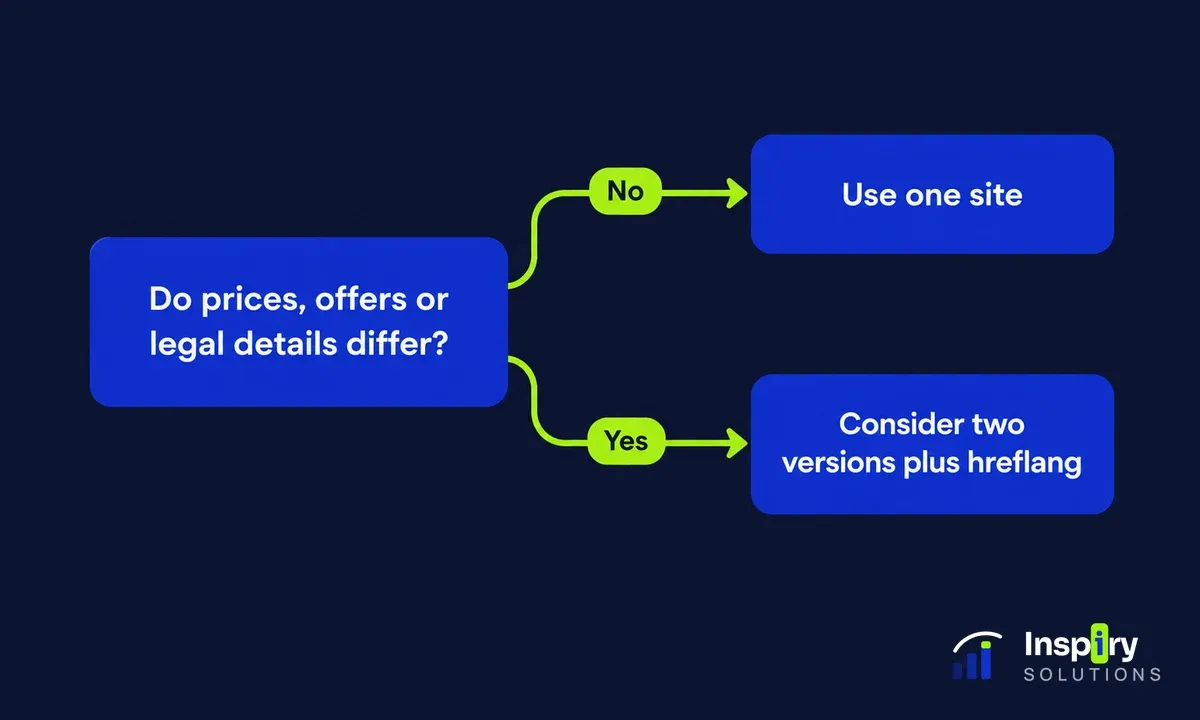
Hreflang for UK and US audiences is only necessary when your website has separate regional versions of the same pages. If your business serves both countries through one English website, you usually do not need hreflang at all. Create UK and US versions when customers genuinely need different prices, offers, legal information or purchasing options. If those differences justify separate pages, hreflang helps Google understand which version suits each audience. The important decision comes before adding any code: does your business actually need two versions of its website?
What hreflang does
Hreflang is an annotation that tells Google which language or regional version of a page is intended for a particular audience.
Those pages could use:
en-GBfor English-speaking users in the United Kingdom.en-USfor English-speaking users in the United States.x-defaultfor a fallback page when none of the specified language or region alternatives matches.
According to Google’s documentation on localised versions, regional alternatives can be declared in HTML, HTTP headers or XML sitemaps.
Do you need hreflang for UK and US versions?
The question is not whether your customers live in different countries.
The following table provides a practical starting point.
| Situation | Separate UK and US versions? | Hreflang needed? | Notes |
|---|---|---|---|
| Same service and prices worldwide | Usually no | No | One international English website may be sufficient. |
| Only spelling differs | Usually no | No | Minor wording differences rarely justify duplicating an entire website. |
| Different prices or currency | Possibly | Yes, if equivalent regional pages exist | Separate versions may improve purchasing clarity. |
| Different legal terms or regulation | Often useful | Yes, for equivalent regional pages | Country-specific terms can make separate pages valuable. |
| Different product range or shipping | Often useful | Yes, for equivalent regional pages | Customers should see relevant stock and delivery information. |
| Separate country teams and offices | Possibly | Yes, if corresponding regional pages exist | Different teams may justify distinct contact and service pages. |
When separate versions make sense
Consider two versions when the differences materially affect the customer journey.
When one English website is enough
If your services, prices and conditions are essentially the same, creating a second country website may add little value.
You may also create near-duplicate regional pages that offer almost identical information under different URLs.
Before building a second version, consider an international technical SEO review. It should establish whether the problem is regional targeting, unclear content, or something else entirely.
If one site serves both, what to do instead
A single website can communicate effectively with UK and US customers without maintaining duplicate sets of pages.
Explain prices and currencies
If you charge clients in USD, say so clearly.
State which countries you serve
Do not make visitors guess whether your company works internationally.
Provide relevant local proof
Different audiences may want reassurance about different things.
Make contacting you straightforward
Show suitable contact options for both markets.
Hypothetical example: a /us/ copy with American spelling only
Hypothetical example: A UK consultancy starts winning US clients.
Its team decides to copy the entire existing website into a /us/ directory.
The original pages use British spelling. The new pages replace words such as “optimise” with “optimize” and “organisation” with “organization”.
Otherwise, the services, offers, contact details and pricing remain unchanged.
The consultancy now maintains two almost identical sets of pages.
Google can recognise their substantial content similarity and may treat them as near duplicates.
The company could add en-GB and en-US annotations, but that would not solve the underlying question of why both sets are necessary.
A more practical approach would be to keep one website and create a useful page explaining its work with US customers.
That page could cover working hours, payment arrangements, project delivery and any genuine differences in service.
It would have its own purpose rather than being a copied version of the UK homepage.
If the consultancy later introduces genuinely different contracts, pricing or services for US customers, separate regional pages may become worthwhile.
At that point, hreflang becomes relevant.
The lesson is straightforward: do not create a second website structure just because you can.
First identify what customers in each market actually need.
Choosing a structure for two versions
When regional differences justify separate versions, choose a URL structure before implementing hreflang.
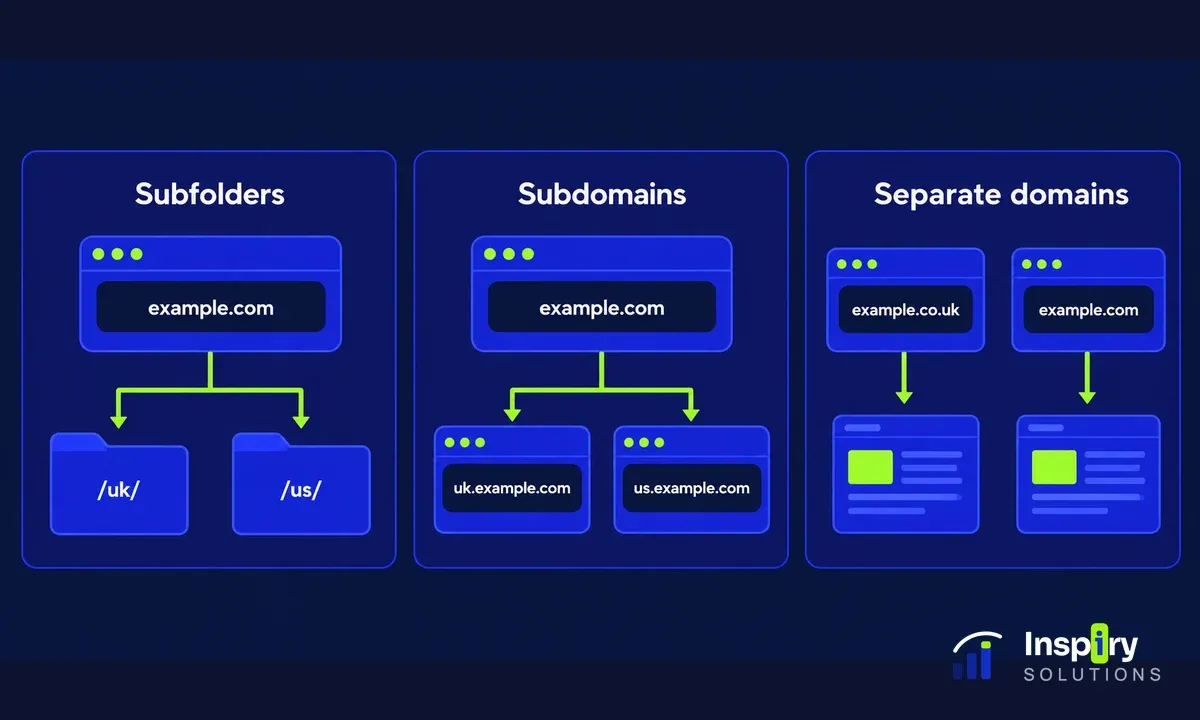
Subfolders
Example:
example.com/uk/services/example.com/us/services/
Subdomains
Example:
uk.example.com/services/us.example.com/services/
Separate domains
Example:
example.co.ukexample.com
Avoid forced country redirects
Whichever structure you choose, allow visitors and search engine crawlers to reach every regional version.
Setting up hreflang correctly
Once you have corresponding regional pages, implementation becomes a technical mapping exercise.
For a pair of service pages:
- UK version:
https://example.com/uk/services/ - US version:
https://example.com/us/services/
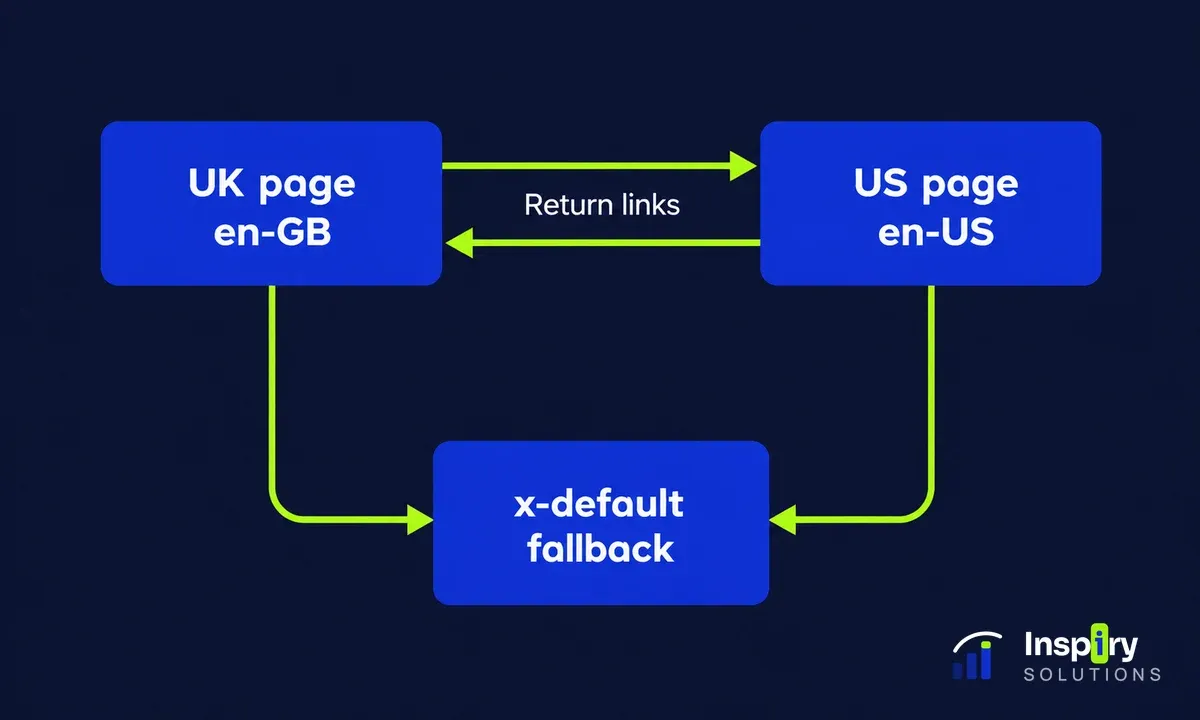
Both pages need matching sets of hreflang annotations.
You can also specify x-default for a suitable fallback, such as an international landing page or country selector.
Understand return links
Return links are essential.
If the UK page declares the US page as an alternate, the US page must identify the UK page in return.
Each page also identifies itself.
For a simple pair, both pages contain the same two regional declarations.
If there is a separate x-default page, it should participate consistently in that alternative set.
Every annotation should refer to the corresponding version of the same content.
For example, a UK service page should identify its equivalent US service page, not an unrelated US homepage.
Google’s hreflang documentation explains the importance of these reciprocal relationships.
Keep canonical tags aligned
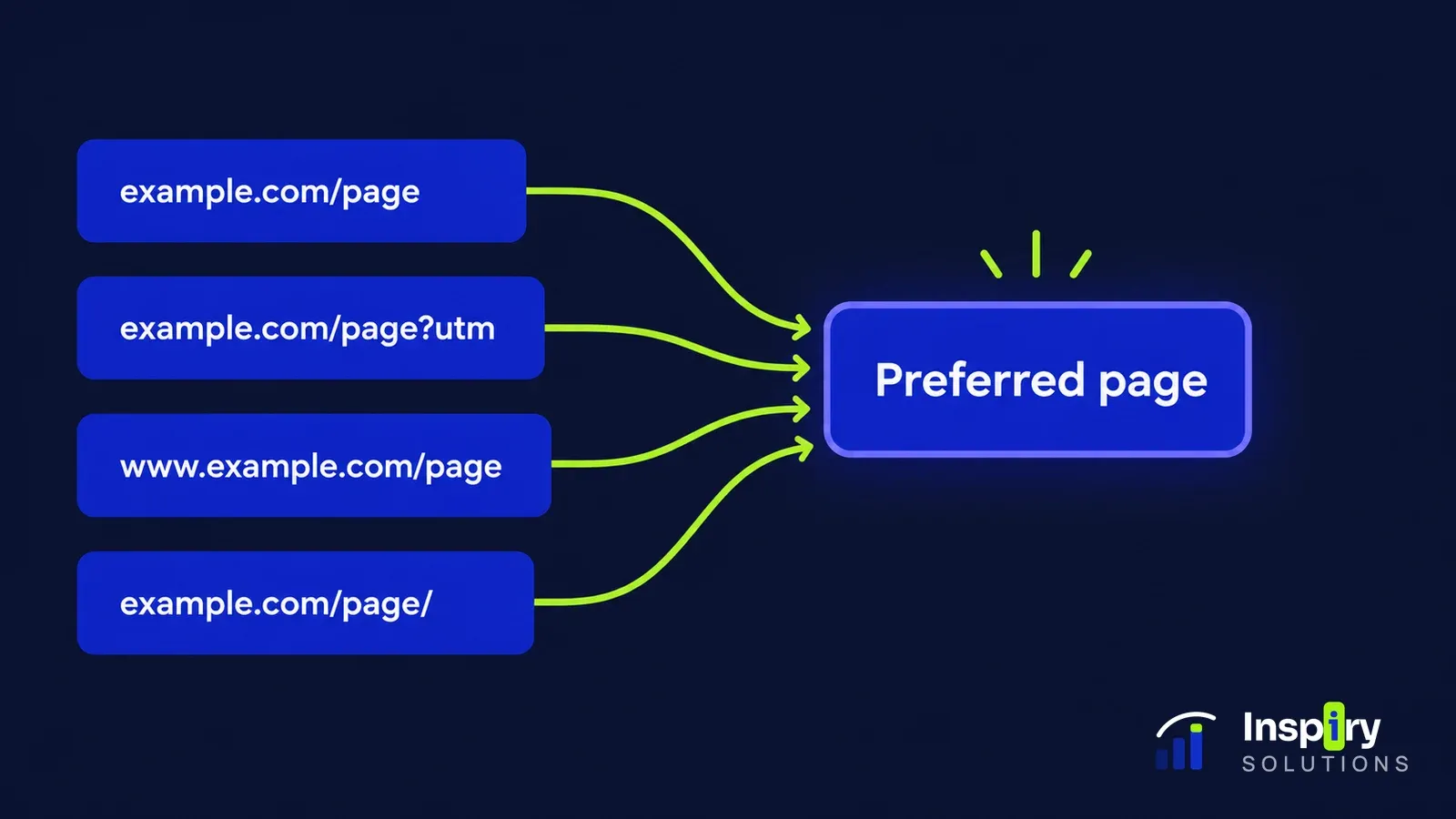
A canonical tag indicates which URL you prefer Google to treat as the main representative of duplicate or very similar content.
For separate UK and US versions intended to appear independently, the normal approach is to use self-referencing canonical tags.
The UK page identifies its own UK URL as canonical.
The US page identifies its own US URL as canonical.
Do not automatically canonicalise every US page to its UK equivalent.
That can conflict with your intention to have both regional pages eligible for indexing.
Google’s canonical URL guidance explains how canonicalisation interacts with duplicate and regional content.
Tags in the HTML head
For standard HTML pages, hreflang annotations can be placed inside the document’s head section.
For example:
<link rel="alternate" hreflang="en-GB"
  href="https://example.com/uk/services/" />

<link rel="alternate" hreflang="en-US"
  href="https://example.com/us/services/" />

<link rel="alternate" hreflang="x-default"
  href="https://example.com/" />
This complete set belongs on both regional service pages.
If the international homepage is the declared fallback for this group, give it consistent alternative annotations too.
The example uses a homepage as the fallback.
Use absolute URLs, including HTTPS and the full hostname.
Check the rendered page source to confirm that the annotations actually appear.
Hreflang in the XML sitemap
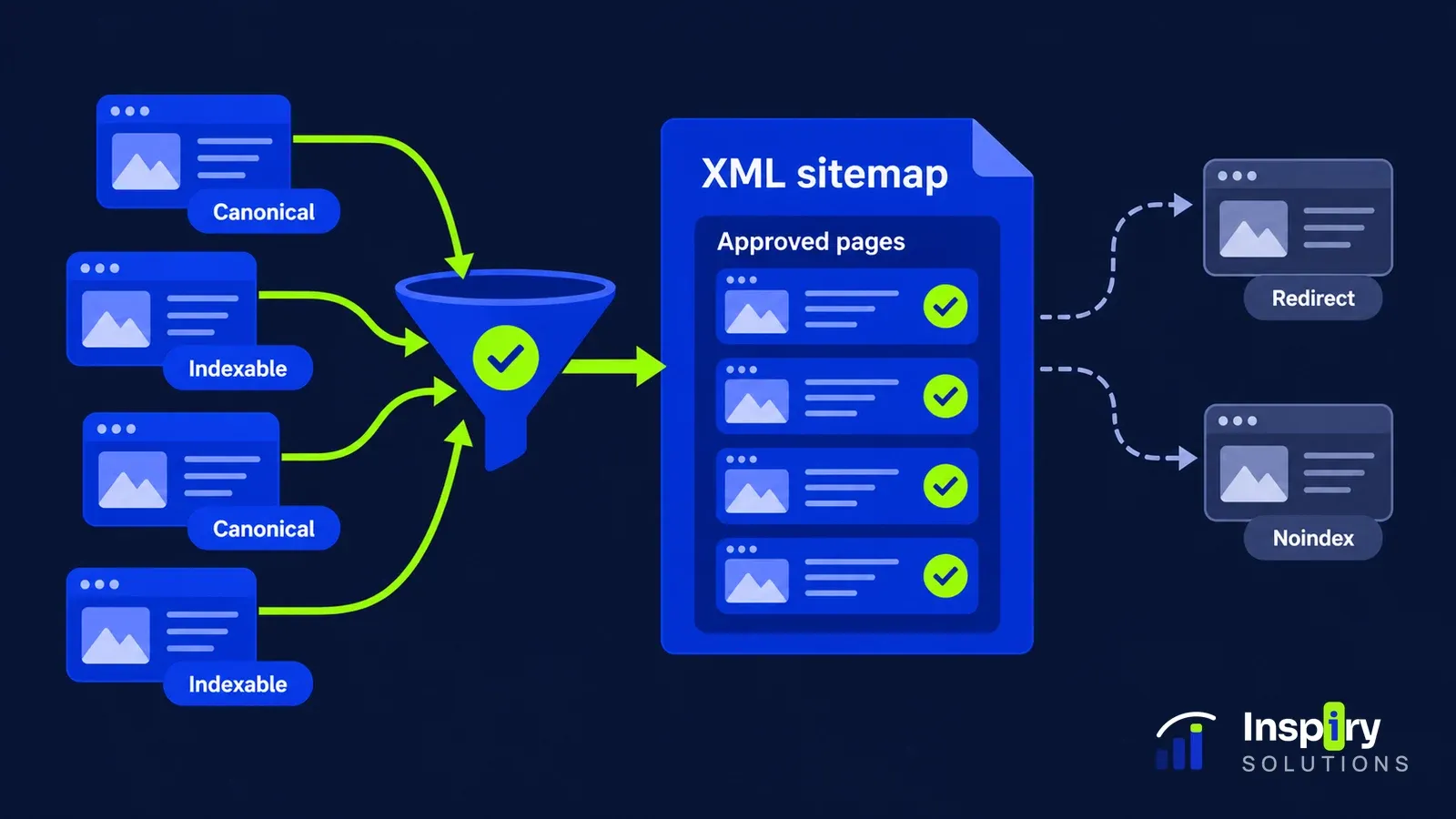
An XML sitemap is a file that helps search engines discover important URLs.
You can also declare regional alternatives in the sitemap instead of placing hreflang tags in HTML.
Each URL entry needs its own location and a complete set of corresponding alternate annotations.
For example:
<url>
  <loc>https://example.com/uk/services/</loc>
  <xhtml:link rel="alternate"
    hreflang="en-GB"
    href="https://example.com/uk/services/"/>
  <xhtml:link rel="alternate"
    hreflang="en-US"
    href="https://example.com/us/services/"/>
</url>
The corresponding US URL requires its own entry containing the same regional alternatives.
The sitemap root must also declare the appropriate XHTML namespace.
Add an x-default alternate to both entries if you use a suitable fallback page, and include that page consistently in the mapping.
Follow the correct sitemap rules so you do not confuse URL discovery with regional targeting.
Google treats supported HTML, HTTP header and sitemap hreflang methods as equivalent.
Implementing all methods provides no additional search benefit and can create consistency problems.
Choose the method your team can maintain accurately.
Hreflang on WordPress and Shopify
On WordPress, hreflang implementation depends on the site’s structure and installed multilingual or SEO tools.
Do not assume that creating /uk/ and /us/ directories automatically generates correct annotations.
Check what your current plugins actually output.
If a plugin manages regional alternatives, verify that it generates reciprocal tags for corresponding pages.
Avoid multiple tools independently generating conflicting annotations.
For a custom WordPress build, the implementation may require template logic or properly configured sitemap generation.
On Shopify, the approach depends on how international markets and regional URLs are configured.
Shopify’s international sales documentation explains the available international selling tools and configurations.
When regional domains or subfolders are involved, check the actual generated URLs and alternative annotations rather than assuming every market configuration behaves identically.
If you are changing platforms, review international signals during a store move.
Migration work should preserve correct regional relationships alongside redirects, canonical URLs and sitemap entries.
4 common hreflang errors
Hreflang problems are often caused by small inconsistencies rather than complicated technical failures.
These four errors deserve attention before publishing new regional pages.
Missing return links
The UK page declares a US alternate, but the US page does not reference the UK page.
This breaks the reciprocal relationship Google expects.
How to spot it: Open both pages, inspect their HTML source and compare the hreflang declarations.
If the implementation uses XML sitemaps, inspect both URL entries.
How to fix it: Add the missing reciprocal annotation and ensure both pages include their own URLs.
For larger sites, use an automated crawl to identify incomplete alternative sets.
Wrong codes such as en-UK instead of en-GB
The United Kingdom uses the region code GB in hreflang.
Therefore, en-GB is correct and en-UK is not a valid code, because hreflang region codes follow the ISO 3166-1 Alpha 2 standard, where the United Kingdom is GB.
Likewise, en-US identifies English content intended for the United States.
How to spot it: Search the rendered HTML source or XML sitemap for hreflang values.
Check each language and regional code against the supported format.
How to fix it: Replace invalid values, then verify the annotations across every affected regional page.
Incorrect codes can cause Google to ignore the intended regional targeting.
Hreflang pointing to redirected or noindexed URLs
An annotation may reference an old URL that redirects elsewhere.
Alternatively, it might reference a page marked noindex, instructing search engines not to index it.
Either condition undermines the intended regional setup.
How to spot it: Test every alternate URL for its final HTTP response, redirect destination and indexing directives.
How to fix it: Reference the final, accessible, indexable URL when that page is intended to appear in search results.
Remove obsolete alternatives from the mapping.
After migrations, recheck these relationships rather than assuming previous annotations remain correct.
Canonical pointing to the other country version
A UK page declares an American alternate while the American page canonicalises back to the UK page.
This sends conflicting signals about which URLs should remain independently available.
How to spot it: Inspect the canonical and hreflang tags together on both pages.
How to fix it: Where both regional pages should be independently indexed, use an appropriate self-referencing canonical on each.
Review canonical mistakes that clash with hreflang before changing these tags across a live website.
Canonical problems can also originate from plugins, templates or platform settings, so identify the source before applying a fix.
What hreflang will not fix
Hreflang is useful, but its role is narrow.
It does not replace meaningful localisation, correct indexing or useful page content.
It does not make duplicate pages more valuable
Google can understand that nearly identical pages target different regions.
That does not mean maintaining those pages will produce better organic performance than one useful international page.
Regional pages should exist because they serve a real customer need.
It does not override canonicalisation
If canonical signals strongly favour one URL, adding regional annotations does not guarantee that both pages will remain indexed separately.
Resolve canonical conflicts rather than trying to compensate with more tags.
It does not increase rankings
Hreflang does not improve content quality, build authority or make your services more relevant.
A UK page with weak information will not become competitive simply because it has an en-GB annotation.
The same applies to the US version.
If rankings are poor, investigate content relevance, internal links, technical accessibility and competition before blaming regional configuration.
Hreflang should support a sensible international structure, not serve as a substitute for one.
Common questions
Do I need hreflang if my site is only in English?
Only if you maintain separate regional versions, such as UK and US pages intended for different audiences. A single English website serving several countries does not need hreflang. If you have just one version of each page, there are no regional alternatives to identify. Focus on making your services, prices and international availability clear.
Is it en-GB or en-UK?
en-GB is correct. The regional code representing the United Kingdom in the supported hreflang format is GB, not UK. Therefore, en-UK is not a valid code for Google regional targeting. Use en-GB for UK English and en-US for US English. Check these values carefully in generated HTML and sitemaps.
What does x-default mean?
The x-default annotation identifies a fallback version for users whose language or region preferences do not match the listed alternatives. It is commonly used for an international homepage or country selection page. It does not mean the same thing as a canonical tag, and it is not compulsory for every regional implementation.
Will hreflang stop UK and US pages being seen as duplicates?
Hreflang helps Google understand that similar pages are regional alternatives. It does not guarantee that both URLs will always appear separately in search results. Pages with genuine local differences are usually a stronger business approach than pages duplicated solely to target a country. Canonical settings and indexability also need to support the intended structure.
Can I redirect visitors automatically based on their location?
Automatic IP-based redirects can prevent Google from crawling or discovering all regional versions reliably. They can also frustrate visitors who are travelling or buying for another country. Offer a visible country switcher instead, with direct links to accessible regional pages. If you suggest a country automatically, preserve the visitor’s ability to choose another version.
Check it is working
Implementation is not complete until you verify what search engines can actually access.
Start with a small set of corresponding UK and US pages before checking the entire website.
First, inspect the rendered source.
Confirm that the expected en-GB, en-US and any x-default annotations appear on the correct pages.
Both regional pages should declare matching alternatives, including themselves.
Second, inspect the sitemap.
If hreflang is implemented in XML, confirm that each URL has the required reciprocal declarations.
Check that the sitemap contains current, intended URLs.
Third, test accessibility and indexing signals.
Every regional page intended for indexing should be reachable, return a successful response and avoid conflicting indexing directives.
Inspect canonical tags and confirm they support the chosen regional structure.
Fourth, review Google Search Console.
Use the Performance report and filter by country to examine UK and US search activity.
Google’s Performance report guidance explains the available filters.
You can also filter by page to compare which regional URL receives impressions and clicks in each country.
Remember that country filtering reports observed performance, not a direct pass or fail result for hreflang.
A correct implementation does not guarantee that Google always selects your preferred version.
Finally, repeat the checks after changes.
New pages, redirects, deleted products and revised website structures can break previously valid mappings.
Include hreflang validation in your publishing and migration processes.
For a small website, checking representative page pairs may reveal a configuration problem.
For a larger website, use a full crawl to detect missing alternatives, redirects, invalid codes and canonical conflicts at scale.
Record the affected URLs, the specific error and the correction made.
The outcome you want is a maintainable configuration that search engines can interpret consistently.
Selling to both the UK and US? We can tell you whether you need separate versions at all and, if you do, set up and test hreflang as part of our technical SEO work. Send your URL for a free audit.