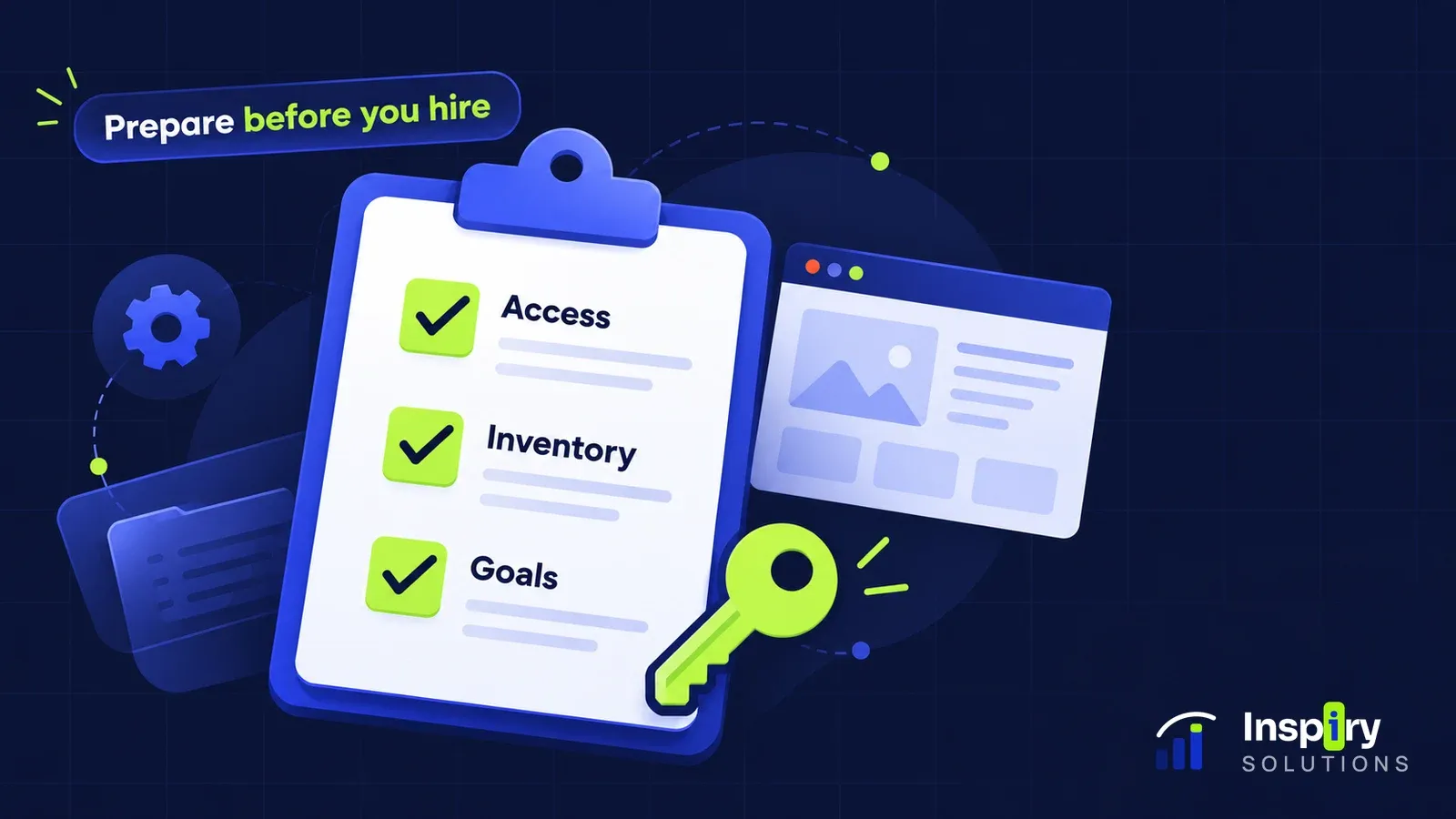
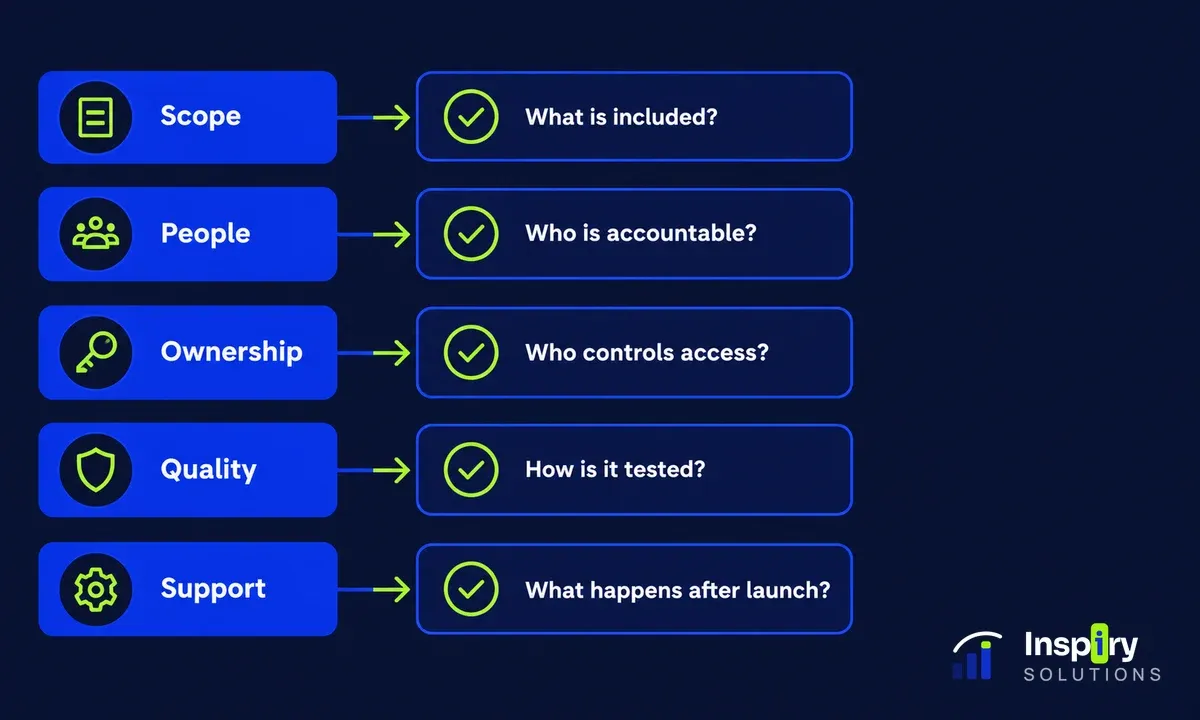
The right questions to ask a web developer cover scope, accountability, ownership, quality and support, not just price or portfolio quality. Before hiring, ask how work will be defined, who will deliver it, which accounts you control, how the website will be tested and what happens after launch.
A reliable developer should explain these decisions clearly and document important commitments. You do not need technical expertise to identify risky answers. You need consistent questions to compare suppliers.
This guide helps business owners interview developers in a 30-minute call. It explains what good and worrying answers sound like and provides a practical scoring method.
What these questions protect you from
A polished portfolio demonstrates previous work, but not necessarily how a developer manages projects. Expensive problems often occur outside the design process.
Five common failure points are:
- Unclear scope: Important pages, features or integrations are excluded, creating unexpected costs.
- Unclear accountability: Nobody clearly owns delivery, technical decisions or problem resolution.
- Lost access: Your supplier controls the domain, hosting or administrator accounts.
- Fragile quality: The website has broken forms, performance issues, security gaps or accessibility barriers.
- Poor handover: Updates, backups and post-launch fixes have no assigned owner.
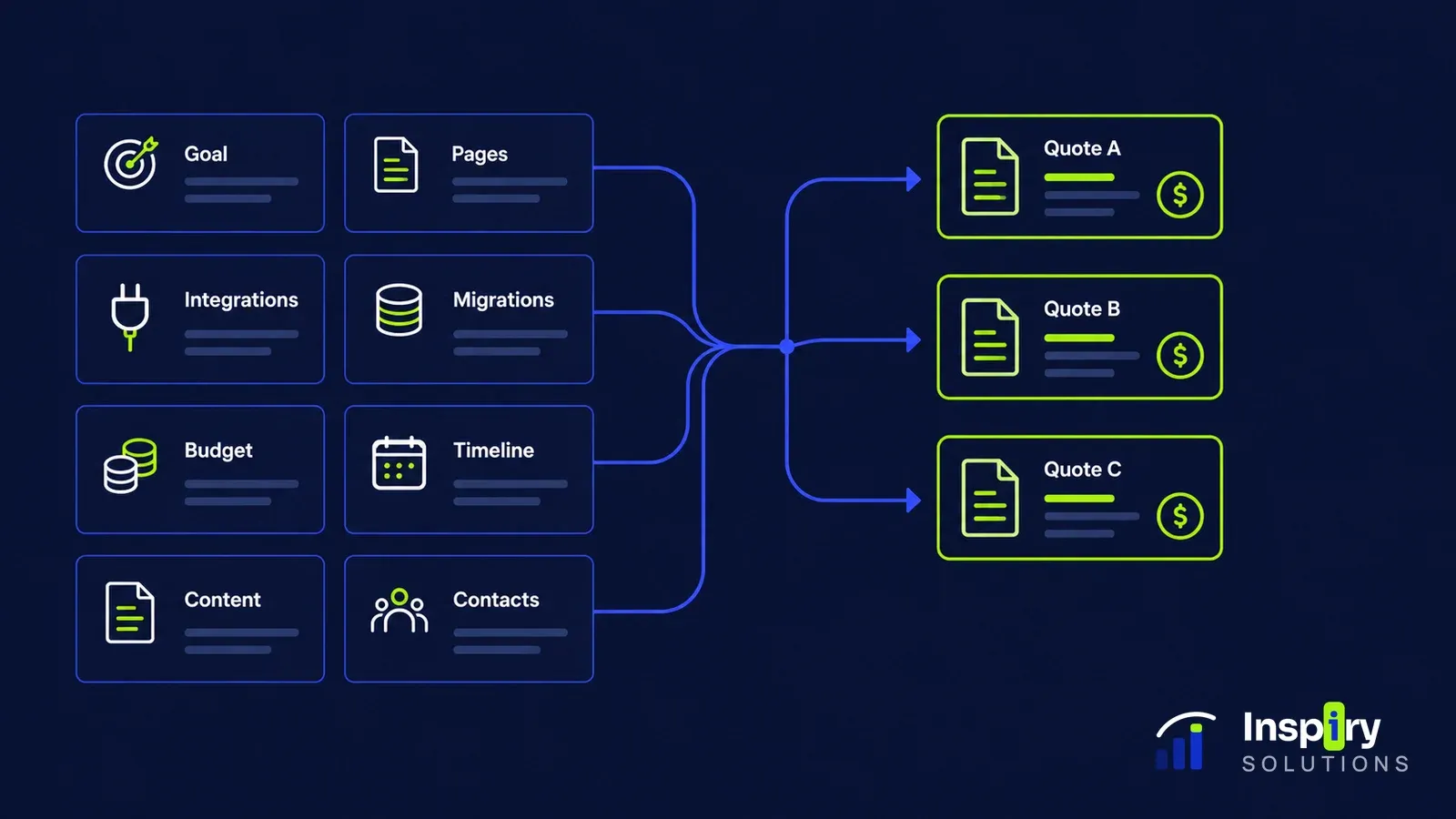
Similar quotes can include different responsibilities. Start with a brief suppliers can price accurately, covering goals, pages, functionality, integrations and your expected launch date.
Give every candidate the same brief and questions.
For a 30-minute call: Spend approximately five minutes on each risk area and five minutes discussing outstanding questions. Listen for specific processes, named responsibilities and written commitments rather than confident reassurances.
Questions about how they work out the scope
The first questions to ask before hiring a web designer or developer concern how they establish your requirements.
An overlooked integration, migration or custom workflow can make an apparently affordable quote unrealistic.
Ask: Will you look at my current website before quoting?
For existing websites, developers should inspect the platform, important functionality and known problems. New projects require a requirements review.
Ask what information they need, such as read-only access, screenshots, a page inventory or an explanation of your enquiry process.
At Inspiry Solutions, diagnosis comes before detailed pricing. This approach forms part of how we run WordPress projects. A free audit can identify areas requiring investigation.
Ask: What assumptions and exclusions will appear in the proposal?
A proposal should clearly identify included and excluded work, covering copywriting, images, hosting, premium licences, multilingual features, content entry and integrations.
Confirm whether testing and launch assistance are included. A description such as “website development” is insufficient.
Ask: How are changes requested and priced?
Changes are normal, but approval should be controlled.
Ask who approves additional work, whether costs are agreed beforehand and how changes affect deadlines.
Correcting work that fails agreed requirements should be distinguished from adding new functionality.
Good answer: a diagnosis step and written assumptions
A reliable response explains that the supplier reviews requirements before quoting, documents deliverables and exclusions, and obtains approval for additional costs.
Ask for these commitments in the proposal rather than relying on meeting notes. They should specify what happens when requirements change.
Worrying answer: a firm price with no questions asked
Be cautious when someone quotes a complex project without reviewing requirements or the existing website.
Simple projects may justify quick estimates. Complex redesigns and migrations require more investigation.
“We will work that out later” is particularly concerning when the unresolved questions affect price. Later may mean after you have paid a deposit.
Questions about who does the work
Knowing who delivers your project matters more than whether the supplier is an agency, studio or freelancer.
Ask: Who will actually build my website, and who will I speak to?
Identify the person responsible for technical decisions and the person coordinating feedback, approvals and deadlines.
You should know who resolves problems without navigating several contacts.
Ask: Is any work subcontracted or white label?
White label development means one business delivers work under another business’s brand. This is common and not inherently problematic.
Inspiry Solutions provides white label development for SEO and web agencies.
Ask who supervises subcontractors, approves their work and controls their access to your systems.
Ask: What happens if your main developer becomes unavailable?
A dependable supplier should explain how another developer can access project documentation, files and outstanding tasks securely.
Freelancers may offer simpler communication, while agencies may provide additional cover. Neither guarantees continuity.
Compare agency or freelancer, judged by failure mode rather than assuming one arrangement is safer.
The essential requirement is clear accountability and a workable continuity plan.
Questions about ownership and access
Ownership questions should be resolved before paying a deposit.
Your website is a business asset. You should be able to manage accounts, appoint another supplier and operate independently.
Ask: Whose name are the domain, hosting and premium licences in?
Domain registration and primary hosting should normally remain under your business’s control.
Clarify ownership and renewal costs for paid themes, plugins and other licences. Supplier-owned agency licences can be acceptable when limitations and transfer arrangements are disclosed.
Ask: Will I have an administrator account from day one?
A WordPress Administrator can manage settings, users, plugins and themes on a standard installation.
The official WordPress roles and capabilities documentation explains permissions, including differences for multisite installations.
Your business should retain an appropriately secured administrator account. Developers should use individual accounts with suitable permissions.
Administrator access does not replace control over hosting, domain registration or backups.
Ask: Do I own the code and design files at the end?
Request written ownership or licensing terms covering custom code, original design files, documentation and any necessary maintenance access.
Third-party fonts, themes, plugins and stock images may carry separate licences. Website ownership does not automatically transfer unrestricted rights to these components.
Hypothetical example: Two developers quote similar prices. One insists on registering your domain under their account and promises support “as needed”. Another confirms business-controlled accounts and a written 30-day post-launch fix period.
The second proposal offers clearer protection, even if slightly more expensive.
Questions about quality, security and accessibility
A visually impressive website can still have serious operational weaknesses. Quality should be tested, not assumed from appearance.
Ask: How do you test the website before launch?
Request a testing process covering:
- Desktop, tablet and mobile layouts.
- Navigation, buttons and interactive features.
- Contact forms and email delivery.
- Performance on real devices.
- Browser compatibility.
- Important enquiry and purchase journeys.
- Broken links, errors and missing images.
Ask who performs these checks and how defects are recorded.
You should also review a staging website, meaning a private testing version, and approve the finished work against agreed requirements.
For redesigns, ask: “How will existing URLs and search visibility be protected?”
The answer should cover redirect mapping, important content and metadata checks. A redirect map connects old URLs to their replacements.
Our guide to protecting rankings during a redesign explains the process. Proper planning reduces avoidable risks but cannot guarantee unchanged rankings.
Ask: How are backups created, and has a restore been tested?
A useful backup includes the data required to recover your website.
Confirm whether database and website files are backed up, where copies are stored, retention periods and who handles recovery.
WordPress provides official guidance on website backups.
Ask whether restoration has been tested safely, preferably in a separate environment.
“The hosting company handles it” is not enough without confirming the host’s actual backup and recovery arrangements.
Ask: Which accessibility standard do you build to?
Accessibility concerns whether people with different abilities can use your website.
The W3C Web Content Accessibility Guidelines provide a recognised framework.
WCAG 2.2 Level AA is a useful benchmark for many business websites, although legal requirements vary.
Ask how keyboard navigation, form labels, colour contrast and screen reader compatibility are tested.
A theme or automated accessibility plugin cannot independently guarantee compliance.
Ask: How many plugins will the website rely on, and why each one?
WordPress plugins provide functionality but also introduce dependencies.
There is no universal safe plugin count. Ten unnecessary plugins may introduce greater risk than more numerous, carefully maintained essential tools.
Ask why important plugins are needed, who maintains them, their licence costs and whether simpler alternatives exist.
Questions about launch, handover and support
Development responsibilities should remain clear when the website goes live.
Ask: What exactly will be handed over?
Request a written handover covering administrator access, hosting, domain registration, relevant licences, custom functionality and contractual design deliverables.
Documentation should explain content updates, form management and important workflows.
Confirm whether staff training is included and whether sessions can be recorded.
Ask: What support is included after launch, and for how long?
Establish the post-launch fix period and which problems qualify as defects.
A defect means something fails agreed requirements. New functionality or changed business needs are separate matters.
Agree response expectations, communication channels and procedures for urgent issues.
“We are always available” is not a meaningful replacement for written support terms.
Ask: Who applies updates, and is that a separate plan?
WordPress requires ongoing software, theme and plugin maintenance. The WordPress updating guide explains the software update process.
Assign responsibility for updates, backups, testing and recovering from failed changes.
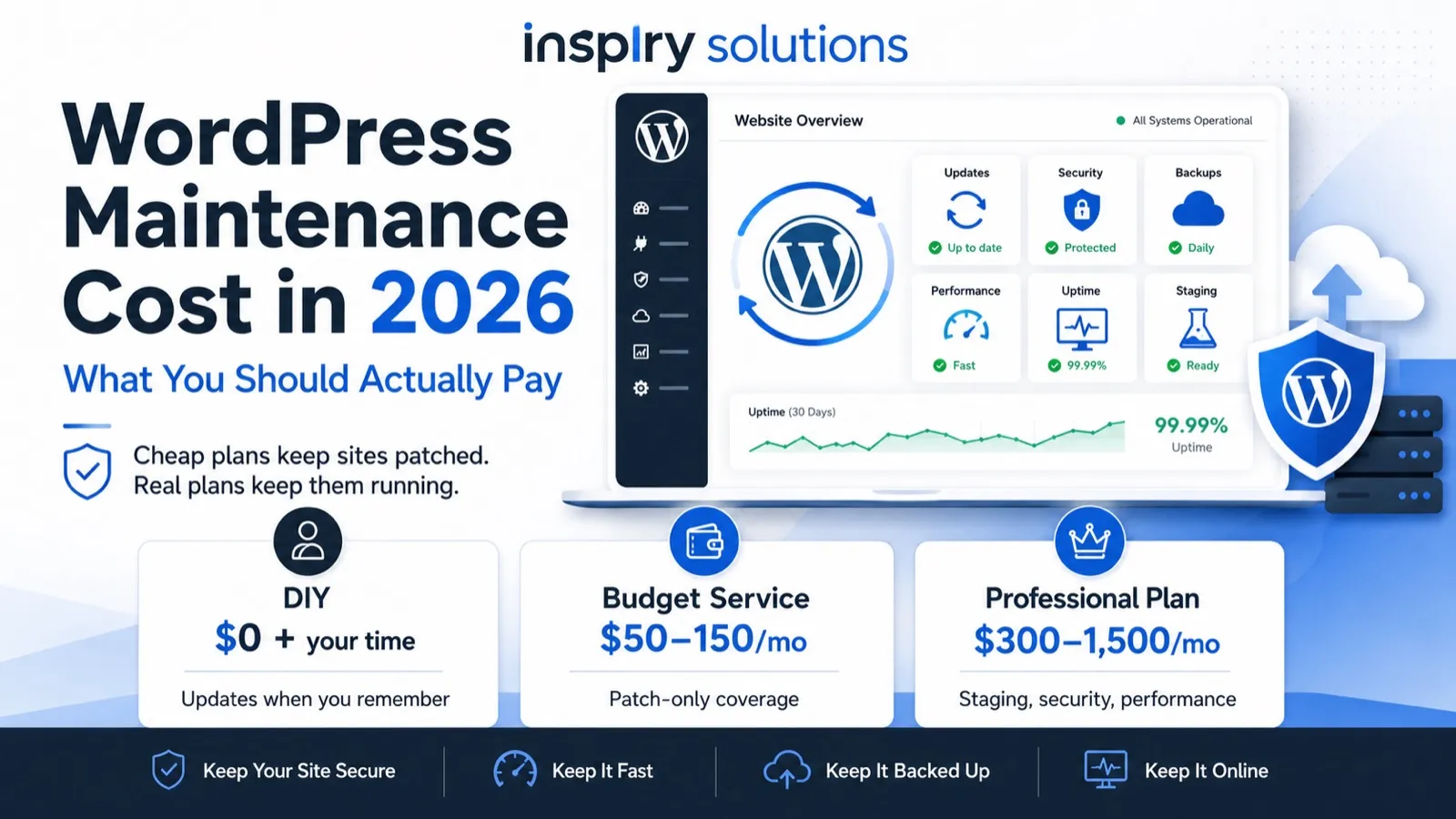
Review what maintenance should cover when comparing packages. Low monthly prices are meaningless without defined responsibilities.
Inspiry Solutions offers WordPress maintenance from $99/month under its Essential plan. Its $199/month plan includes performance monitoring and priority support.
These ongoing services are separate from contractual development and post-launch obligations.
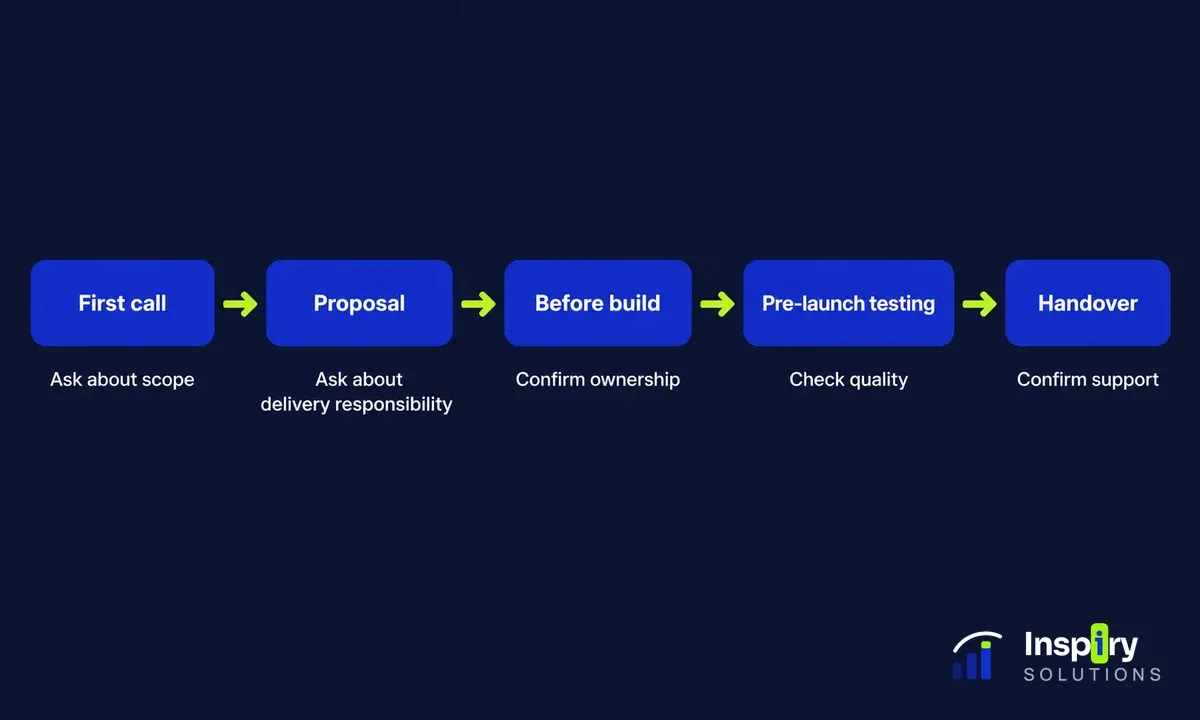
Timing matters: agree scope before quoting, ownership before development, testing before launch and support arrangements before handover.
How to score the questions to ask a web developer
Avoid choosing suppliers based solely on personality, confidence or portfolio quality.
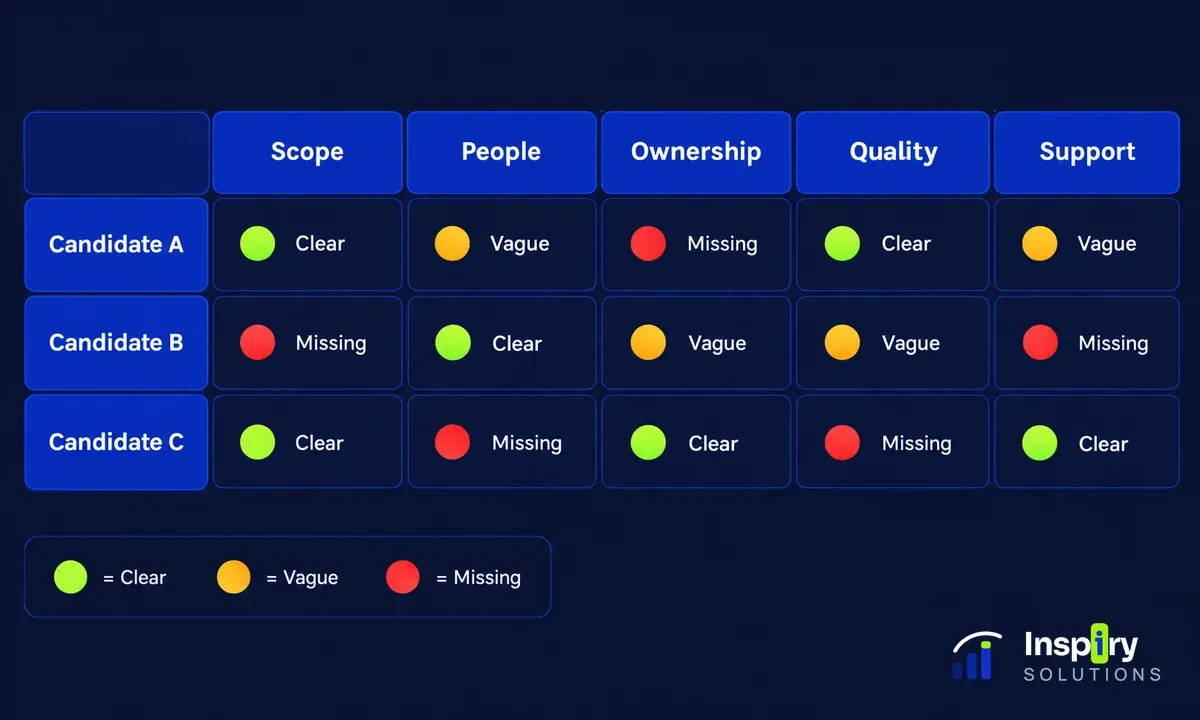
Assess the same five risk areas using three ratings:
- Clear: Specific processes, named responsibilities and documented commitments.
- Vague: Reassurances without verifiable details.
- Missing: Unanswered questions, refusal or unresolved contractual gaps.
Do not average these into a numerical score. Good design cannot compensate for losing control of your domain.
Scope
Clear: Requirements are reviewed, assumptions documented and changes priced transparently.
Vague: Everything is promised without defining exclusions.
Missing: No meaningful scope or change approval process.
Require the page list, functionality and exclusions in writing.
Who does the work
Clear: Named project lead, communication process and accountable delivery owner.
Vague: “Our team handles everything” without defined responsibilities.
Missing: Nobody accepts responsibility for delivery or technical decisions.
Subcontracting is acceptable. Unclear accountability is not.
Ownership and access
Clear: Your business controls primary accounts and licensing arrangements are documented.
Vague: Everything will supposedly transfer later without specifics.
Missing: Appropriate administrator access is refused or the supplier retains exclusive control.
Unresolved ownership questions should prevent contract approval.
Quality and security
Clear: Documented testing, backup recovery, accessibility expectations and dependency management.
Vague: Visual appearance or automated scores are presented as sufficient evidence.
Missing: No testing, recovery plan or security responsibilities.
Request practical evidence appropriate to your project.
Launch and support
Clear: Written handover, defined fix period and assigned maintenance responsibilities.
Vague: Informal support promises without duration or scope.
Missing: No handover arrangements or post-launch support explanation.
Clarify critical gaps before signing.
Scoring sheet: questions, risks and answers
Record each supplier’s commitments and mark them Clear, Vague or Missing.
| Question | What it protects | Good answer sounds like | Worrying answer sounds like |
|---|---|---|---|
| Will you review the existing site? | Hidden technical work | “We inspect it before the fixed quote.” | “No need. We know the price.” |
| What is excluded? | Scope disputes | “Exclusions appear in the proposal.” | “Everything is included.” |
| How are changes approved? | Unexpected costs | “You approve written variations first.” | “We sort costs out later.” |
| Who performs the build? | Unclear accountability | “Here is your delivery lead.” | “Different people will handle it.” |
| Who owns domain and hosting? | Account lock-in | “Your business controls both accounts.” | “Keep them in our account.” |
| Will I have administrator access? | Dependence on supplier | “Your authorised owner has access.” | “Clients do not need admin access.” |
| What testing is completed? | Broken functionality | “We check devices, forms and journeys.” | “We check how it looks.” |
| Can backups be restored? | Failed recovery | “We verify a recovery procedure.” | “Hosting backs it up somewhere.” |
| What happens after launch? | Unplanned support costs | “Here is the included fix period.” | “Contact us if anything happens.” |
| Who maintains the website? | Outdated software | “The agreement assigns update responsibility.” | “It should run on its own.” |
The table records answers, not guarantees.
After each call, send your understanding of key commitments to the candidate. Ask them to correct inaccuracies and include confirmed terms in their proposal.
Written confirmation makes comparisons more reliable and reduces disputes over verbal promises.
Common questions
How many developers should I talk to before hiring?
Two or three developers usually provide enough comparison without creating an unnecessarily lengthy selection process. Give each the same brief and questions. Compare scope, ownership, testing and support rather than increasing the shortlist without purpose. Ask each one to put their answers in writing so you can compare them side by side.
Should I ask a web developer for references?
Yes. Ask previous clients about communication, agreed scope, reliability and what they would change. Prioritise projects similar to yours. References provide useful evidence but cannot replace written contractual commitments covering your project. Ask for at least one reference from a project completed in the last two years.
What is a red flag when hiring a web developer?
Major warning signs include refusing appropriate administrator access, insisting on exclusive control of primary accounts, offering complex fixed quotes without investigation and avoiding written support commitments. These risks remain significant regardless of portfolio quality. Treat vague answers about testing or handover as a reason to ask follow-up questions.
Is it a problem if a developer uses subcontractors?
Not automatically. White label and subcontracted arrangements are common when specialist skills are required. Ask who manages the work, controls access, checks quality and resolves defects. Accountability must remain clearly assigned. Ask to see this written into the proposal, with one named contact responsible for delivery.
Should I ask about ongoing maintenance before hiring?
Yes. Clarify whether maintenance is included or separately charged. Ask about update testing, backup frequency, restoration assistance, security checks and response expectations. Identify who remains responsible if you appoint another maintenance provider. Ask for these commitments in writing before you sign, not after launch.
Your next step
Use these questions during a consistent 30-minute interview with each shortlisted developer.
Compare written scope, delivery responsibilities, account ownership, testing procedures and post-launch support before selecting a supplier.
The cheapest quote is not necessarily the lowest-risk option. A supplier who identifies unknowns and recommends investigation may be more dependable than someone promising certainty without evidence.
If important commitments remain undocumented, treat them as unresolved.
You can ask Inspiry Solutions the same questions. We are a remote WordPress development and technical SEO studio that aims to understand requirements before pricing work.
Start with a free audit or contact our WordPress development team. We reply in plain language within two working days.
Send your website URL and a description of your project to hello@inspirysolutions.com. We will explain what needs reviewing and recommend a sensible next step.