Fixed price vs hourly web development is safest when the billing model matches how clearly the work can be defined. A fixed quote generally protects your budget when the deliverables, requirements and acceptance criteria are clear. Hourly billing makes more sense when the developer must investigate an unknown problem or respond to changing requirements. Neither automatically protects you from overspending. The strongest agreement combines the right pricing model with written scope, spending limits where appropriate, a fair change-request process and clear acceptance rules.
If you are commissioning a business website, planning a redesign or hiring someone to repair an existing site, this guide will help you compare contracts without confusing a predictable invoice with a successful project.
Fixed price vs hourly: match the model to the work
The short answer
Choose fixed price when you can describe the finished work clearly enough for a developer to estimate it responsibly.
For projects that sit between these situations, a short discovery exercise followed by a fixed quote often offers better protection than committing to either model immediately.
At Inspiry Solutions, our fixed-quote WordPress development process can begin with a free audit.
The distinction is not simply whether you prefer a known total or a flexible arrangement.
With a fixed price web development contract, the developer generally carries the risk of taking longer than expected to complete the agreed scope.
With hourly billing, the client pays for approved time spent, even when investigation takes longer than anticipated.
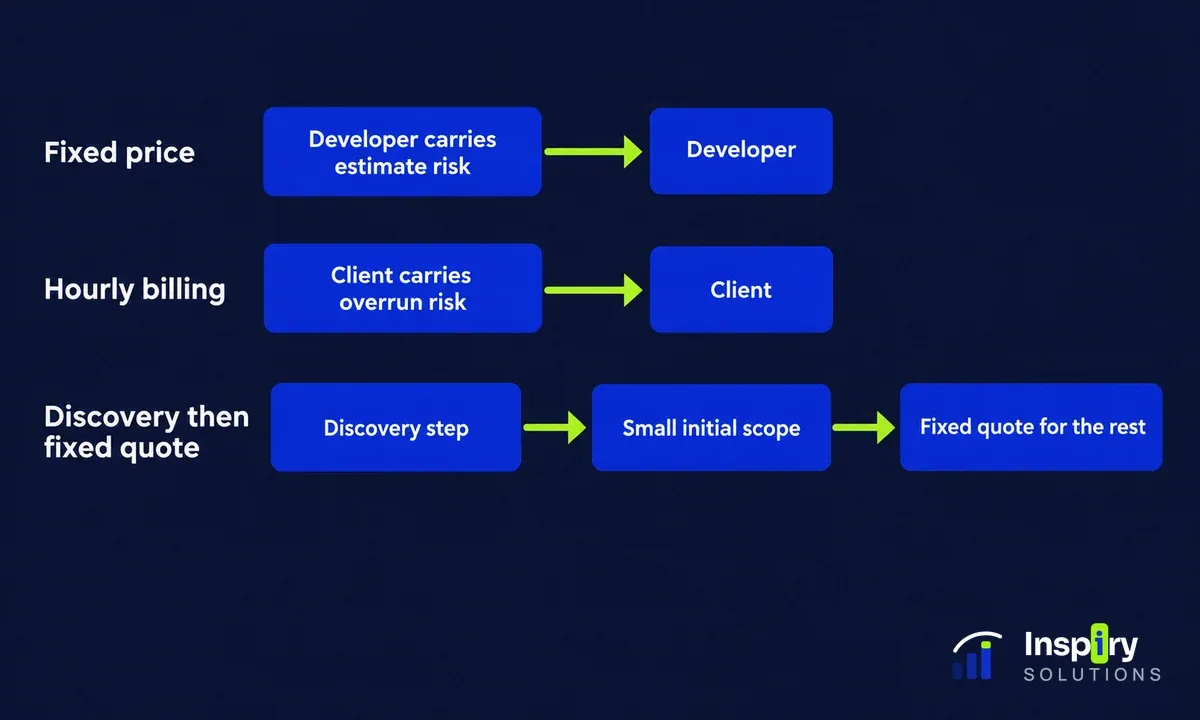
A quote only gives meaningful certainty when it describes what you will receive.
The practical question is therefore: how much uncertainty can you remove before signing?
How fixed-price web development protects you, and where it fails
Fixed price works best when the project has a stable scope, identifiable deliverables and a reasonable method for confirming completion.
For example, a business website with agreed page templates, supplied content, established branding and standard functionality is usually easier to quote than a complicated redesign involving unknown integrations.
What a fixed quote protects
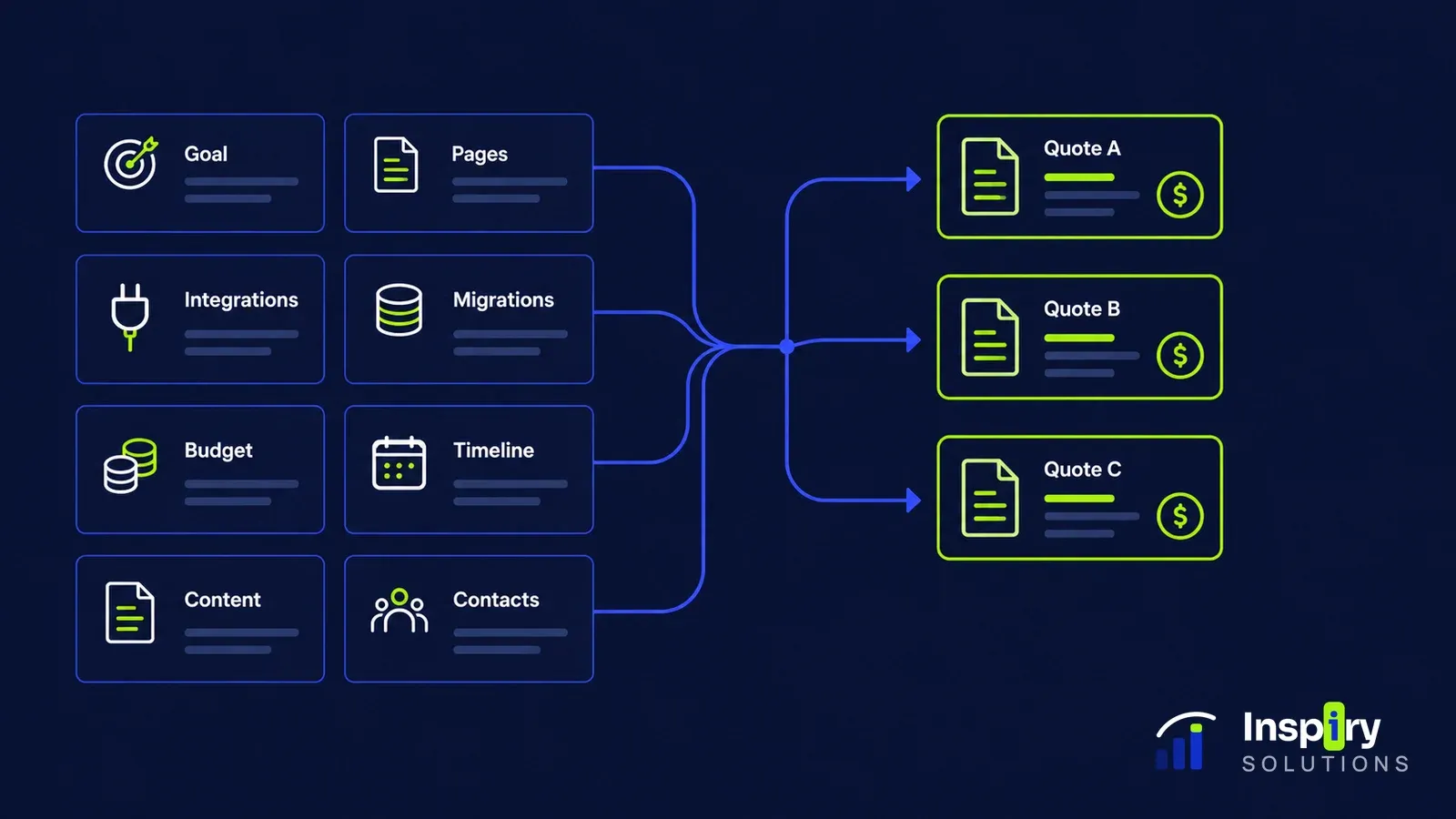
A proper fixed quote should identify the pages, templates, features, integrations, testing requirements and handover responsibilities included in the price.
It should also explain how the developer will deal with defects discovered during acceptance testing.
When those details are written down, you can assess whether the finished site matches the agreement rather than relying on conflicting recollections of conversations.
Where fixed pricing becomes risky
Developers cannot responsibly quote unknown work with perfect accuracy.
That means a fixed quote can cost more than the work would have cost under an efficient hourly arrangement.
The opposite problem is underquoting.
Neither outcome is good for the client.
Disagreements also arise when terms such as “complete redesign”, “SEO ready” or “fully responsive” appear without measurable definitions.
Those phrases sound reassuring but do not establish which templates, devices, integrations or checks are included.
Make the scope measurable
Assumptions describe what the estimate depends on, such as receiving approved copy before development or retaining an existing payment provider.
Exclusions identify work that is not covered, such as additional language versions, third-party subscription charges or new functionality requested later.
Acceptance criteria describe what must be working before the deliverable is approved.
A useful starting point is writing a brief that can be priced.
Also confirm what happens if an assumption proves incorrect.
The safest fixed price is not necessarily the lowest.
How hourly billing protects you, and where it fails
Rather than promising a finished deliverable for an agreed amount, the developer charges for the time spent on authorised work.
This is sometimes described as time and materials, although a full time-and-materials agreement may also include expenses and other chargeable resources.
Where hourly billing helps
The main benefit is flexibility.
You also pay for recorded work rather than automatically paying a fixed sum that includes contingency for problems that never materialise.
That can suit small improvements, technical investigations and agency requests where priorities change regularly.
However, paying for actual time does not guarantee good value.
The danger of an open-ended invoice
A low hourly rate can become expensive if the developer needs excessive time, repeats unsuccessful approaches or fails to report emerging complications.
When evaluating an hourly rate vs fixed price project, compare the expected total cost, the uncertainty around that estimate and the oversight required.
Ask for an estimate expressed as a range where appropriate, along with an explanation of what might extend the work.
Set a maximum number of authorised hours before another approval is needed.
Why debugging is difficult to estimate
A broken form might result from a plugin conflict, email configuration, a server restriction or custom code.
The official WordPress debugging documentation describes diagnostic tools including error logs and testing methods.
A sensible initial investigation establishes the symptoms, attempts to reproduce the fault, reviews relevant logs and isolates likely causes.
Only then can the developer make a more reliable estimate for the corrective work.
Hypothetical example: A website has a checkout error that appears only on some phones.
If the investigation is billed hourly without a cap, the client cannot know how much the search for the cause will cost.
If a developer offers a fixed price without diagnosing the problem, the quote may contain substantial contingency. Alternatively, it may underestimate the complexity.
A short, bounded diagnosis first, followed by a fixed quote for the identified fix, gives both sides a clearer basis for agreement.
The important deliverable from diagnosis is a finding, not a promise that every possible cause will be solved immediately.
Hybrid models that often work better
Many web development projects benefit from separating uncertain investigation from predictable implementation, or from dividing a larger commitment into smaller agreements.
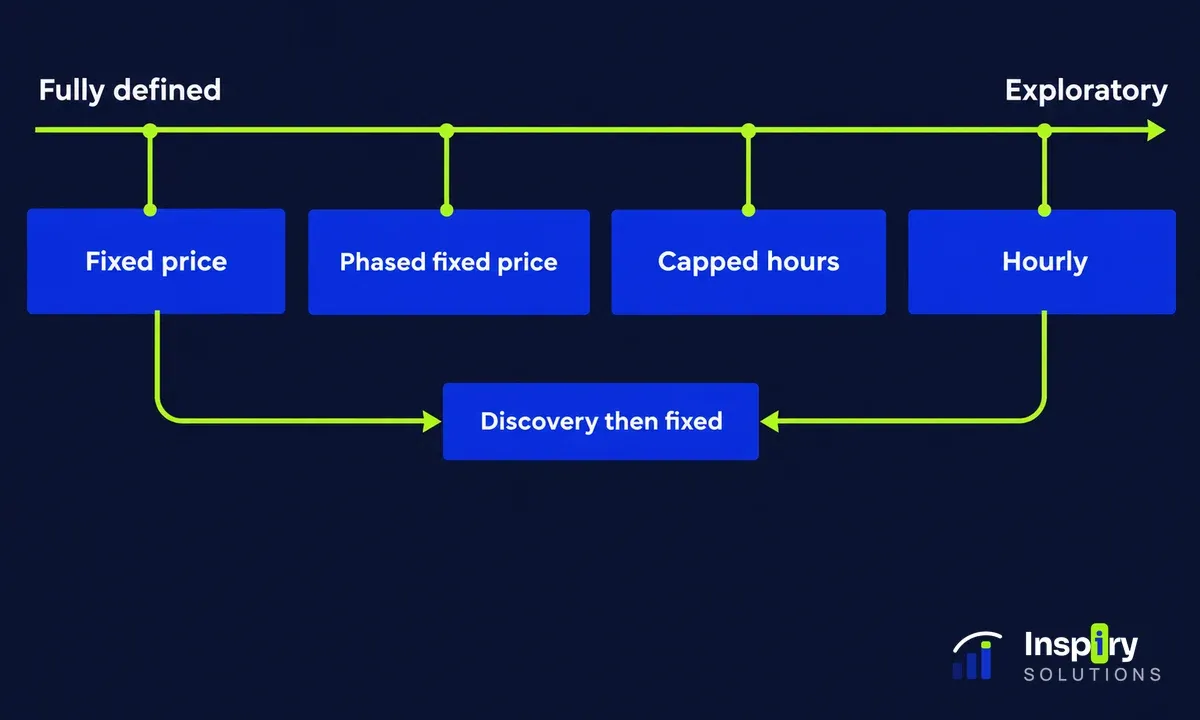
These four arrangements give clients more control while allowing developers to price their responsibilities realistically.
Discovery, then a fixed quote
It may involve checking the existing website, reviewing plugin and theme dependencies, inspecting integrations or clarifying requirements with the client.
The WordPress Site Health screen provides useful information about site configuration and health issues.
Discovery can be free or paid, depending on its depth and agreed scope.
At Inspiry Solutions, an engagement can begin with a free audit.
Where the findings allow the work to be defined, we can follow with a fixed quote.
If important unknowns remain, those should be identified rather than hidden inside a confident-looking price.
Fixed price per phase
A typical sequence might involve design approval, template development, functionality, migration and final testing.
The client approves the scope and payment for each phase before committing to the next.
This limits the amount of money committed before the next review and creates opportunities to reconsider priorities.
State what happens if one phase is delayed or reveals additional requirements for a later phase.
Capped hours with a review point
The contract should specify whether the cap is a hard stop or merely a point at which the client is consulted.
A hard stop is better for strict budget control, although it can mean work pauses before a problem has been fully resolved.
Require a useful status report at the review point: what was tested, what was discovered, what remains uncertain and what the next allocation of time would achieve.
This approach is particularly suitable for difficult bugs, performance investigations and changing technical requirements.
Monthly plans for recurring work
A monthly plan establishes an ongoing set of responsibilities for a predictable recurring fee.
Typical activities may include updates, routine checks, backups, maintenance and agreed support.
WordPress publishes guidance for updating WordPress, reflecting the continuing attention that an actively maintained site requires.
Inspiry Solutions offers WordPress maintenance from $99/month.
Our guide to how website subscriptions compare explains the wider differences between ongoing website costs and project-based development.
Change control: the clause that decides your final bill
Weak change control can undermine an otherwise sensible fixed price or hourly contract.
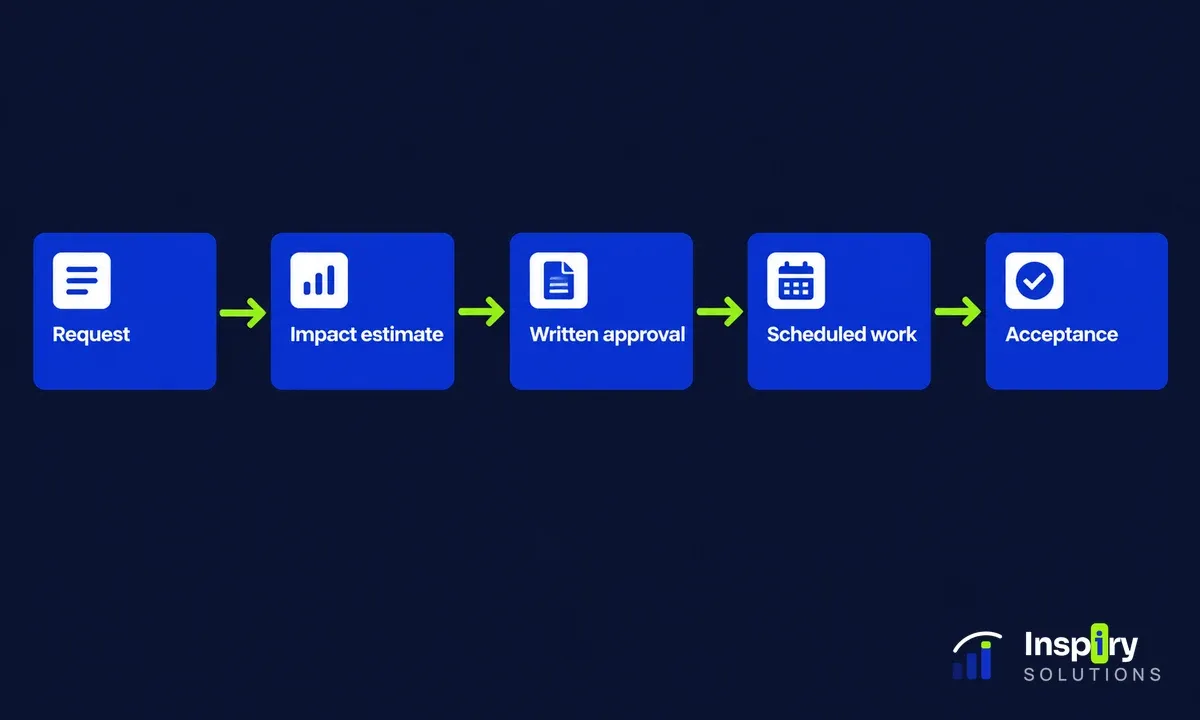
A formal process for web development change requests should be simple enough to use without slowing down every minor decision.
Use a written approval sequence
- Request: The client describes the proposed change and the reason it is needed.
- Impact estimate: The developer explains the additional cost, expected schedule effect and any dependencies.
- Written approval: The authorised client contact accepts or rejects the proposal before chargeable implementation begins.
- Scheduled work: The approved change is added to the delivery plan and recorded against the revised budget.
- Acceptance: Both parties verify the result against the agreed criteria.
Separate defects from new requirements
If a quoted checkout feature fails an agreed test, correcting that failure should normally be part of delivering the original scope.
If the client subsequently requests a new payment method not included in the agreement, that is potentially additional work.
Your agreement should define the defect correction period and distinguish it from post-launch enhancements.
Test before final acceptance
Acceptance testing means checking the completed work against written requirements before formally approving it.
For a website, tests might cover agreed page templates, responsive behaviour, forms, checkout functions, access permissions and browser compatibility.
Record any failed criteria, give the developer an opportunity to correct them and repeat the affected tests.
Tie the final payment to the agreed acceptance process, not simply to an announcement that development is complete.
Agencies should also agree who can authorise additional work. Our guide to pricing and change control for agency partners covers the extra coordination needed when an agency manages the end client.
Good change control protects both parties.
Which model fits which job
The right arrangement depends more on uncertainty than on the size of the website.
A substantial project can have a predictable scope.
Use this decision matrix to choose a starting point, then adjust it to the actual requirements.
| Type of work | How well defined | Better model | Clause to insist on |
|---|---|---|---|
| New business site | Usually high after briefing | Fixed price | Defined templates, content responsibilities and acceptance criteria |
| Redesign with migration | Medium, with technical unknowns | Discovery then fixed phases | Migration inventory, testing and rollback responsibilities |
| One-off bug or fix | Low until diagnosis | Capped investigation then fixed quote | Investigation cap and separate fix approval |
| Speed improvements | Variable until diagnosis | Discovery then fixed scope or capped hours | Defined work, measurement method and limits |
| Ongoing updates and support | Recurring, reasonably predictable | Monthly plan | Included tasks, exclusions and response expectations |
| White label agency overflow | Varies by assignment | Fixed tasks or capped hourly work | Approval authority, reporting and ownership terms |
New business websites
A new business website usually suits fixed pricing after the pages, design requirements, integrations and content responsibilities are established.
Inspiry Solutions lists typical business websites at $2,500-$8,000, with small sites starting from $1,200.
These are published service ranges, not universal market averages or guarantees for a particular project.
You can explore realistic website price ranges for further budgeting context.
Redesigns and migrations
A redesign becomes less predictable when it involves preserving existing URLs, moving content, replacing functionality or transferring data.
An initial review should identify what must remain unchanged, what will be replaced and what requires testing.
Phased fixed pricing can then separate the uncertain preparation from the more predictable implementation.
Require a migration checklist and clarify responsibility for backups, redirects, launch verification and recovery if deployment encounters problems.
One-off fixes and performance work
At Inspiry Solutions, one-off WordPress fixes are generally quoted at $400-$1,800 after a free audit.
Website performance diagnosis and fixes also typically fall within $400-$1,800, depending on the work identified.
Those prices should not be interpreted as a promise that every technical problem has a straightforward solution.
For performance projects, insist on identifying what will actually be changed and how the result will be measured.
A developer should distinguish between controllable technical improvements and outcomes influenced by hosting, third-party services or visitor conditions.
Ongoing support and agency overflow
Monthly maintenance works when responsibilities recur and the scope remains relatively stable.
Agency overflow is different.
Use a fixed quote for clearly specified deliverables and capped hourly work for investigation or changing requests.
Whichever model applies, the agency should control approvals, know who communicates with the end client and receive a useful record of completed work.
Questions to settle before you sign
Before signing, ask your developer to explain the financial consequences of uncertainty, disagreement and early termination.
A polished proposal is not enough if it leaves those questions unanswered.
Our guide to questions to put to any developer provides a wider checklist for evaluating a potential supplier.
For budget protection, concentrate on these contractual points:
- Scope: What exactly is included, and which features, revisions, integrations or third-party costs are excluded?
- Incorrect estimates: If the original estimate proves wrong, who pays and what must happen before the budget changes?
- Completion: Who decides whether a phase is finished, and which written criteria govern that decision?
- Payments: Are payments tied to defined deliverables, approved phases or documented time?
- Changes: Who has authority to approve additional work and how is the revised cost recorded?
- Ownership: Who owns the completed code, content, designs and project files, including work produced before termination?
- Exit: If the project stops halfway, what work is handed over, what amounts remain payable and which access credentials must be returned?
Pay particular attention to deposits and milestone payments.
For hourly work, establish reporting frequency and spending authority before the first invoice.
For fixed work, agree on defect corrections, acceptance testing and the circumstances that justify a separate charge.
Do not sign an agreement that leaves the developer free to increase costs without written approval while giving you no effective way to verify progress.
Common questions
Is fixed-price web development more expensive?
Not necessarily. A fixed quote may include contingency for unknown requirements or technical complications, which can make it higher than an efficient hourly arrangement. Reducing those unknowns through an audit or discovery step can reduce the contingency. Compare the total expected cost, scope and risk of each proposal rather than judging an hourly rate against a fixed price alone.
What happens if a fixed-price project needs changes?
Changes outside the agreed scope are normally priced separately and should be approved before work begins. A written change-request process records the cost, schedule impact and acceptance requirements, helping both sides avoid disputes. Fixes needed to make previously agreed functionality work correctly should not be reclassified as chargeable changes simply because they require additional development time.
Why do some developers only work hourly?
Some development tasks cannot be defined reliably before investigation. Debugging, unfamiliar integrations and ongoing website tweaks may expose new requirements as work progresses. Hourly billing allows the developer to respond without making an unsupported fixed-price promise. If you accept that arrangement, request a spending cap or review point, meaningful progress reports and approval before additional hours are authorised.
How does Inspiry price projects?
Inspiry Solutions starts with a free audit, then provides a fixed quote where the scope can be clearly defined. Typical business websites cost $2,500-$8,000, while one-off WordPress fixes are generally $400-$1,800 after review. Recurring work such as maintenance is offered through monthly plans starting at $99/month. The audit helps identify uncertainties before a project price is agreed.
Your next step
Start by describing what you need the developer to deliver, not by asking which billing model they prefer.
List the affected pages, required features, existing problems, available access and anything that must remain unchanged.
If the work is clearly defined, request a fixed quote with written scope and acceptance criteria.
If the work is uncertain, agree on a bounded investigation before committing to the full implementation.
For ongoing responsibilities, compare a monthly service plan against repeated individual requests, paying attention to what each arrangement excludes.
The safest contract is not the one that shifts every possible risk to the other party.
Want a fixed price without padding? Send us your site or brief for a free audit; we reply within two working days and, where the work is clear, our WordPress development team gives you a fixed quote.